

Explore essential commercial cleaning contract considerations list to secure a hassle-free service agreement, ensuring clarity and compliance.
A commercial cleaning contract is a formal service agreement that specifies exact cleaning tasks, frequencies, pricing, access protocols, and compliance measures to protect both the client and the cleaning provider. Without a detailed contract, disputes over scope, billing, and quality are almost inevitable. This guide walks through every critical element of a commercial cleaning contract considerations list, drawing on guidance from Facility Management Insights, GetBidClean, and COSHH compliance frameworks. Whether you manage a single office suite in San Antonio or a multi-site facility, these factors in cleaning contracts determine whether your service relationship succeeds or fails.
1. Scope of work: the foundation of every cleaning contract
The scope of work (SOW) is the single most important section of any commercial cleaning agreement checklist. It defines exactly what gets cleaned, how often, and to what standard. A vague SOW is the root cause of most service disputes.
Start by listing every area included in the contract:
- Included areas: private offices, open-plan workstations, restrooms, break rooms, lobbies, stairwells, and parking structures
- Excluded areas: server rooms, executive suites with restricted access, storage rooms, or any space requiring specialist clearance
- Task-level detail per area: vacuuming, mopping, dusting surfaces, disinfecting touchpoints, emptying trash, restocking consumables, and cleaning glass partitions
- Frequency per task: daily, three times per week, weekly, monthly, or quarterly deep-clean intervals
- Approved products and methods: specify whether green-certified products are required, which disinfectants are approved, and whether microfiber-only protocols apply
- Supply ownership: state clearly who provides soap, paper towels, trash liners, and other consumables
A restroom cleaning checklist, for example, should list toilet disinfection, sink scrubbing, mirror polishing, floor mopping, and consumable restocking as separate line items. Bundling them into “restroom cleaned” creates room for interpretation and service gaps. The same logic applies to event resets, post-construction cleanup, and any non-routine service.
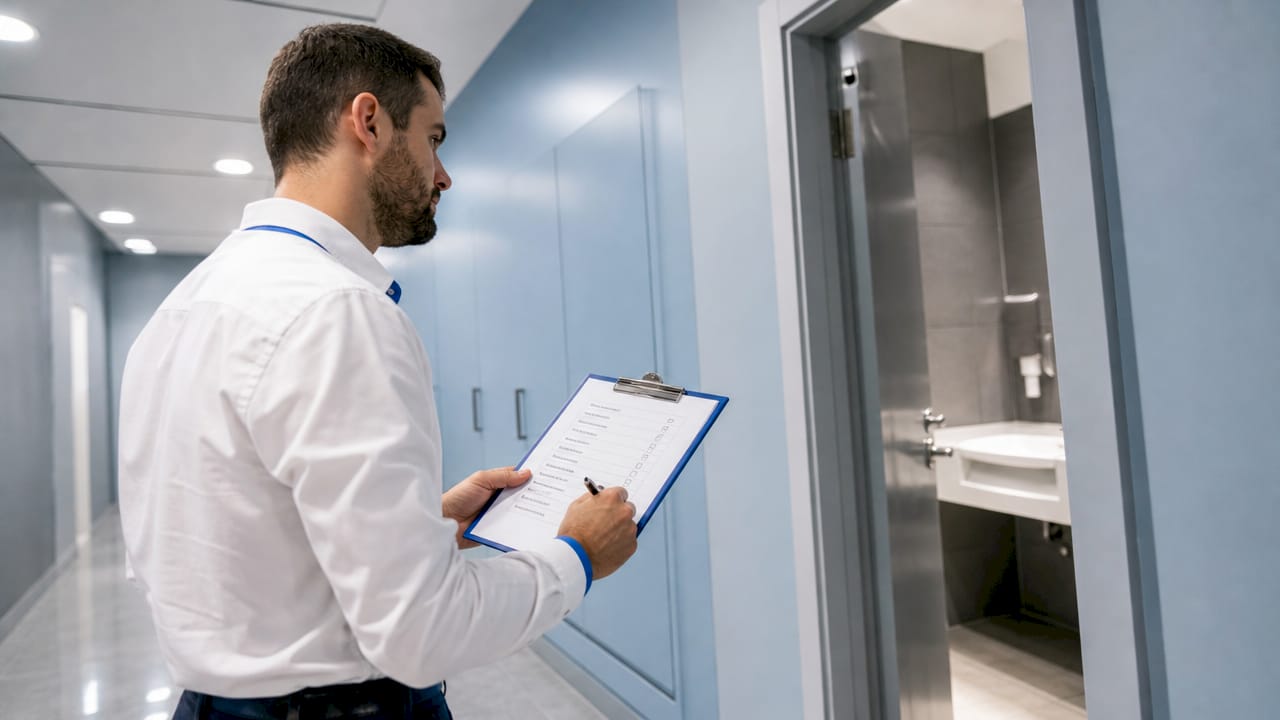
Pro Tip: Walk through the facility with the cleaning provider before signing. Photograph every area and attach the images to the contract as an exhibit. This eliminates “I didn’t know that room existed” disputes six months in.
2. Pricing models and billing structures
Pricing in a commercial cleaning contract must be tied directly to the SOW. Vague square footage distorts staffing estimates and creates billing disputes that are difficult to resolve after the fact.
The three most common pricing models each suit different situations:
| Pricing Model | Best Suited For | Key Risk |
|---|---|---|
| Fixed monthly fee | Stable, predictable facilities with consistent scope | Scope creep if SOW is not locked |
| Per square foot | Large facilities with measurable cleanable area | Inaccurate footage inflates or deflates cost |
| Hourly billing | Variable or project-based work | Difficult to budget; incentivizes slow work |
Cleanable square footage is not the same as gross square footage. It excludes walls, columns, fixed equipment, and non-cleanable surfaces. Accurate SOW definitions prevent the most common pricing dispute in commercial cleaning: a client paying for 10,000 square feet when only 7,200 are actually serviced.
Contracts should also define how extra work is handled. Any task outside the original SOW should trigger a written change order with an agreed price before work begins. Invoice frequency, required backup documentation such as time logs or task completion reports, and payment terms of net 15 or net 30 should all appear in the contract.
Pro Tip: Request an itemized bid that breaks cost by area and task. Low bids that bundle everything into one line item almost always hide omitted work that surfaces as a dispute later.
3. Scheduling, access, and security protocols
Cleaning schedules must state exact days and time windows, not vague terms like “after hours” or “as needed.” Defining access rules including keyholder policies and alarm procedures in the contract’s schedule section prevents operational conflicts before they start.
A well-structured access section covers:
- Exact cleaning days and hours: for example, Monday through Friday, 6:00 p.m. to 9:00 p.m.
- Key and badge issuance: who holds keys, how many sets are issued, and what happens if a key is lost
- Alarm codes and procedures: which zones the cleaning crew can arm or disarm, and the contact to call if an alarm triggers
- Sign-in and sign-out requirements: some facilities require a physical log or digital check-in for every visit
- Restricted area protocols: server rooms, executive offices, and records storage should require written authorization before any cleaning crew enters
- Emergency contact chain: a named facility manager and a backup contact, with phone numbers, for access issues or incidents
Clean Space SA’s access management guidance recommends treating access protocols as a security document, not just a scheduling note. A cleaning crew with unrestricted access and no documented procedure is a liability for both parties.
4. Health, safety, and chemical compliance
Chemical safety is one of the most overlooked sections in a commercial cleaning agreement checklist, and it carries real legal exposure. Under the UK’s COSHH framework, contractors must provide a COSHH register listing every hazardous substance used on site, complete with Safety Data Sheets and risk assessments. Compliance inspections routinely begin with a review of this register.
Key compliance requirements to include in the contract:
- COSHH register: a full list of cleaning chemicals used on site, each linked to its SDS and a site-specific risk assessment
- Staff training documentation: written evidence that all cleaning personnel have been trained in safe chemical handling and PPE use
- PPE requirements: specify which protective equipment is mandatory for which tasks and who supplies it
- Waste removal intervals: Regulation 9 of the Workplace Health, Safety and Welfare Regulations 1992 requires cleanliness and waste removal at defined intervals. The contract should state these intervals explicitly.
- Hazardous waste disposal: any specialist waste such as sharps, clinical materials, or chemical containers requires a documented disposal method
Even when a contractor supplies all cleaning chemicals, the site employer retains legal responsibility for overseeing their safe use. Requiring the contractor’s COSHH documentation and training records is not optional. It is a legal duty in UK-regulated environments.
For San Antonio businesses operating under U.S. OSHA standards, the equivalent obligation is requiring Safety Data Sheets for all chemicals used on your premises and confirming that cleaning staff have received Hazard Communication training.
5. Insurance and liability coverage
Insurance clauses belong in the operational body of the contract, not buried in a legal appendix. Insurance terms directly affect supervision, incident reporting, and access control decisions made every single day.
The contract should specify minimum coverage levels for general liability insurance, typically $1 million per occurrence for commercial facilities. Workers’ compensation coverage must be confirmed for all cleaning staff, including part-time and subcontracted workers. Some facilities also require a certificate of insurance naming the client as an additional insured, which provides direct protection if a cleaning-related incident triggers a claim.
Bonding is a separate but related requirement. A cleaning company that is bonded provides financial protection if an employee steals from the client’s premises. Confirm bonding status in writing and request updated certificates annually.
6. Quality assurance and service level agreements
A Service Level Agreement (SLA) defines what “clean” means in measurable terms and establishes the consequences when those standards are not met. Contracts that specify response times, inspection schedules, and complaint resolution workflows produce better service outcomes than those relying on informal feedback.
A strong quality assurance section includes:
- Inspection schedule: monthly walkthroughs with a named representative from both parties, documented with a signed checklist
- Performance metrics: measurable standards such as restroom inspections passing at 95% or above, or zero missed trash removals per month
- Complaint response time: a defined window, such as 24 hours for acknowledgment and 48 hours for resolution, for any reported service failure
- Cure period: a defined number of days, typically 5 to 10 business days, for the contractor to correct a documented deficiency before financial penalties apply
- Escalation path: a named escalation contact at the cleaning company above the account manager level
Payment triggers tied to SLA performance are increasingly common in commercial contracts. A clause stating that invoice payment is withheld or reduced if inspection scores fall below a defined threshold gives the client real leverage without requiring termination.
7. Contract duration, renewal, and termination terms
Contract duration and exit rights are the most negotiated elements in any cleaning contract negotiation. Plain-language termination rules and cure processes protect both parties and prevent costly disputes at the end of a contract relationship.
Every commercial cleaning contract should state:
- Start and end dates: avoid open-ended agreements with no defined term
- Auto-renewal clause: if the contract renews automatically, specify the notice period required to cancel, typically 30 to 60 days before the renewal date
- Termination for cause: define what constitutes a material breach, such as repeated SLA failures, safety violations, or non-payment, and the cure period before termination takes effect
- Termination for convenience: either party should retain the right to exit with reasonable notice, typically 30 days, without needing to prove fault
- Transition obligations: the outgoing contractor should be required to hand over keys, access credentials, and any site-specific documentation within a defined period
Perpetual contracts with no termination-for-convenience clause are a significant risk for clients. If service quality declines, the only exit without financial penalty becomes proving a material breach, which requires documentation and often legal involvement.
Key takeaways
A commercial cleaning contract protects both parties only when it specifies scope, pricing, access, compliance, quality standards, and termination rights in precise, unambiguous language.
| Point | Details |
|---|---|
| Lock down the scope of work | List every area, task, and frequency in writing before pricing is agreed. |
| Tie pricing to accurate square footage | Verify cleanable area independently to prevent billing disputes from day one. |
| Define access as a security document | Name keyholders, alarm procedures, and restricted areas explicitly in the contract. |
| Require chemical compliance documentation | Demand COSHH registers or OSHA SDS records and training proof before work starts. |
| Include SLAs with real consequences | Inspection schedules and cure periods give quality assurance actual enforcement power. |
Why the details you skip are the ones that cost you
I have reviewed dozens of commercial cleaning contracts over the years, and the pattern is consistent. The disputes that turn ugly are almost never about the big items. Nobody forgets to include a price. The problems come from the gaps: a restroom that was “assumed” to be included, an alarm code that was never written down, a chemical that nobody knew was being used on the premises.
The COSHH compliance angle surprises most U.S. businesses when they first encounter it in a UK context, but the underlying principle applies everywhere. If a cleaning crew is using chemicals in your building, you carry some responsibility for knowing what those chemicals are and confirming the crew is trained to handle them safely. That is not a legal technicality. It is a practical reality that becomes very clear after an incident.
My strongest recommendation is to do a full walkthrough before the contract is signed, not after. Bring a camera, a tape measure, and a list of every space you want cleaned. Verify the square footage yourself. Photograph the server room, the executive suite, and the storage closet. Attach everything to the contract as exhibits. This single step eliminates more disputes than any legal clause ever will.
SLAs are powerful, but only if the inspection process is real. A monthly walkthrough that takes 10 minutes and produces no written record is theater. A 45-minute inspection with a signed checklist and photographs creates accountability on both sides and gives you a paper trail if the relationship deteriorates.
— Jean
Get commercial cleaning right from the start with Clean Space SA
Clean Space SA serves businesses across San Antonio, including Leon Valley, Helotes, and Alamo Ranch, with office cleaning services built around transparent contracts, verified staff, and consistent quality standards. Every Clean Space SA engagement starts with a detailed scope of work discussion, accurate square footage verification, and a clear service schedule. There are no hidden extras and no vague billing. If you are ready to put a commercial cleaning agreement in place that actually protects your business, Clean Space SA’s team is ready to walk through every consideration with you. Explore the full range of services and request a tailored quote today.
FAQ
What should always be in a commercial cleaning contract?
Every commercial cleaning contract must include a detailed scope of work, pricing tied to accurate square footage, scheduling and access protocols, chemical safety documentation, insurance requirements, SLA performance standards, and clear termination terms.
How is cleanable square footage different from gross square footage?
Cleanable square footage excludes walls, fixed equipment, columns, and non-serviced areas. Using gross square footage inflates cost estimates and creates billing disputes, so always verify the actual cleanable area before agreeing to a price.
Who is responsible for chemical safety when a contractor cleans your building?
Even when the cleaning contractor supplies all chemicals, the site employer retains legal responsibility for overseeing their safe use. Requiring Safety Data Sheets, a chemical register, and proof of staff training is a legal duty in UK-regulated environments and a best practice under U.S. OSHA standards.
What is a cure period in a cleaning contract?
A cure period is a defined window, typically 5 to 10 business days, during which the contractor must correct a documented service failure before financial penalties or termination rights take effect. It protects both parties by allowing resolution before escalation.
How much notice is standard for terminating a commercial cleaning contract?
Most commercial cleaning contracts require 30 to 60 days written notice for termination without cause. Contracts without a termination-for-convenience clause expose clients to significant risk if service quality declines and no material breach can be proven.
Recommended
- How to Negotiate Commercial Cleaning Contract Terms
- Commercial cleaning service checklist for San Antonio
Jean runs growth strategy at AimSetWin, a performance marketing agency specializing in local service businesses across Texas. he's helped plumbers, HVAC companies, pest control operators, and home service brands build predictable revenue systems using data-driven advertising and conversion optimization.


