

Discover how commercial cleaning pricing works for San Antonio landlords. Understand bids, models, and save money on your next contract!
If you’ve ever collected three bids for the same office cleaning job and received three completely different numbers, you already know that understanding how commercial cleaning pricing works is not optional — it’s essential. The gap between those bids isn’t random. It reflects different pricing models, different assumptions about your space, and sometimes very different levels of transparency. For property managers and landlords in San Antonio overseeing rental units, multi-tenant offices, or commercial spaces, decoding those differences is the difference between a fair contract and an expensive surprise six months in.
Table of Contents
- Common commercial cleaning pricing models explained
- How per-square-foot pricing is calculated
- Factors that influence commercial cleaning pricing
- Comparing commercial cleaning bids: what to look for
- Applying transparent pricing knowledge to manage your San Antonio rental units
- Why most commercial cleaning bids confuse property managers and how to fix it
- How Clean Space Sa helps San Antonio property managers get transparent commercial cleaning pricing
- Frequently asked questions
Key Takeaways
| Point | Details |
|---|---|
| Understand pricing models | Know per-square-foot, hourly, and flat-rate models and when each fits your property type. |
| Focus on cleanable area | Always base bids on cleanable square footage excluding non-service areas for accuracy. |
| Expect separate add-ons | Day porters, deep cleans, and specialty services should be itemized, not buried in base rates. |
| Compare bids carefully | Use consistent baselines and clear line items to avoid surprises and budget confidently. |
| Review contracts regularly | Annual contract reviews help adjust pricing to reflect labor changes and scope shifts. |
Common commercial cleaning pricing models explained
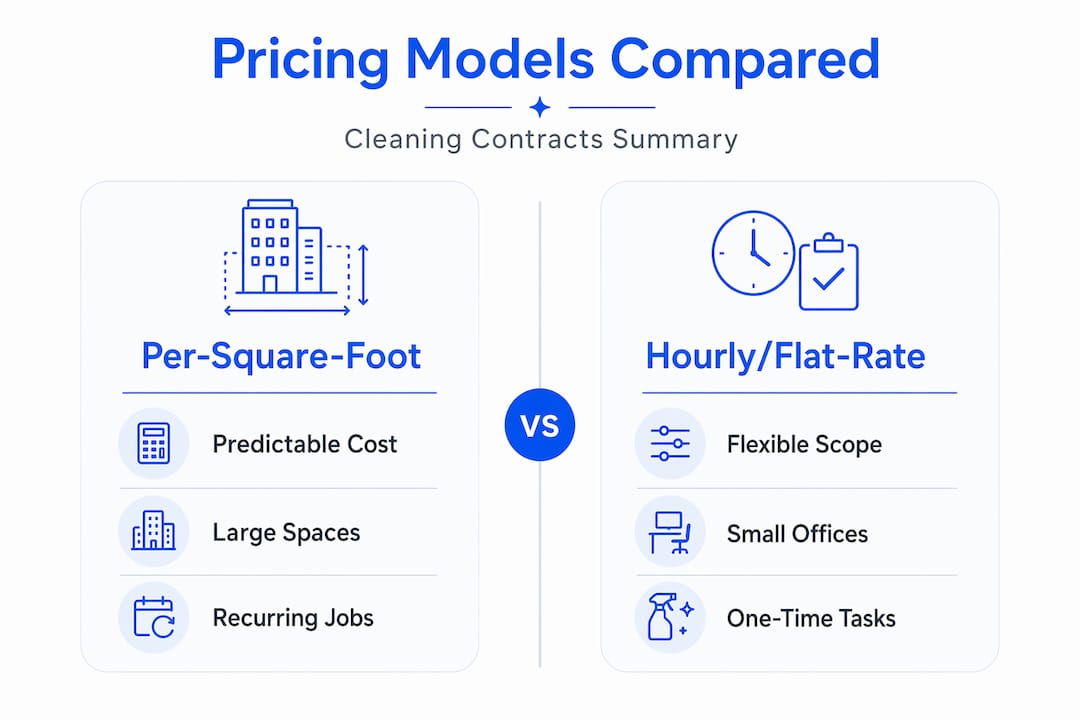
Most property managers assume cleaning bids are calculated the same way across vendors. They’re not. Three pricing models dominate commercial cleaning contracts: per-square-foot for recurring janitorial, hourly for one-time or less predictable jobs, and flat-rate for smaller spaces or defined visit scopes. Understanding which model a vendor is using — and whether it’s the right fit for your property — changes everything about how you evaluate a proposal.
Per-square-foot pricing is the industry standard for recurring janitorial contracts in facilities over 3,000 square feet. You pay a fixed rate per cleanable square foot per month, which makes budgeting predictable and scope disputes easier to resolve. For a 10,000-square-foot office building in San Antonio, this model gives you a stable monthly number tied directly to your facility size.
Hourly pricing works best for irregular or one-time cleanings where the scope is genuinely hard to predict. Think post-renovation cleanup or a tenant move-out with unknown levels of damage. The risk here is that billing can balloon if the job takes longer than estimated, which is why alternative pricing models for smaller offices are worth exploring when your space and scope are well defined.
Flat-rate per visit is common for small retail shops, single-suite offices, or spaces with a fixed, repeatable task list. You agree on a price per visit, and it doesn’t change unless the scope changes. Many vendors actually use a hybrid of all three models, billing recurring janitorial at a per-square-foot rate while quoting deep cleaning and specialty service pricing as flat-rate add-ons.
| Pricing model | Best for | Budget predictability | Risk |
|---|---|---|---|
| Per-square-foot | Recurring janitorial, 3,000+ sq ft | High | Low if cleanable area is defined |
| Hourly | One-time or irregular cleanings | Low | Billing overruns |
| Flat-rate per visit | Small offices, defined task lists | High | Scope creep if tasks expand |
| Hybrid | Mixed service types | Medium | Complexity in bid comparison |
How per-square-foot pricing is calculated
Knowing a vendor charges $0.12 per square foot tells you almost nothing on its own. What matters is how they arrived at that number. The labor cost calculation includes labor hours derived from facility size and cleaning production rates, multiplied by fully loaded labor rates with payroll burden and overhead included. Here’s how a transparent vendor builds that number from scratch.
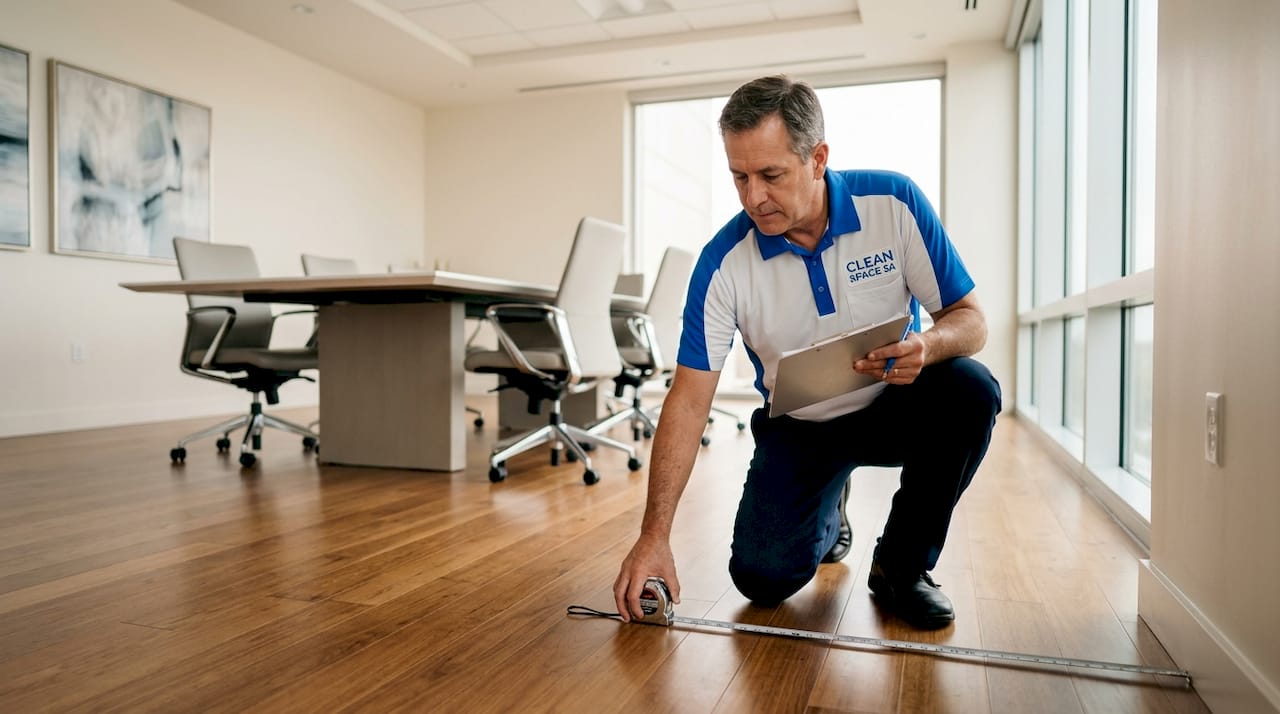
- Measure cleanable square footage. This excludes mechanical rooms, server closets, elevator shafts, and any area cleaners won’t actually service. Using gross square footage inflates the bid.
- Apply ISSA production rates. ISSA (the Worldwide Cleaning Industry Association) publishes production rates that estimate how many square feet a cleaner can service per hour for specific tasks. Vacuuming open office space runs faster than cleaning restrooms or detailed kitchenettes.
- Calculate total labor hours. Divide cleanable square footage by the applicable production rate to get hours per visit, then multiply by visit frequency per month.
- Apply fully loaded labor rate. This is not just the cleaner’s hourly wage. It includes payroll taxes, workers’ compensation insurance, health benefits, and any other employer-side costs. In San Antonio, a fully loaded rate typically runs 25 to 35 percent above base wage.
- Add supplies, equipment depreciation, and overhead. Supplies typically add 5 to 10 percent to labor cost. Equipment depreciation and company overhead (office, insurance, vehicles) add another 10 to 20 percent.
- Apply profit margin. A healthy commercial cleaning margin runs 10 to 20 percent. Bids with paper-thin margins often lead to staff cuts and service quality drops within three months.
Pro Tip: Ask any vendor to show you the production rates and cleanable square footage they used to build your bid. A vendor who can’t or won’t share that breakdown is either guessing or hiding a margin problem.
| Cost component | Typical percentage of total bid |
|---|---|
| Direct labor (fully loaded) | 50 to 60% |
| Supplies and consumables | 5 to 10% |
| Equipment and depreciation | 3 to 7% |
| Overhead (office, insurance, vehicles) | 10 to 15% |
| Profit margin | 10 to 20% |
For medical cleaning and pricing factors, these percentages shift significantly because supply costs and labor time increase with infection control requirements. Reviewing transparent janitorial contract tips before signing any agreement helps you verify these components are accounted for honestly.
Factors that influence commercial cleaning pricing
Even two identical 5,000-square-foot offices in San Antonio can receive bids that differ by 40 percent. That’s not vendor manipulation — it’s the legitimate effect of variables that most property managers don’t think to ask about.
- Facility type. Medical and clinical spaces are priced 30 to 50% higher than standard offices due to sanitation protocols, specialized products, and compliance requirements. Industrial spaces with heavy soil loads cost more than light-traffic professional offices.
- Cleaning frequency. More frequent visits lower the per-square-foot rate because the facility stays cleaner and each visit takes less time. But total monthly spend rises. A daily cleaning contract will cost more per month than a twice-weekly contract, even if the per-visit rate is lower.
- Soil levels and traffic. A dental office with heavy foot traffic and patient-facing areas requires more labor per square foot than a quiet accounting firm with the same footprint.
- Add-on services. Day porter services (staff who clean during business hours rather than after), quarterly deep cleans, carpet extraction, and specialty floor care should always be quoted as separate line items. Bundling them into a base rate hides the true cost and makes future scope adjustments nearly impossible to price fairly.
- Local labor and insurance costs. San Antonio’s labor market affects what vendors pay their teams. Regional workers’ comp rates and general liability insurance premiums vary and directly influence what a local vendor must charge to stay solvent.
Failure to exclude non-cleanable areas like mechanical rooms and server closets from your square footage calculation can inflate a bid by 10 to 20 percent on a large facility. Always provide vendors with your actual cleanable area, not the number from your lease.
Pro Tip: When reviewing bids, ask vendors to list cleaning scope transparency tips and all add-ons as separate line items. If a vendor bundles everything into one number, request an itemized version before comparing it to other proposals. Also, if your property includes exterior windows or hard-to-reach surfaces, confirm that specialized cleaning add-ons are quoted separately so they don’t distort your base rate comparison.
Comparing commercial cleaning bids: what to look for
Getting three bids is a good start. Comparing them correctly is the part most property managers skip. Separating base per-square-foot rates from add-ons like day porter, restocking supplies, and quarterly deep cleans is what allows you to compare proposals on equal footing.
| What to check | Red flag | Green flag |
|---|---|---|
| Square footage basis | Gross square footage used | Cleanable square footage defined and documented |
| Add-on pricing | Bundled into base rate | Itemized as separate line items |
| Contract length | No mention of term or notice period | Clear term with renewal and exit clauses |
| Specialty services | Priced per recurring visit | Priced per event with separate scope |
| Billing model for recurring work | Hourly | Per-square-foot or flat-rate |
Here’s what to check on every bid you receive:
- Confirm the square footage basis. Ask vendors to document which areas are included and which are excluded. Any bid built on gross square footage without exclusions is not comparable to one built on cleanable area.
- Separate recurring from one-time pricing. A quarterly carpet cleaning should not be folded into your monthly janitorial rate. It distorts both numbers.
- Check for supply markups. Some vendors charge a percentage markup on consumables like paper products and soap. Others include it in the base rate. Know which you’re dealing with.
- Read the contract length and notice period. A low monthly rate on a 24-month contract with a 90-day notice period is not always the deal it appears to be. Budget certainty and flexibility have a price.
- Avoid hourly billing for recurring work. Hourly contracts for regular janitorial cleaning create billing disputes and make monthly budgeting unreliable. For predictable recurring work, per-square-foot or flat-rate contracts protect you.
For clear janitorial contract examples that outline these elements clearly, reviewing real proposals before you start collecting bids gives you a useful reference point.
Applying transparent pricing knowledge to manage your San Antonio rental units
Understanding pricing theory is only useful if you act on it. Here’s a practical sequence for getting fair, clear bids on your San Antonio properties.
- Define your cleanable square footage before reaching out. Walk the space, exclude non-serviceable areas, and document the number. Give every vendor the same figure.
- Request itemized proposals. Your bid request should specify that you want base rate, add-ons, exclusions, frequency, and supply handling listed separately. Vendors who resist this structure are telling you something.
- Compare bids on a consistent baseline. Build a simple spreadsheet with base monthly cost, add-on costs, and contract terms side by side. A bid that looks 15 percent cheaper may include fewer visits or exclude restroom restocking.
- Negotiate annual contracts. Annual contracts are typically 10 to 15% lower than month-to-month agreements, and they give vendors staffing certainty, which translates to better service consistency for your property.
- Schedule deep cleans and specialty services as separate events. Rather than folding a semi-annual deep clean into your monthly rate, book it as a separate line item. This keeps your base rate clean and lets you adjust or skip specialty services without renegotiating the whole contract.
- Document everything. Agreed scope, frequencies, exclusions, and pricing should all be in writing before the first cleaning visit. This protects you at renewal time and prevents scope creep charges.
Pro Tip: For move-in and move-out cleaning services between tenants, always price these as separate events rather than folding them into a recurring janitorial contract. Turnover cleans have a different scope, labor intensity, and supply requirement than routine maintenance cleaning.
Why most commercial cleaning bids confuse property managers and how to fix it
Here’s something vendors rarely say out loud: most commercial cleaning bids are structured to win, not to inform. Vendors know that a single bundled number is harder to challenge than an itemized one. They also know that most property managers don’t ask about production rates, cleanable area definitions, or fully loaded labor costs. So they don’t volunteer that information.
The result is a market where property managers end up comparing a per-square-foot bid against a hybrid bid against an hourly bid, all for the same building, and trying to make sense of numbers that were never meant to be compared directly. That’s not incompetence on anyone’s part. It’s a structural problem in how cleaning proposals are typically formatted.
The fix is straightforward but requires you to take control of the process. Stop accepting bids in whatever format vendors prefer. Send a bid request template that specifies exactly what you want: cleanable square footage used, base rate per square foot per visit, visit frequency per month, add-ons itemized separately, and contract terms clearly stated. Vendors who can’t fill out that template accurately are showing you their operational maturity before you sign anything.
Local knowledge matters here too. San Antonio’s labor market, workers’ comp rates, and general liability insurance costs sit at specific benchmarks. A bid that comes in dramatically below what local labor economics support is either cutting corners on coverage or planning to understaff your property. Neither is a deal. Understanding transparency in janitorial agreements is what separates property managers who get consistent service from those who cycle through vendors every year.
How Clean Space Sa helps San Antonio property managers get transparent commercial cleaning pricing
Knowing how commercial cleaning pricing works puts you in a stronger position. Having a local partner who prices the same way makes the whole process easier.
Clean Space Sa provides itemized commercial cleaning quotes to property managers and landlords across San Antonio, including neighborhoods like Leon Valley, Helotes, and Alamo Ranch. Every proposal breaks out base rates, add-ons, exclusions, and frequencies so you can compare and budget with confidence. Whether you need commercial office cleaning services for a multi-tenant building, move-in/move-out cleaning services between tenant turnovers, or windows and specialty cleaning as a separate line item, Clean Space Sa structures each contract to match your actual scope. Annual contract options include built-in savings, and every team member is background-checked and trained to consistent standards. Transparent pricing from a local team that knows San Antonio’s market is the starting point for a cleaning partnership that actually holds up.
Frequently asked questions
What is the most common pricing model for commercial cleaning in San Antonio?
Per-square-foot pricing is standard for recurring janitorial cleaning in commercial buildings larger than 3,000 square feet in San Antonio, offering predictable monthly costs tied directly to your facility size.
How can I make sure I’m comparing commercial cleaning bids fairly?
Compare bids using the same cleanable square footage baseline, check that add-ons like day porter and deep cleaning are separated as line items, and confirm exclusions are clearly documented in every proposal.
Why do medical facility cleaning rates cost more than office cleaning?
Medical cleaning requires more labor and supplies due to infection control protocols and specialized sanitation, increasing rates by 30 to 50% compared to standard office cleaning.
Should I prefer an hourly or per-square-foot cleaning contract?
For predictable recurring cleaning, per-square-foot contracts provide budget certainty; hourly pricing makes budgeting harder and works best only for irregular or one-time cleanings where scope is genuinely unknown.
How often should commercial cleaning contracts be reviewed or updated?
Contracts should be reviewed annually due to wage pressure, insurance cost changes, and any expansion in cleaning scope to keep pricing fair and aligned with the service actually being delivered.
Recommended
- Home old – Clean Space Sa | commercial cleaning | San Antonio, TX, USA
- Clean Space Sa | commercial cleaning | San Antonio, TX, USA
- Clean Space Sa | commercial cleaning | San Antonio, TX, USA
- Clean Space Sa | commercial cleaning | San Antonio, TX, USA
Jean runs growth strategy at AimSetWin, a performance marketing agency specializing in local service businesses across Texas. he's helped plumbers, HVAC companies, pest control operators, and home service brands build predictable revenue systems using data-driven advertising and conversion optimization.


