

Struggling to find a reliable cleaner? Use our choose commercial cleaning service checklist in San Antonio to simplify your decision-making today!
Finding a reliable commercial cleaning company in San Antonio is harder than it should be. You post a request, get flooded with bids, and suddenly you’re comparing apples to oranges with no clear way to tell who will actually show up consistently and do the job right. A solid choose commercial cleaning service checklist cuts through that noise. It gives you a repeatable, objective process to evaluate vendors on scope, quality assurance, insurance, and price, so you stop guessing and start making decisions you can stand behind.
Table of Contents
- Understand what your cleaning service needs
- Evaluate commercial cleaning providers using a detailed checklist
- Understand San Antonio commercial cleaning pricing and cost benchmarks
- Create and use a commercial cleaning service checklist effectively
- Verify insurance, compliance, and quality assurance for peace of mind
- Why focusing on scope clarity and inspection processes beats price shopping
- How Clean Space Sa supports your commercial cleaning needs
- Frequently asked questions
Key Takeaways
| Point | Details |
|---|---|
| Define cleaning scope clearly | Specify areas, tasks, frequencies, and quality standards to avoid confusion and disputes. |
| Evaluate providers objectively | Use a weighted checklist including insurance, references, pricing, and quality assurance. |
| Understand local San Antonio pricing | Know typical rates and factors influencing cleaning costs beyond just square footage. |
| Implement detailed cleaning checklists | Use room-by-room checklists with clear standards to ensure consistent, high-quality results. |
| Verify insurance and compliance | Always request certificates and confirm compliance to protect your business legally. |
Understand what your cleaning service needs
Before you contact a single vendor, you need to know exactly what you’re buying. This sounds obvious, but most business owners skip this step and end up with vague contracts that lead to missed tasks, disputes, and frustration.
Start by mapping every area of your facility that needs attention:
- Offices and workstations: Dusting, trash removal, vacuuming, surface wiping
- Restrooms: Disinfecting fixtures, restocking supplies, mopping floors
- Break rooms and kitchens: Appliance wipe-downs, sink scrubbing, floor mopping
- Lobbies and common areas: Glass cleaning, floor care, high-touch surface disinfection
- Conference rooms: Table and chair cleaning, whiteboard erasure, trash removal
Once you have your areas, assign a frequency to each task. Daily tasks (restroom disinfection, trash removal) are different from weekly tasks (vacuuming carpets, mopping hard floors) and monthly tasks (deep cleaning vents, scrubbing grout). Your office cleaning scope details should reflect this breakdown clearly.
The final piece is defining what “done” looks like. If your standard for a restroom is that no visible residue remains on any surface and supplies are stocked to at least 75% capacity, write that down. Cleaning scope should explicitly cover areas, task descriptions, frequencies, and finishing standards. Without those four elements, you have no way to hold a vendor accountable.
Scope definition checklist:
- List every area requiring cleaning
- Assign specific tasks to each area
- Set cleaning frequency per task
- Define measurable quality standards per area
- Identify any specialty tasks (post-construction, window washing, floor waxing)
Pro Tip: Walk your facility with a notepad before writing your scope. You will catch areas you forgot, like storage rooms, server closets, and stairwells, that vendors may exclude from their default proposals.
| Area | Task | Frequency | Quality standard |
|---|---|---|---|
| Restrooms | Disinfect all fixtures | Daily | No residue, supplies stocked |
| Offices | Vacuum carpets | Weekly | No visible debris |
| Break room | Wipe appliances | Weekly | Streak-free surfaces |
| Lobby | Mop floors | Daily | No footprints or smears |
| Conference rooms | Clean tables/chairs | After each use | No marks or dust |

Evaluate commercial cleaning providers using a detailed checklist
With your cleaning needs defined, the next step is to use a structured checklist to evaluate and compare potential providers effectively. This is where most business owners get it wrong. They pick the company that sounds most professional on a phone call or offers the lowest number. Neither approach works.
Use this cleaning service evaluation checklist when vetting providers:
- Request a certificate of insurance (COI) before any site visit or proposal
- Ask about subcontracting and whether the workers entering your building are employees or third-party contractors
- Request a sample inspection report with photos to see how they document completed work
- Evaluate communication by timing how long they take to respond to your initial inquiry
- Ask for references from facilities similar to yours in size and industry
- Review their complaint resolution process in writing, not just verbally
Ask for a sample inspection report with photos and a clear process for resolving complaints. A company that cannot produce one is telling you something important about how they operate.
Pro Tip: Send a test email to the company’s general inbox at 7 p.m. on a Tuesday. If you don’t hear back within 24 hours, that’s how fast they’ll respond when you have a problem at 6 a.m. before a client visit.
A weighted scoring approach gives you an objective way to compare vendors without letting price dominate the decision.
| Evaluation factor | Weight | Vendor A score | Vendor B score |
|---|---|---|---|
| Pricing | 30% | 8 | 6 |
| Experience | 25% | 7 | 9 |
| Quality assurance | 20% | 6 | 8 |
| Insurance and compliance | 15% | 9 | 9 |
| Technology and reporting | 10% | 5 | 7 |
| Weighted total | 100% | 7.1 | 7.6 |
Use this table as a starting point for your own commercial cleaning provider evaluation. Fill it in for each vendor you’re seriously considering. The numbers often reveal a clear winner that gut instinct would have missed.
When you’re ready to move forward, request cleaning quotes from at least three providers using the same scope document so you’re comparing identical services.
Understand San Antonio commercial cleaning pricing and cost benchmarks
Now that you can evaluate providers, it’s essential to understand San Antonio market pricing to interpret their proposals accurately.
Office cleaning in San Antonio costs roughly $0.08 to $0.13 per square foot per month for standard office spaces. But that range shifts significantly based on several variables:
- Floor type: Carpet requires different equipment and labor than polished concrete or tile
- Occupancy density: A 5,000 sq. ft. office with 50 employees generates more mess than one with 10
- Day porter services: On-site daytime cleaning adds cost but keeps high-traffic areas presentable throughout the day
- Compliance requirements: Healthcare facilities and defense contractor spaces require specific protocols that add overhead
| Facility type | Estimated monthly rate (per sq. ft.) |
|---|---|
| Standard office | $0.08 to $0.13 |
| Medical or healthcare | $0.15 to $0.25 |
| Warehouse or light industrial | $0.05 to $0.09 |
| Retail space | $0.10 to $0.18 |
Never accept a quote based purely on square footage without a site visit. A vendor who prices your facility without walking it is guessing, and you’ll pay for that guess in missed tasks or surprise charges later. Check San Antonio cleaning pricing details to get a clearer picture of what a well-scoped proposal should look like locally.
Pro Tip: If a bid comes in more than 20% below the others, ask the vendor to walk you through their staffing model. Low bids often mean fewer hours on-site, higher staff turnover, or both. Those factors directly impact cleaning quality.
Create and use a commercial cleaning service checklist effectively
With pricing understood, let’s focus on how to create and leverage your own checklist to maintain cleaning quality over time.
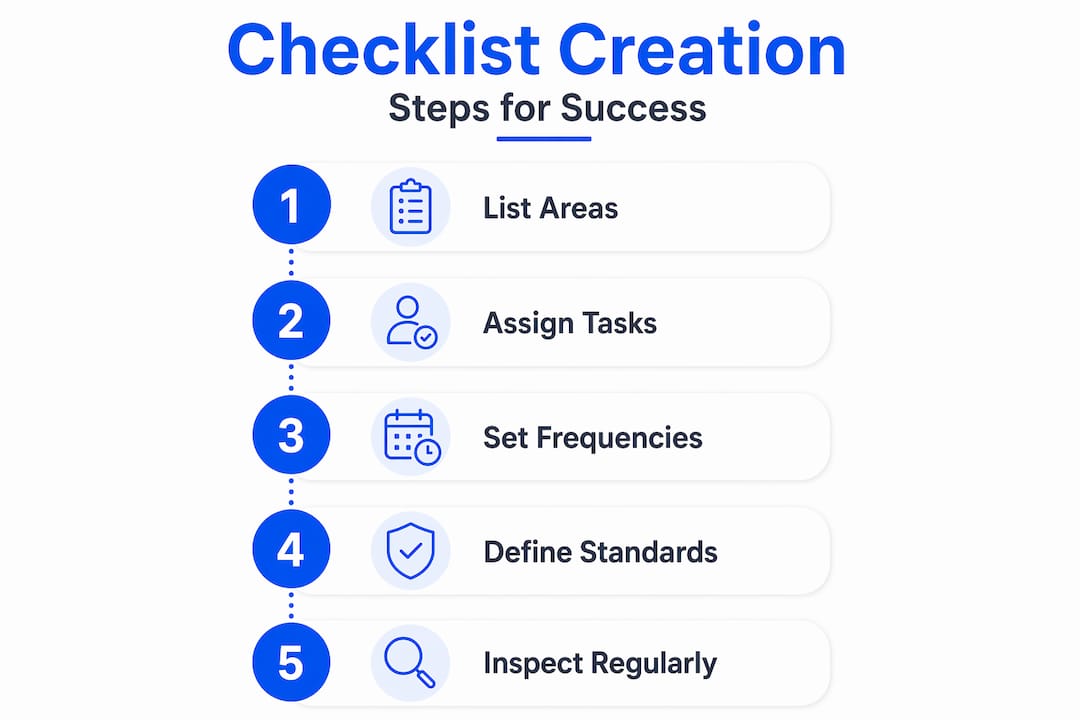
A checklist is only as useful as its specificity. “Clean the restroom” is not a checklist item. “Scrub and disinfect all toilet bowls, wipe down all fixtures, mop the floor with a disinfectant solution, restock paper towels and soap dispensers to full capacity” is a checklist item.
Here’s how to build and use one that actually works:
- Draft the checklist by area, using the scope document you created earlier as the foundation
- Assign frequencies to every task so nothing falls into an ambiguous “when needed” category
- Add a sign-off field for each task so the cleaner confirms completion
- Choose a format that works for your operation, whether that’s a printed sheet left on-site or a digital app your vendor uses
- Train your internal point of contact to inspect against the checklist, not just eyeball the space
- Review the checklist quarterly and update it when your facility’s needs change
Standardizing processes by area and frequency with clear quality expectations reduces missed tasks and rework. That’s not a small thing. Rework means your vendor comes back to fix something they should have done right the first time, which disrupts your staff and erodes trust in the relationship.
For cleaning checklist implementation in a multi-floor office, consider creating a separate checklist page for each floor or zone. This makes inspections faster and makes it easier to pinpoint exactly where problems are occurring.
Pro Tip: Take photos of your facility right after a cleaning you’re happy with. Use those photos as the visual standard in your checklist. A picture of a clean restroom tells a cleaner more than any written description.
Verify insurance, compliance, and quality assurance for peace of mind
Finally, verifying insurance and compliance safeguards your investment and ensures trustworthy service from your chosen vendor.
This step is non-negotiable. If a cleaning worker is injured in your facility and the company lacks proper workers’ compensation coverage, you could face liability. If equipment damages your property and the company isn’t bonded, you’re absorbing that cost.
Here’s what to verify before signing any contract:
- Certificate of insurance (COI): Request a current one and call the carrier to confirm it’s active
- Workers’ compensation coverage: Confirm it meets the minimums required in your contract
- General liability insurance: Look for at least $1 million per occurrence for most commercial spaces
- Bonding: Protects you if an employee steals from your facility
- Industry certifications: Look for CIMS (Cleaning Industry Management Standard), OSHA compliance, or Avetta registration for higher-risk facilities
Ask for a current certificate of insurance and verify coverage levels, bonding, and compliance certifications like CIMS, OSHA, and Avetta as standard checklist items. Any reputable company will hand these over without hesitation.
A cleaning company that hesitates to share insurance documentation is a company you should not hire. Legitimate operators keep these documents current and accessible because they know clients will ask.
Also confirm that their insurance and compliance verification process includes documented inspection and complaint resolution steps. Verbal promises about quality mean nothing if there’s no paper trail.
Pro Tip: Add a clause to your contract requiring 30 days’ advance notice of any lapse in insurance coverage. This gives you time to find a replacement vendor rather than discovering the gap after an incident.
Why focusing on scope clarity and inspection processes beats price shopping
Here’s an uncomfortable truth most commercial cleaning guides won’t say directly: the companies that lose the most money on cleaning contracts are usually the ones who thought they were getting a deal.
Underpricing often leads to staffing and quality risks, and comparing detailed scope is more reliable than per-square-foot pricing. That’s not just theory. In San Antonio’s commercial cleaning market, we see it consistently. A business owner selects the lowest bid, skips the scope review, and six months later is dealing with a vendor who has rotated through four different cleaning crews, none of whom know the facility’s specific requirements.
The real issue is that price is easy to compare and scope is not. So buyers default to price. But a $200 monthly difference between two vendors means nothing if one of them is cleaning your office in 90 minutes and the other is spending three hours doing it properly.
Documented inspection processes and sample reports are how you keep quality from drifting over time. Cleaning quality doesn’t degrade all at once. It slips gradually. A task gets skipped once, then twice, then it’s just not being done. Without an inspection process tied to a documented checklist, you won’t notice until a client or employee points it out.
The vendors worth hiring are the ones who welcome your inspection process. They want documented standards because it protects them too. It removes ambiguity and gives their crews clear targets. When you find a vendor who brings their own scope versus price insights to the conversation, that’s a sign you’re dealing with a professional operation.
How Clean Space Sa supports your commercial cleaning needs
Applying this checklist framework takes time, but you don’t have to do it alone.
Clean Space Sa serves San Antonio businesses across Leon Valley, Helotes, Alamo Ranch, and surrounding areas with professional office cleaning services built around exactly the kind of scope-based approach this article describes. Every engagement starts with a site assessment, not a generic quote. Pricing is transparent and tied to your actual facility requirements. The team is background-checked, insured, and trained to consistent standards. Digital inspection reports keep you informed after every visit, and you’ll always have a dedicated contact who knows your account. Whether you need routine office cleaning or a specialized program, explore commercial and residential cleaning options or request a cleaning quote to get started.
Frequently asked questions
What should be included in a commercial cleaning service checklist?
A commercial cleaning checklist should define what needs to be cleaned, how often, and what standards should be met, covering every area, task, frequency, and quality benchmark in your facility.
How can I verify the insurance of a commercial cleaning company?
Request a current certificate of insurance and verify the carrier is licensed by calling the insurer directly before signing any contract.
Why is cleaning scope clarity more important than price?
Scope clarity beats price shopping because underpriced bids often hide staffing shortcuts and quality risks that cost you more in rework and vendor turnover than a slightly higher rate would have.
How often should different commercial areas be cleaned?
High-traffic areas and restrooms need daily cleaning, while deep cleaning tasks like carpet extraction or grout scrubbing are typically scheduled monthly or as facility conditions require.
What questions should I ask when evaluating commercial cleaning companies?
Ask about insurance, subcontracting policies, sample inspection reports, staff turnover rates, complaint resolution timelines, and references from facilities that are comparable to yours in size and industry.
Recommended
- Home old – Clean Space Sa | commercial cleaning | San Antonio, TX, USA
- Clean Space Sa | commercial cleaning | San Antonio, TX, USA
- Clean Space Sa | commercial cleaning | San Antonio, TX, USA
- Clean Space Sa | commercial cleaning | San Antonio, TX, USA
Jean runs growth strategy at AimSetWin, a performance marketing agency specializing in local service businesses across Texas. he's helped plumbers, HVAC companies, pest control operators, and home service brands build predictable revenue systems using data-driven advertising and conversion optimization.


