

Discover how commercial cleaning differs from residential in San Antonio. Learn key differences to ensure a healthier workplace!
Most homeowners and property managers assume a good vacuum and an all-purpose spray cover the basics — whether the space is a family living room or a 10,000-square-foot office. That assumption is wrong, and in commercial spaces, it can be genuinely risky. Understanding how commercial cleaning differs from residential is not just an academic exercise. It determines whether your employees stay healthy, whether your facility passes inspection, and whether your cleaning dollars are actually doing the job you think they are. This guide breaks down every meaningful difference so you can make a smarter call for your property.
Table of Contents
- Key differences in cleaning standards and regulations
- Why cleaning products differ: EPA-registered disinfectants vs household cleaners
- Frequency and focus: how commercial cleaning addresses high-touch surfaces differently
- Cost and staffing: why commercial cleaning differs financially and operationally
- Choosing the right cleaning service for your property in San Antonio
- Our take: the most expensive cleaning mistake is not spending more money
- Get the right cleaning partner in San Antonio
- Frequently asked questions
Key Takeaways
| Point | Details |
|---|---|
| Regulatory standards | Commercial cleaning follows strict OSHA and health guidelines while residential cleaning does not. |
| Disinfectant quality | Commercial cleaning uses EPA-registered disinfectants that kill nearly all pathogens, unlike most residential products. |
| Cleaning frequency | High-touch surfaces in commercial spaces are disinfected several times daily, much more often than in homes. |
| Cost and staffing | Commercial cleaning costs more due to scale, trained staff, and specialized products and equipment. |
| Service choice guidance | Choose commercial cleaning for high-traffic or public properties and residential cleaning for standard home care. |
Key differences in cleaning standards and regulations
Commercial cleaning and residential cleaning are not just different in scale. They operate under entirely different rule sets. OSHA standards require that work areas be kept clean, orderly, and sanitary, with specific hand-washing provisions and mandated chemical safety practices. That means commercial facilities must document their cleaning procedures, use Safety Data Sheets (SDS) for every chemical product on-site, and ensure staff are trained in proper handling.
Residential cleaning carries none of those legal requirements. A housekeeper can use the same spray cleaner on a kitchen counter and a bathroom sink without any regulatory consequence. In a commercial setting, using the wrong chemical in the wrong space without proper training can violate federal workplace safety rules.
Here is what commercial cleaning regulations typically require that residential does not:
- Written cleaning and disinfection protocols reviewed by management
- Safety Data Sheets for every cleaning chemical used on the premises
- Employee training on chemical handling, dilution ratios, and PPE (personal protective equipment)
- Proper labeling of all cleaning solutions
- Documented cleaning logs available for inspection
The regulatory gap between these two types of services is significant. If you manage a San Antonio office, medical suite, or retail location, EPA-approved disinfectants in commercial cleaning are not optional extras. They are baseline expectations. For a fuller picture of why commercial cleaning for businesses requires this structured approach, the regulatory framework is the best place to start.
Why cleaning products differ: EPA-registered disinfectants vs household cleaners
Walk into any grocery store and you will see shelves full of products labeled “cleans,” “sanitizes,” or “kills 99.9% of germs.” The language sounds impressive. The reality is more complicated.
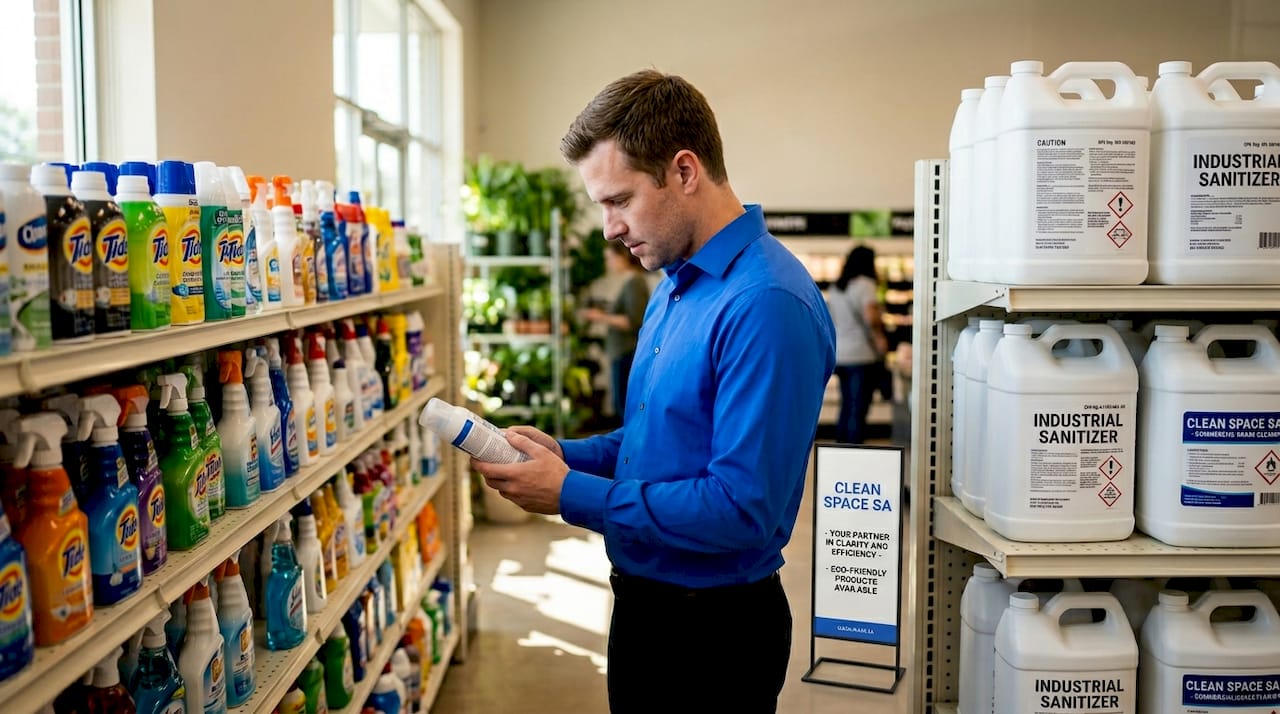
There are three distinct categories here. A cleaner removes visible dirt and grime but does not kill pathogens. A sanitizer reduces bacteria by a defined percentage but is not tested against viruses or fungi. A disinfectant kills nearly all microorganisms, but only if it carries a verified EPA registration number. EPA registration ensures a 99.999% pathogen kill rate in commercial disinfectants, compared to consumer cleaners that simply remove dirt without verified disinfection.
That “99.9%” claim on your kitchen spray? It often refers to sanitizing, not disinfecting. And it may be tested against only one or two common bacteria, not the broader spectrum of viruses and fungi that a commercial space encounters daily. A true disinfectant must be EPA-registered, tested against specific pathogens, and carry an EPA registration number printed directly on the label.
The key product differences between commercial and residential cleaning include:
- Commercial disinfectants carry verifiable EPA registration numbers on the label
- Residential cleaners typically address visible soil, not microbial load
- Commercial-grade products are tested against a broader pathogen spectrum including norovirus, MRSA, and influenza
- Dilution ratios in commercial settings are precise and standardized
- Commercial products require proper dwell time (the time the product must stay wet on a surface to work), which residential users rarely follow
Pro Tip: Do not assume a product labeled “kills 99.9% of germs” meets commercial disinfection standards. Check the EPA registration number and the pathogen list on the label before accepting it as adequate for a business environment.
Understanding differences in home vs commercial cleaning products is one of the most overlooked distinctions in this entire conversation. The right product used incorrectly still fails. That is why commercial disinfectants require trained application, not just purchase.
Frequency and focus: how commercial cleaning addresses high-touch surfaces differently
Here is a stat that surprises most people: CDC guidelines stress that commercial high-touch surfaces require disinfection every 2 to 4 hours in high-traffic areas. No one is wiping down their doorknob at home every two hours. But in a busy San Antonio office or retail store, that interval is what keeps germs from spreading between dozens or hundreds of people.
High-touch surfaces in commercial spaces include far more points of contact than a typical home. Consider the difference:
- Door handles and push plates touched by every single person entering or leaving
- Elevator buttons pressed hundreds of times per day
- Shared keyboards, mice, and phone handsets used by rotating staff
- Break room appliance handles and microwave keypads
- Reception desk surfaces and visitor sign-in tablets
- Restroom faucets, flush handles, and paper towel dispensers
In a home, a front door handle might get touched by five people. In a commercial space, that same surface might see five hundred interactions before noon. The pathogen load builds differently, and the cleaning response has to match that reality.
| Surface type | Residential frequency | Commercial frequency |
|---|---|---|
| Door handles | Weekly or as needed | Every 2 to 4 hours |
| Shared electronics | Occasionally | Daily or between users |
| Restroom fixtures | 1 to 2 times per week | Multiple times daily |
| Kitchen/break room surfaces | A few times per week | After each use period |
| Floor disinfection | Weekly | Daily in high-traffic zones |
Pro Tip: Cleaning frequency directly affects health outcomes, especially in public-facing venues. A visible space that looks clean may still carry a high microbial load if high-touch surfaces are not being disinfected at appropriate intervals.
For San Antonio property managers looking at cleaning frequency in commercial settings, this table tells you why a residential cleaning schedule simply cannot transfer. The gap is not just visible cleanliness. It is actual pathogen control. Learn more about commercial cleaning for business environments and what a proper schedule looks like in practice.
Cost and staffing: why commercial cleaning differs financially and operationally
Commercial cleaning costs more. That is the honest answer. But understanding why it costs more helps you evaluate whether the investment makes sense for your property.
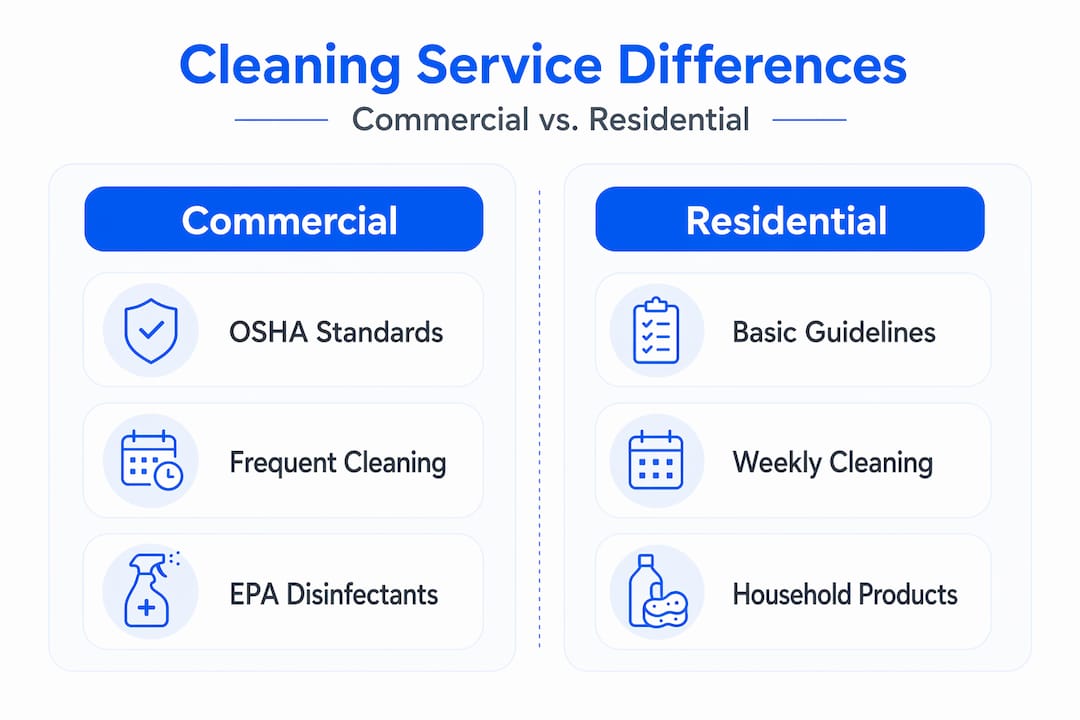
Office cleaning averages $0.10 to $0.30 per square foot in the U.S., while residential cleaning is typically priced hourly and varies based on home size and visit frequency. A 5,000-square-foot commercial office could run $500 to $1,500 per cleaning visit, while a comparable residential deep clean might cost $200 to $400.
The cost gap comes from several real factors:
- Staffing: Commercial cleaning teams are larger, trained in OSHA protocols, and often background-checked across the board
- Equipment: Industrial floor scrubbers, HEPA-filter vacuums, and electrostatic sprayers carry purchase and maintenance costs far above residential tools
- Products: EPA-registered commercial disinfectants cost significantly more per unit than consumer cleaners
- Compliance: Maintaining documentation, SDS binders, and training records adds operational cost
- Frequency: Commercial cleaning often happens daily or multiple times per week, compounding the total
| Factor | Residential cleaning | Commercial cleaning |
|---|---|---|
| Pricing model | Hourly ($80 to $150/hr) | Per sq ft ($0.10 to $0.30) |
| Visit frequency | Weekly or biweekly | Daily to multiple times/week |
| Staff training | General cleaning skills | OSHA-compliant, product-certified |
| Products used | Consumer grade | EPA-registered, SDS-documented |
| Equipment | Standard household tools | Industrial grade |
For San Antonio homeowners curious about residential cleaning costs and challenges, the comparison is eye-opening. And for business owners evaluating commercial cleaning staffing, these cost factors explain why cutting corners on service quality creates real risk.
Choosing the right cleaning service for your property in San Antonio
Now that you understand the differences in regulations, products, frequency, and cost, the practical question is: which service does your property actually need?
The answer depends on how your space is used, not just what it looks like. A home-based business with one employee probably does not need commercial-grade disinfection protocols. A San Antonio medical office or daycare center absolutely does, regardless of square footage.
Use this framework to assess your situation:
- Foot traffic: More than 20 people per day using the space? Commercial cleaning standards apply.
- Vulnerability of occupants: Children, elderly individuals, or immunocompromised people on the premises raise the disinfection bar significantly.
- Regulatory exposure: Do health departments, OSHA inspectors, or licensing boards review your facility? Commercial cleaning documentation protects you.
- Surface sharing: Any shared equipment, restrooms, or kitchen areas in a multi-person setting warrants commercial-grade protocols.
- Public access: If anyone off the street can walk into your space, you are operating in commercial cleaning territory.
For purely private homes with no commercial activity, residential cleaning meets the need efficiently and affordably. For anything involving regular occupancy by multiple people, mixed use, or regulated industries, residential cleaning overview offers a starting point before you escalate to commercial-grade service.
Pro Tip: When interviewing any cleaning company for a commercial property, ask three specific questions: What EPA registration numbers are on your disinfectants? How often do you disinfect high-touch surfaces? What OSHA training have your staff completed? If the answers are vague, keep looking.
Our take: the most expensive cleaning mistake is not spending more money
Here is something you rarely hear: the problem is not that people choose residential cleaning for commercial spaces because they are cheap. The problem is that most people genuinely cannot tell the difference just by looking at the result.
A commercial space cleaned with residential products and a residential schedule looks clean. Surfaces are wiped. Floors are swept. The bathroom smells like pine. But the pathogen load on that shared keyboard or elevator button has not been meaningfully addressed. The illusion of cleanliness is doing real harm.
We have seen this pattern repeatedly in San Antonio businesses that switched to proper commercial cleaning after staff illness rates climbed or an inspection turned up compliance gaps. The visual standard was fine. The microbial standard was not.
The uncomfortable truth is that cleaning is one of those business expenses where under-buying feels invisible until it is not. One norovirus outbreak in a break room, one OSHA notice, one health department visit, and the cost of “saving money” on cleaning becomes very clear very fast.
Property managers in particular carry this risk. When you manage multiple tenants in a commercial building in Leon Valley or Alamo Ranch, your cleaning protocol affects every person in that building. Choosing the right service is not a preference. It is a liability decision.
Get the right cleaning partner in San Antonio
Whether you manage a commercial property in Helotes or own a busy office near Alamo Ranch, understanding the difference between cleaning types helps you protect what you have built.
At CleanSpace SA, our team is background-checked, trained in commercial-grade disinfection protocols, and equipped with EPA-registered products built for real-world business environments. We serve residential and commercial clients across San Antonio with the same attention to detail and documented approach. If you are ready to stop guessing and start cleaning with confidence, get a custom quote for your property today. The right protocol makes a measurable difference. We are here to help you find it.
Frequently asked questions
What is the main difference between commercial and residential cleaning products?
Commercial cleaning uses EPA-registered disinfectants that kill nearly all pathogens, while residential products often clean dirt or reduce some bacteria without verified disinfection standards. The registration number on the label is what separates a true disinfectant from a general cleaner.
How often are high-touch surfaces cleaned in commercial spaces compared to homes?
Commercial spaces require disinfection of high-touch surfaces every 2 to 4 hours in high-traffic areas, according to CDC facility guidelines. Most residential cleaning schedules address these surfaces once a week at most.
Are commercial cleaning services more expensive than residential ones?
Yes, because of larger scale, regulatory compliance, trained staff, and commercial-grade products. Office cleaning rates average $0.10 to $0.30 per square foot compared to residential hourly pricing that rarely accounts for compliance or industrial equipment.
Can residential cleaning services provide enough disinfection for a commercial space?
No. Residential cleaners use products and schedules that do not meet commercial disinfection standards, which means pathogens on high-touch surfaces in shared environments are not being adequately addressed. The risk is real and largely invisible until something goes wrong.
What should I ask a cleaning company when hiring for my business property?
Ask for the EPA registration numbers on their disinfectants, their disinfection intervals for high-touch surfaces, how staff are trained on OSHA chemical safety standards, and whether they maintain cleaning logs for compliance review.
Recommended
- Home old – Clean Space Sa | commercial cleaning | San Antonio, TX, USA
- Clean Space Sa | commercial cleaning | San Antonio, TX, USA
- Clean Space Sa | commercial cleaning | San Antonio, TX, USA
- Clean Space Sa | commercial cleaning | San Antonio, TX, USA
Jean runs growth strategy at AimSetWin, a performance marketing agency specializing in local service businesses across Texas. he's helped plumbers, HVAC companies, pest control operators, and home service brands build predictable revenue systems using data-driven advertising and conversion optimization.


