

Discover how cleaners access commercial properties in 2026. This guide covers compliance, technology, and essential entry protocols for success.
Understanding how cleaners access commercial properties is far more complex than most people assume. A cleaning crew showing up with a key is the exception, not the rule. In 2026, gaining legal, compliant entry to a commercial building involves background checks, insurance documentation, access control technology, and vendor verification systems that can disqualify even experienced service providers before they ever step through the door. This guide breaks down exactly what cleaning professionals and business owners need to know to get in, stay compliant, and keep contracts.
Table of Contents
- Key takeaways
- How cleaners access commercial properties: vendor compliance first
- Access control methods used by commercial clients
- Operational protocols for entering commercial spaces
- Common access challenges and how to avoid them
- My take on access protocols after years in commercial cleaning
- Let Clean Space SA handle the access details for you
- FAQ
Key takeaways
| Point | Details |
|---|---|
| Compliance comes before access | Background checks, valid insurance, and vendor verification must be completed before any commercial entry is granted. |
| Technology controls entry | Electronic fobs, access cards, and third-party keyholding services have largely replaced physical keys in commercial properties. |
| Documentation gaps get you locked out | Expired insurance or missing paperwork triggers automatic access deactivation with no grace period. |
| Protocols protect both parties | Proper sign-in procedures, wet-floor signage, and incident documentation reduce liability for cleaners and clients alike. |
| Staying current prevents contract loss | Keeping vendor profiles updated and monitoring renewal dates is as important as the cleaning work itself. |
How cleaners access commercial properties: vendor compliance first
Before any conversation about keys or access cards, there is a compliance layer that determines whether a cleaning company qualifies for access at all. Property managers and building owners have formalized this process significantly, especially in multi-tenant and enterprise environments.
Background checks are non-negotiable for most commercial contracts, and many property managers now require annual re-screening rather than a one-time check at onboarding. This applies to every employee who will physically enter the building, not just management.
The insurance requirements go deeper than most new cleaning businesses expect:
- Certificate of Insurance (COI): Your policy must name the client as an Additional Insured on the certificate. A standard COI without this endorsement will be rejected.
- Workers’ Compensation coverage: Workers’ Compensation insurance is mandatory for any vendor with employees. It removes the property owner’s financial exposure if a cleaner is injured on-site.
- Janitorial dishonesty bonding: Bonding typically costs $500 to $5,000 annually, covering $50,000 to $500,000 per occurrence, and is required by most enterprise contracts as a condition of entry.
- License and entity verification: Active business licenses, W-9s, and tax IDs must be on file. Incomplete vendor applications simply do not move forward in most property management systems.
Enterprise contracts add another layer. Additional insured status, waiver of subrogation, and advance cancellation notice are standard clauses in commercial service agreements. Missing any one of these can disqualify a bid before site access is even discussed.
Vendor portals like those used by larger property management groups centralize all of this. Your COI, background check results, licenses, and trade-specific knowledge are stored, verified, and monitored in a single system. Competency quizzes with a roughly 90% passing threshold are increasingly common, particularly for specialized tasks like post-construction or high-rise window cleaning.
Pro Tip: Ask every new commercial client which vendor portal they use before you submit paperwork. Getting compliant in the wrong system wastes time and can delay your start date by weeks.
Here is a quick comparison of the core compliance documents required for commercial property cleaning access:
| Document | Purpose | Common Mistake |
|---|---|---|
| Certificate of Insurance | Proves active general liability coverage | No Additional Insured endorsement listed |
| Workers’ Compensation policy | Covers employee injuries on-site | Policy does not cover the specific trade |
| Dishonesty bond | Protects client from theft | Bond amount too low for enterprise contract |
| Background check results | Verifies cleaner identity and history | Only screened at hire, not annually |
| Business license and W-9 | Confirms legal entity and tax status | Expired license or mismatched entity name |
Access control methods used by commercial clients
Once compliance is confirmed, how cleaners actually enter the building depends heavily on the property type, the client’s security posture, and the hours of service. The commercial vs. residential cleaning difference is most visible here. Residential clients hand you a key. Commercial clients have layered systems.
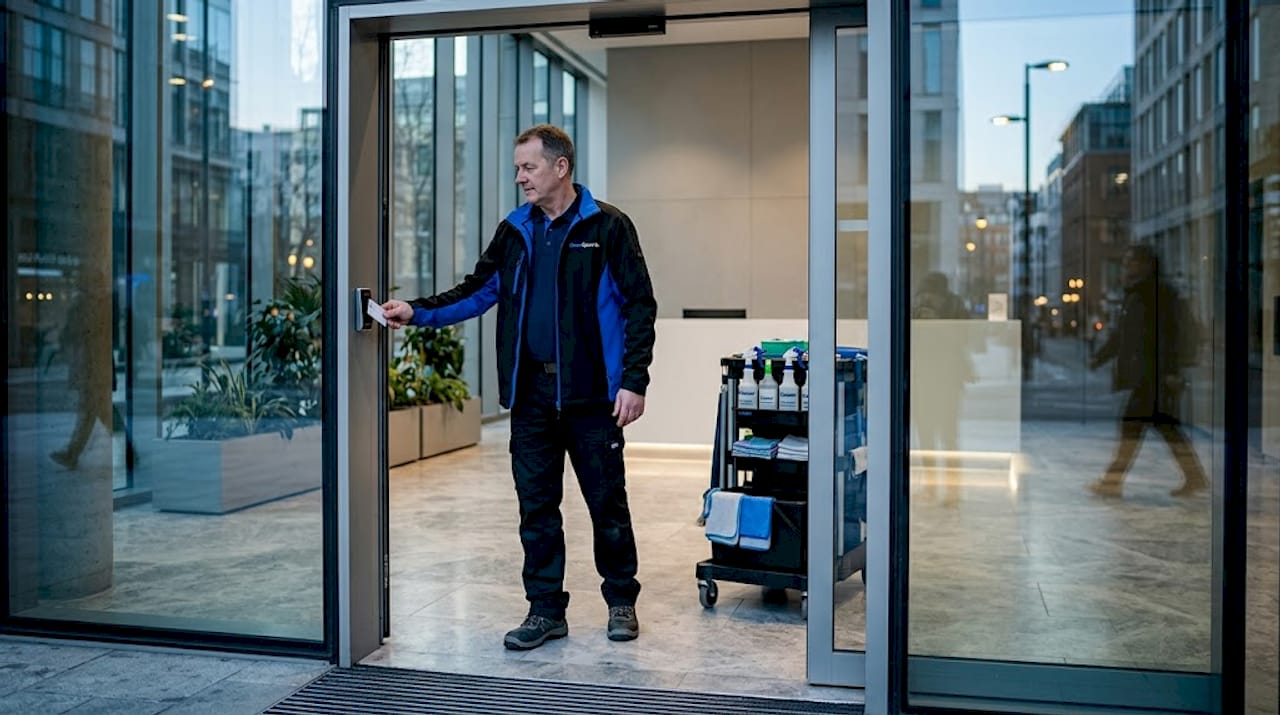
Traditional physical keys still exist but are increasingly rare in professionally managed commercial spaces. The reasons are practical. Keys can be copied, lost, or passed to unauthorized people without any record. Most property managers have moved to electronic access cards or fobs that can be programmed, time-restricted, and deactivated remotely. A cleaner’s access card can be set to work only during their scheduled shift window, which limits exposure without requiring anyone to physically supervise entry.
For after-hours commercial access, third-party keyholding services are a growing solution. These services hold physical keys and alarm codes on behalf of the property, dispatching an authorized representative to unlock the building before a cleaning crew arrives and re-lock after they leave. Access onboarding is typically done in a 15-minute call, and all keys are held to BS7984 standards with full alarm code management and visit documentation included. This removes the liability of cleaners carrying keys entirely.
Digital visit logs and access audits provide time-stamped confirmations for every cleaning visit. For property managers, this is useful evidence during audits or disputes. For cleaning companies, it is proof of service delivery that supports invoicing and contract renewal.
Alarm codes require careful handling during client onboarding. Codes should be collected through a secure channel, stored in an encrypted system, and updated whenever staff turnover occurs. Sharing alarm codes through text messages or unencrypted emails is a compliance risk that has cost cleaning companies contracts when discovered.
Pro Tip: When taking on a new commercial client, create a dedicated access file for each property. Include entry method, alarm codes, emergency contacts, and scheduled access windows. Review it at every staff rotation.
Operational protocols for entering commercial spaces
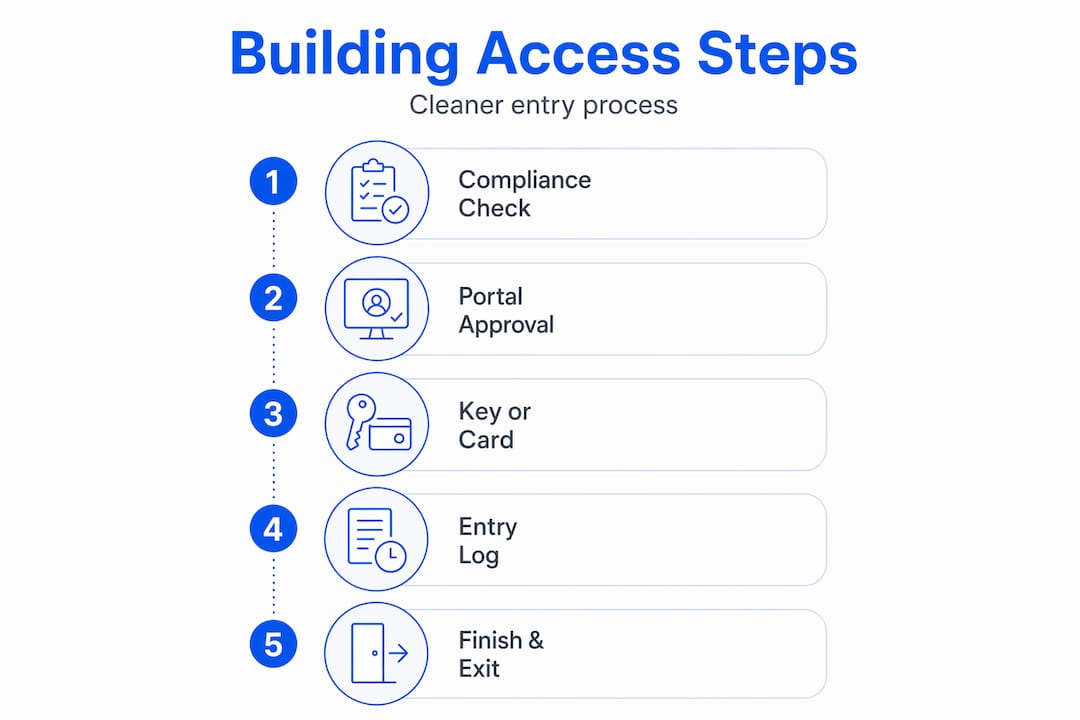
Compliance gets you in the door. Operational protocols keep you there. Cleaning teams working in commercial properties need to follow a clear sequence of procedures on every visit, not just at onboarding.
- Coordinate scheduling in advance. Always confirm access windows with the property manager before each service, especially for after-hours or weekend work. Last-minute changes to cleaning schedules cause security alerts and delay entry.
- Sign in and log your presence. Many commercial buildings require vendors to sign in at reception or use a digital check-in system. Skipping this step is a compliance violation regardless of how often your team has visited before.
- Post safety signage immediately upon entry. Wet-floor signage and slip/trip prevention procedures reduce liability claims and are required in most commercial cleaning contracts. Put signs out before any mopping begins.
- Follow chemical handling protocols. Proper labeling, storage, and usage of cleaning agents is not optional. Misuse of chemicals in a commercial space can trigger damage claims, void your insurance coverage, and result in immediate contract termination.
- Complete the work according to the agreed scope. Use a written checklist tied to the client’s service agreement. For a structured reference, the commercial cleaning service checklist covers the key task categories most commercial clients expect.
- Document exit and secure the property. Confirm all exit points, fire doors, and alarms are secured. Scheduled locking procedures should include a complete audit of entry and fire exits before the crew leaves.
- Report any incidents immediately. Property damage, injuries, or security anomalies must be reported to the client on the same day. Delayed reporting looks like concealment and will damage your relationship far more than the incident itself.
Common access challenges and how to avoid them
Even well-organized cleaning businesses run into access problems. Most are preventable with the right systems in place.
The most costly issue is documentation expiration. Automated vendor management systems send reminders at 60, 30, and 7 days before expiration, but if your team misses them, access is deactivated automatically with no grace period. You will not find out until a cleaner shows up and their card does not work. Set your own internal calendar reminders two weeks ahead of every expiration date.
Communication breakdowns create access delays that look unprofessional and cost money. If a property manager changes alarm codes, updates access hours, or adds new security requirements, your team needs to know before the next visit. Establish a named point of contact at every commercial account and require written confirmation of any access changes.
Theft risk management is an ongoing responsibility, not a checkbox at hire. Background checks reduce exposure but bonding covers the financial fallout when something does go wrong. Clients want to see both, and bonding requirements are standard in enterprise contracts. Make sure your bond amount actually meets the minimum stated in your service agreements, not just the lowest tier your insurer offers.
- Keep a compliance renewal calendar with automatic alerts for every document on file.
- Designate one person per commercial account as the primary access coordinator.
- Audit your vendor portal profiles quarterly, not just at renewal time.
- Update alarm codes and access cards immediately when staff leave the company.
- Review bonding levels annually as your contract values grow.
Pro Tip: Run a mock compliance audit on yourself once a year. Pretend you are the property manager and check whether everything you would need to grant access is current, correctly formatted, and accessible within two minutes. Most cleaning companies discover at least one gap.
My take on access protocols after years in commercial cleaning
I have seen cleaning companies lose six-figure commercial contracts over a single expired COI that nobody caught for three weeks. And I have seen new companies with half the experience land those same contracts because their compliance documentation was spotless and their communication was faster.
Here is what I have learned: most cleaning businesses treat compliance as a one-time onboarding task. It is not. It is an ongoing operational function that requires the same attention as scheduling or quality control. The companies that treat vendor compliance as infrastructure, not paperwork, are the ones that keep contracts for years.
The technology side is catching up quickly. Electronic access systems, digital visit logs, and vendor portal automation have made it easier than ever to demonstrate accountability to property managers. But technology only works if the human side is maintained. If a cleaner loses an access card and nobody reports it for a week, no amount of logging software helps you.
My honest advice: invest in a compliance coordinator before you invest in more equipment. One person whose job it is to track renewals, manage vendor portals, and stay in contact with property managers will protect your access rights better than any tool on the market. That role pays for itself the first time it prevents a lockout.
The future is more automation, not less. Property managers are moving toward biometric and mobile-credential access in newer buildings, and cleaning companies that understand these systems will have a real advantage. Start learning them now before they become contract requirements.
— Jean
Let Clean Space SA handle the access details for you
Managing commercial property cleaning access requires background checks, active insurance, vendor portal registrations, and precise operational protocols on every visit. At Clean Space SA, all of that is already built into how we work. Our team is background-checked, fully insured with proper Additional Insured endorsements, and bonded. We coordinate directly with property managers in San Antonio, Leon Valley, Helotes, and Alamo Ranch to handle scheduling, access procedures, and compliance documentation from day one. If you need a reliable team for your office cleaning needs or want to learn more about how we can service your commercial space without the access headaches, get a quote today and we will walk you through exactly how it works.
FAQ
What documentation do cleaners need to access commercial buildings?
Cleaners typically need a valid Certificate of Insurance with an Additional Insured endorsement, Workers’ Compensation coverage, a janitorial dishonesty bond, background check results, and active business licenses before being granted access to a commercial property.
How do cleaners enter buildings after hours?
After-hours commercial access is most commonly managed through electronic access cards with restricted time windows, third-party keyholding services that unlock and re-lock the property around scheduled cleaning visits, or alarm codes collected securely during onboarding.
What happens if a cleaning company’s insurance expires?
Most commercial property management systems automatically deactivate a vendor’s access when insurance or compliance documents expire, often with no grace period. Automated reminders are typically sent at 60, 30, and 7 days before expiration.
Are background checks required for commercial cleaning staff?
Yes. Background checks are standard for commercial cleaning contracts and are increasingly required as annual re-screens rather than one-time checks at hiring. Every employee who physically enters the building is usually subject to screening.
How do digital access logs benefit cleaning companies?
Digital visit logs provide time-stamped, documented proof of entry and exit for every cleaning visit, which supports accurate invoicing, protects against false damage claims, and demonstrates accountability to property managers during contract reviews.
Recommended
- How commercial cleaning differs from residential: San Antonio guide
- Types of Commercial Office Cleaning Services Explained
- Commercial cleaning service checklist for San Antonio
Jean runs growth strategy at AimSetWin, a performance marketing agency specializing in local service businesses across Texas. he's helped plumbers, HVAC companies, pest control operators, and home service brands build predictable revenue systems using data-driven advertising and conversion optimization.


