

Discover how cleaning contracts for businesses work in 2026 and learn to avoid billing surprises. Master your agreements today!
A commercial cleaning contract is a legally binding service agreement that defines what cleaning tasks will be performed, where, how often, at what price, and to what measurable standard. Business owners and managers who understand how cleaning contracts for businesses work gain a direct advantage: they avoid billing surprises, prevent scope disputes, and hold vendors accountable from day one. The industry standard term for these documents is a commercial cleaning service agreement, and the distinction matters because a well-structured agreement functions as an operational blueprint, not just a purchase order. Organizations like BOMA International and cleaning firms such as KleenMark and Aspire have long recognized that the contract itself determines whether a cleaning partnership succeeds or fails.
How cleaning contracts for businesses work: the core structure
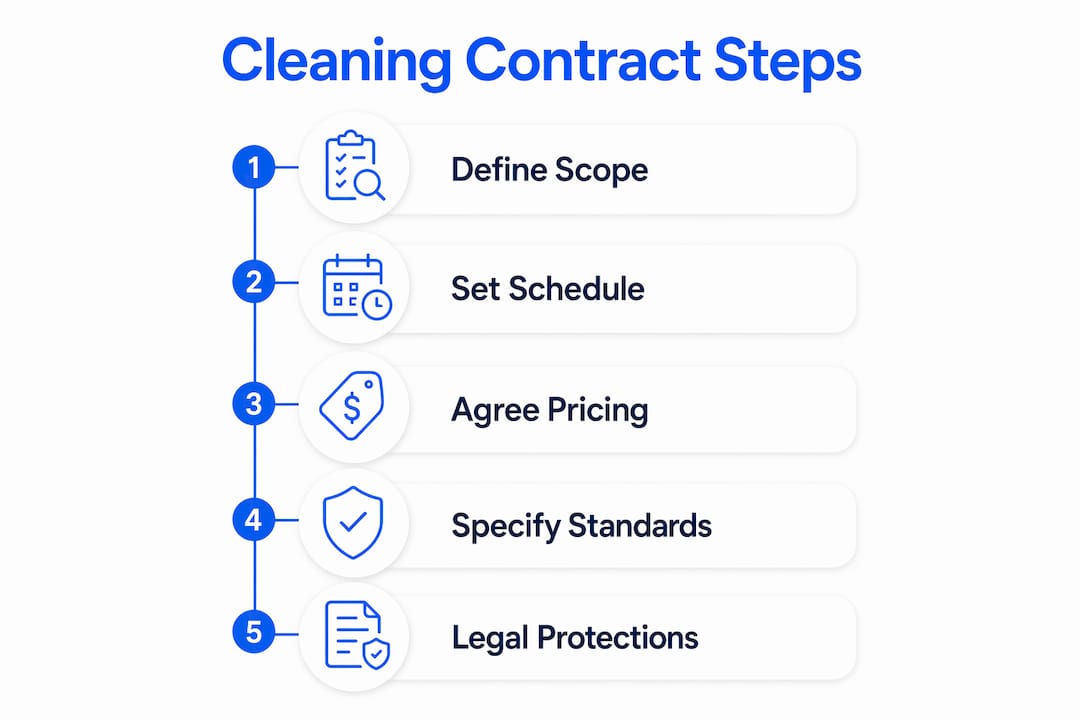
A commercial cleaning service agreement is built around five foundational components: scope of work, service schedule, pricing and payment terms, performance standards, and legal protections. Each component carries equal weight. Skipping or vaguely drafting any one of them is where most problems begin.
Scope of work
The scope of work is the most consequential section in any business cleaning contract. It lists every task, every area, and every frequency. A strong scope reads: “Vacuum all carpeted areas in the main office suite nightly, Monday through Friday. Clean and disinfect all restroom surfaces three times per week.” A weak scope reads: “Clean the office regularly.” Ambiguity in scope is the leading cause of disputes, because missing “out of scope” statements allow unapproved extra tasks to accumulate without extra pay. Understanding the full range of commercial office cleaning services before drafting this section prevents gaps.

Service schedule and performance standards
The schedule defines when work happens. The Service Level Agreement, or SLA, defines how well it must be done. An effective SLA sets measurable outcomes, such as monthly inspection scores averaging 85% or above, rather than simply listing tasks. That number gives both parties a clear pass/fail benchmark. Without it, “clean” means something different to every person in the room.
Pricing, payment terms, and extra charges
Financial transparency in cleaning contracts prevents surprise invoices by detailing base rates and the specific triggers for additional charges. A solid pricing section names the base monthly rate, the billing cycle, accepted payment methods, and the exact conditions under which add-on fees apply, such as post-event cleanup or emergency response. Vague language like “additional services billed as needed” is a red flag in any commercial cleaning agreement.
Pro Tip: Request an itemized rate card alongside the contract. If a vendor cannot break down costs by task or area, that is a signal their pricing model lacks the transparency you need to manage your budget.
Legal protections: insurance, confidentiality, and subcontracting
Vendors should carry minimum general liability insurance of $1 million per occurrence, with higher limits required for large or high-traffic facilities. The contract should also specify whether the vendor can subcontract work, require background checks for all personnel, and include a confidentiality clause covering access to sensitive areas. Reviewing how cleaners access commercial properties is a practical step before finalizing these clauses.
Here is a quick comparison of clear versus vague contract language:
| Contract element | Vague language | Clear language |
|---|---|---|
| Scope of work | “Clean common areas as needed” | “Mop lobby floors nightly; clean breakroom surfaces Mon/Wed/Fri” |
| Performance standard | “Maintain a clean facility” | “Monthly inspection score of 85% or higher required” |
| Pricing | “Additional services billed accordingly” | “Post-event cleanup billed at $75/hour with 24-hour notice” |
| Termination | “Either party may cancel” | “30 days written notice required for termination for convenience” |
How do contracts protect both parties and reduce service disputes?
60% of cleaning contract disputes arise from vague or missing contract terms rather than actual service quality failures. That statistic reframes the entire conversation: most conflicts are a documentation problem, not a performance problem. A contract that defines tasks, frequencies, and inspection benchmarks removes the subjective arguments before they start.
Scope creep is the most common friction point in commercial cleaning agreements. It happens when a client assumes a task is included and the vendor assumes it is not. Scope creep leads to cleaners performing extra tasks without extra pay, which breeds resentment and eventually service decline. The fix is a written exclusions list inside the scope of work section.
“Treat cleaning contracts as partnership blueprints rather than mere transaction documents for better operational results.” — KleenMark
Insurance clauses carry more weight than most facility managers realize. A vendor without adequate coverage exposes your business to liability for accidents, property damage, or theft that occurs on your premises. Requiring a certificate of insurance before work begins, and verifying it annually, is a non-negotiable best practice.
Pro Tip: Build a 90-day performance review into the contract itself. Scheduled reviews create a formal mechanism to address issues before they escalate, and they signal to the vendor that accountability is ongoing, not just at contract signing.
Clear communication protocols also reduce disputes. The contract should name a single point of contact on both sides, define how complaints are submitted, and set a response time standard, such as 24 hours for routine issues and 4 hours for urgent ones. When both parties know the process, problems get resolved instead of ignored.
What are best practices for negotiating and managing business cleaning contracts?
Negotiating a commercial cleaning agreement requires more than comparing monthly prices. Facility managers who focus only on cost often end up with contracts that cut corners on frequency, staffing, or supplies. The following steps produce better outcomes:
- Solicit at least three bids. Compare them on identical scope documents, not on each vendor’s default proposal. A bid that wins work and a signed contract that governs the relationship are distinct documents that serve different purposes. Conflating them creates confusion and hampers performance management.
- Negotiate scope alongside price. If a vendor’s price is too high, reduce frequency on lower-priority areas before accepting a lower standard of work on high-priority ones. Cutting the supply closet cleaning from weekly to biweekly costs less than cutting restroom disinfection frequency.
- Request a 30 to 60-day trial period. A trial period with a defined exit clause protects you if the vendor underperforms during onboarding, without locking you into a full contract term.
- Separate routine and project work. Deep cleaning, post-construction cleanup, and window washing should be priced separately from recurring maintenance. Bundling them obscures true costs and makes budget forecasting harder.
- Monitor compliance actively. Conduct monthly walkthroughs using a standardized inspection checklist. Request updated insurance certificates and training records annually. Review the office cleaning schedule against actual service logs quarterly.
- Handle disputes in writing. When a service failure occurs, document it with photos and timestamps, submit it through the agreed complaint channel, and reference the specific contract clause that was not met. Written records protect both parties if the dispute escalates.
Pro Tip: Ask vendors how they handle staff turnover and training. High turnover is endemic in the cleaning industry, and a contract that requires the vendor to maintain trained, background-checked staff at all times protects you from service degradation when personnel change.
How do contract models and durations affect your cleaning service?
Standard commercial cleaning contracts typically run between 12 and 36 months, with industry experts recommending a one-year initial term when onboarding a new provider. A one-year term gives both parties enough time to establish routines and identify gaps without locking the client into a multi-year commitment before trust is established.
Auto-renewal clauses are standard and worth reading carefully. Best practice requires 60 to 90 days’ notice for non-renewal and 30 days’ notice for termination for convenience. Missing a notice window can bind you to another full contract term automatically. Set a calendar reminder 90 days before your contract anniversary date.
The table below compares the most common contract models:
| Contract model | Typical length | Flexibility | Best for |
|---|---|---|---|
| Fixed-term | 12 to 36 months | Low | Established facilities with stable needs |
| Month-to-month | Rolling | High | New vendors or changing facility requirements |
| Multi-year with annual review | 24 to 36 months | Medium | Large facilities seeking price stability |
| Trial period plus fixed-term | 30 to 60 days then 12 months | Medium | First-time commercial cleaning partnerships |
Supply and equipment provision is another contract variable that affects both cost and accountability. Vendor-supplied consumables, such as paper products and cleaning chemicals, simplify your operations but add a markup. Client-supplied consumables give you cost control but shift the responsibility for stocking and quality to your team. The contract must specify which model applies to avoid disputes over who is responsible when supplies run out.
Key takeaways
A well-drafted commercial cleaning service agreement is the single most effective tool for preventing disputes, controlling costs, and maintaining consistent service quality.
| Point | Details |
|---|---|
| Scope of work is critical | Define every task, area, and frequency explicitly, including a written exclusions list. |
| SLAs enforce accountability | Require measurable inspection scores, such as 85% monthly, not just task descriptions. |
| Insurance protects your business | Vendors must carry at least $1M general liability per occurrence before work begins. |
| Notice periods prevent surprises | Set calendar reminders 90 days before contract renewal to avoid automatic rollover. |
| Bids and contracts are separate | Use the bid to select a vendor, then negotiate a formal service agreement to govern the work. |
Contracts are partnerships, not paperwork
After years of working with facility managers and business owners across San Antonio, one pattern stands out clearly. The clients who struggle most with their cleaning vendors are not the ones who hired the wrong company. They are the ones who signed a vague contract and assumed good intentions would fill the gaps.
I have seen a 10,000-square-foot office building go through three cleaning vendors in two years, not because the vendors were incompetent, but because nobody defined what “clean” meant in writing. The moment the fourth vendor signed a contract with an SLA, inspection scores, and a formal complaint process, the relationship stabilized. The vendor did not change. The agreement did.
The other mistake I see repeatedly is treating the competitive bid as the contract. A bid is a sales document. It is designed to win work, not to govern a relationship. Once you sign, the bid becomes irrelevant. What matters is the service agreement, and if that agreement is thin, you have no leverage when performance slips.
My honest advice: spend as much time reviewing the contract as you spend evaluating the bid. Negotiate the scope, the SLA, the termination terms, and the insurance requirements before you sign anything. A cleaning contract that takes two hours to negotiate properly can save you months of frustration and thousands of dollars in disputed charges.
— Jean
Clean Space SA’s commercial cleaning services for San Antonio businesses
Clean Space SA serves commercial clients across San Antonio, including businesses in Leon Valley, Helotes, and Alamo Ranch, with cleaning programs built around clear, customized service agreements. Every engagement starts with a detailed scope of work, transparent pricing, and defined performance standards so there are no surprises on either side. The team is background-checked, trained to consistent standards, and managed to deliver the same quality on every visit.
If you are ready to put a professional cleaning agreement in place for your facility, explore Clean Space SA’s commercial cleaning services or learn more about what commercial cleaning covers before your first consultation. Clean Space SA makes the contract process straightforward so you can focus on running your business.
FAQ
What is included in a commercial cleaning contract?
A commercial cleaning contract includes the scope of work, service schedule, pricing and payment terms, performance standards such as SLA inspection scores, insurance requirements, termination conditions, and confidentiality clauses. Every task, area, and frequency should be named explicitly to prevent disputes.
How long do business cleaning contracts typically last?
Standard commercial cleaning contracts run between 12 and 36 months. Industry experts recommend a one-year initial term when working with a new provider so both parties can evaluate fit before committing to a longer agreement.
What is the most common cause of cleaning contract disputes?
60% of disputes stem from vague or missing contract terms, not poor service quality. Ambiguous scope of work language is the primary trigger, often leading to scope creep where extra tasks are performed without agreed compensation.
How much liability insurance should a cleaning vendor carry?
Vendors should carry a minimum of $1 million general liability per occurrence. High-traffic or large facilities should require higher limits. Always request a certificate of insurance before work begins and verify it annually.
What is the difference between a cleaning bid and a cleaning contract?
A bid is a sales document used to win work. A signed service agreement is the legal document that governs the ongoing relationship. Using a bid as a contract creates confusion and removes your ability to enforce performance standards.
Recommended
- Commercial Cleaning Contract Considerations List for Businesses
- How to Negotiate Commercial Cleaning Contract Terms
- How Cleaners Access Commercial Properties: 2026 Guide
Jean runs growth strategy at AimSetWin, a performance marketing agency specializing in local service businesses across Texas. he's helped plumbers, HVAC companies, pest control operators, and home service brands build predictable revenue systems using data-driven advertising and conversion optimization.


