

Discover how cleaning estimates work and learn to evaluate quotes confidently. Avoid surprises with expert insights in our homeowner's guide.
A cleaning estimate is a formal offer that specifies the scope, cost, and timing of cleaning services based on your property’s size, condition, and service type. Understanding how cleaning estimates work saves you from surprise charges, vague quotes, and providers who underbid to win your business. This guide breaks down every factor that shapes a quote, from square footage and labor burden costs to condition multipliers and add-on pricing, so you can evaluate any estimate with confidence.
How cleaning estimates work: the core components
A cleaning estimate is built from four core elements: labor time, supplies, scope of work, and optional add-ons. Each element is calculated separately, then combined into a total price. The scope of work defines exactly which rooms, surfaces, and tasks are included. Labor time is the biggest cost driver, and it changes based on your home’s size and condition.
Providers use the scope of work to set expectations on both sides. A professional estimate names every task, such as vacuuming, mopping, bathroom scrubbing, and kitchen wipe-downs, rather than using a vague phrase like “full clean.” This specificity protects you from disputes on service day. According to industry best practices, professional estimates include a detailed scope of work, task outlines, cleaning frequency, and license and insurance information, with a validity period of typically 15–30 days.

Add-ons are priced separately and listed clearly in a quality estimate. Services like oven cleaning, refrigerator cleaning, interior window washing, and garage sweeping each carry their own labor cost. Seeing them itemized tells you exactly what you are paying for and what you can remove to lower the total.
What factors determine your cleaning price?
Property size is the single largest factor in any cleaning estimate. A 1,000-square-foot apartment takes roughly half the labor time of a 2,000-square-foot house. Providers translate square footage directly into labor hours, which drives the base cost before any other variable is applied.
Beyond size, the number of bedrooms and bathrooms matters significantly. Bathrooms are the most labor-intensive rooms in a home. A three-bathroom house takes noticeably longer to clean than a one-bathroom unit of the same square footage. Most providers price bathrooms as individual line items for this reason.
Service type creates the biggest price jumps. Standard cleaning for a 3-bedroom home generally costs $140–$260, deep cleans run $220–$450, and move-out cleans range from $300 to $650 or more. Recurring visits can save you 15–30% compared to one-time rates. That gap between a standard clean and a move-out clean reflects the additional labor required to restore a property to a neutral condition.
Home condition is the factor most homeowners underestimate. Clients often under-report clutter levels, pet hair accumulation, and general soil buildup, which causes labor time surprises and friction on service day. Describing your home honestly, including whether you have pets, how long since the last professional clean, and whether any rooms are heavily cluttered, produces a far more accurate quote.
Key factors that affect your estimate include:
- Square footage and layout: Open floor plans clean faster than compartmentalized layouts.
- Number of bathrooms: Each bathroom adds 20–40 minutes of labor on average.
- Cleaning type: Standard, deep, and move-out cleans carry different labor multipliers.
- Home condition: Heavy soiling can multiply labor time by up to 3x compared to a well-maintained home.
- Add-on services: Oven cleaning, window washing, and appliance interiors each add cost.
- Geographic location: Metro areas like San Antonio command higher rates than rural markets.
Geographic variation is real. Labor costs in urban Texas markets differ from rural ones, and providers factor local wage rates into every bid.
How do providers calculate cleaning prices?
Cleaning providers use three main pricing models: hourly rates, flat fees, and per-square-foot rates. Each has trade-offs for you as a buyer.
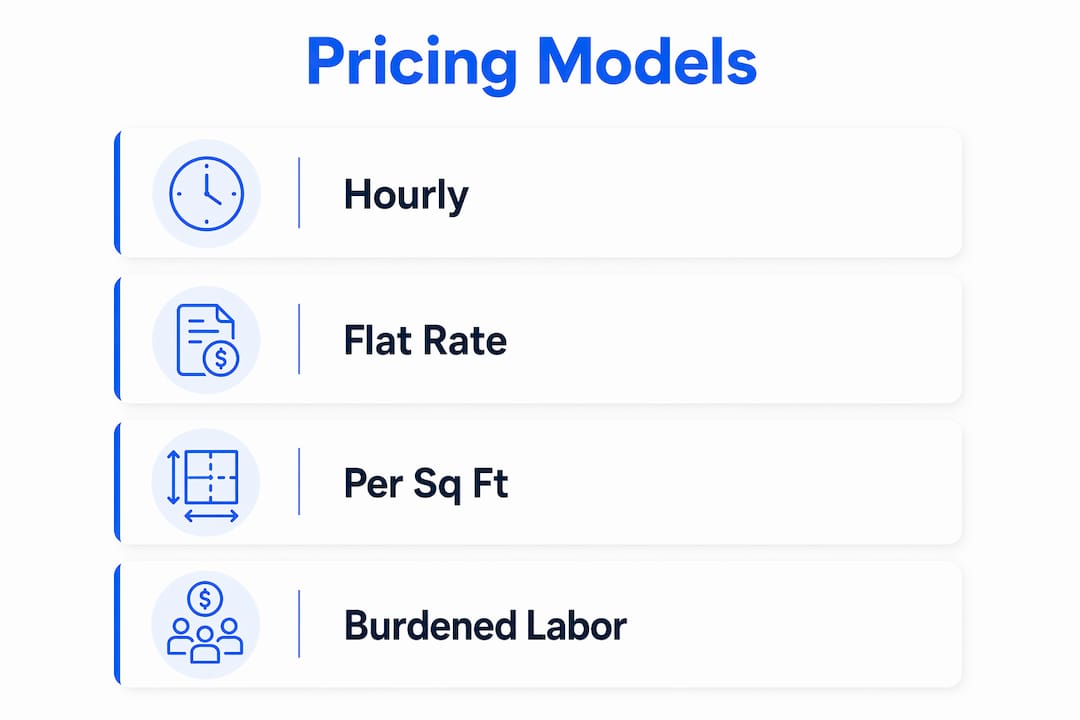
Hourly rates are the most transparent model. Most residential cleaning services charge $40–$55 per hour nationwide, with rates ranging from $25 to $90 depending on location. Metro areas often command $50–$80 or more per hour. The risk with hourly pricing is that an inefficient crew costs you more time. Always ask for an estimated total hour range, not just the hourly rate.
Flat-rate pricing uses a base rate plus multipliers for difficulty and add-ons. This model protects you from runaway hours and gives you a predictable total. The multipliers account for home condition, service type, and any extras you request. Flat-rate structures with difficulty multipliers are common in residential cleaning, and a trial clean is recommended to verify estimate accuracy before a long-term commitment.
| Pricing Model | How It Works | Best For |
|---|---|---|
| Hourly Rate | You pay per hour of labor | Smaller, straightforward jobs |
| Flat Rate | Fixed price based on scope and multipliers | Recurring service contracts |
| Per Square Foot | Rate multiplied by total area | Large commercial properties |
One cost most homeowners never see is the burdened labor rate. Burdened labor rates are 15–25% higher than the base wage because they include payroll taxes and insurance. A provider paying a cleaner $18 per hour actually spends $21–$22.50 per hour in true labor cost. Low-priced quotes that ignore burdened labor often signal providers who cut corners on insurance coverage.
Pro Tip: Ask any provider whether their quote reflects burdened labor costs. If they cannot explain the difference between their wage and their true labor cost, that is a sign their pricing may not be sustainable or fully insured.
How to read and evaluate a cleaning estimate
Reading a cleaning estimate well takes about five minutes if you know what to look for. Start with the scope of work. Every room, task, and surface should be named explicitly. A quote that says “whole house clean” without a task list is not a professional estimate.
Follow these steps when reviewing any quote:
- Check the scope of work. Confirm that every room you expect cleaned is listed by name.
- Verify add-ons are itemized. Transparent quotes list add-ons like oven cleaning separately and specify a validity period to guard against price changes.
- Confirm the validity period. Most professional estimates are valid for 15–30 days. A quote with no expiration date may change without notice.
- Look for insurance and licensing details. A reputable provider includes proof of general liability insurance and, where required, a business license.
- Watch for red flags. Vague pricing, no task list, and quotes significantly below market rate all signal risk. Low bids may signal unsustainable pricing that cannot cover proper insurance or reliable staffing.
- Request a trial clean. Before committing to a recurring contract, one trial visit lets you verify that the actual labor matches the estimated scope.
Pro Tip: Before accepting any quote, ask the provider: “What happens if the job takes longer than estimated?” A professional answer protects you from surprise charges. A vague answer is a warning sign.
Property managers overseeing multiple units should also ask about commercial cleaning pricing structures, since volume discounts and per-unit flat rates often apply differently than residential quotes.
Real scenarios: what estimates look like in practice
Seeing numbers in context makes the estimate process concrete. Here are three scenarios that show how the same property produces different quotes based on service type and condition.
| Scenario | Property | Service Type | Estimated Cost |
|---|---|---|---|
| Standard recurring clean | 3-bed, 2-bath, well-maintained | Standard | $140–$200 |
| First-time deep clean | 3-bed, 2-bath, moderate clutter | Deep clean | $280–$380 |
| Move-out clean | 3-bed, 2-bath, heavy soiling | Move-out | $400–$650+ |
The difference between the standard and move-out scenarios is not just service type. It reflects the condition multiplier at work. A heavily soiled property can require three times the labor of a well-maintained one, which is why condition levels affect labor multipliers so significantly. An “excellent condition” home might reduce estimated time by a factor of 0.8, while heavy soiling multiplies it by 3.
Add-ons shift costs in ways that surprise many first-time buyers:
- Interior oven cleaning typically adds $25–$50 to any quote.
- Interior refrigerator cleaning adds $20–$40.
- Window washing, handled as a separate service, can add $80–$200 depending on the number of windows and stories.
- Post-construction cleanup carries its own pricing tier entirely, often double or triple a standard clean.
Recurring service discounts are real and worth negotiating. Weekly service typically costs less per visit than biweekly, and biweekly costs less than monthly. Locking in a recurring schedule also stabilizes your rate against seasonal price increases. You can learn more about what to expect from a cleaning service before committing to a recurring plan.
Key takeaways
A cleaning estimate’s accuracy depends on the quality of information you provide and the transparency of the provider’s pricing structure.
| Point | Details |
|---|---|
| Scope of work is non-negotiable | Every room and task must be named explicitly in a professional estimate. |
| Condition multipliers change costs dramatically | Heavy soiling can triple labor time compared to a well-maintained home. |
| Burdened labor explains price gaps | True labor costs run 15–25% above base wages due to taxes and insurance. |
| Validity periods protect both parties | Confirm your quote is valid for 15–30 days to lock in the stated price. |
| Trial cleans reduce long-term risk | One visit before a recurring contract confirms the estimate reflects actual labor. |
What i’ve learned about getting a fair cleaning estimate
After years of watching homeowners navigate the quoting process, the most common mistake I see is treating an estimate like a fixed menu price. It is not. An estimate is a starting point built on assumptions about your home’s condition, and those assumptions are only as good as the information you provide.
The homeowners who get the fairest, most accurate quotes are the ones who describe their homes honestly before the provider ever walks through the door. That means mentioning the dog, the teenager’s bathroom, and the kitchen that has not had a deep clean in two years. Providers who receive honest information give better quotes. Providers who get vague answers build in a buffer, and you pay for that buffer whether the work requires it or not.
I also think most people undervalue the trial clean. Committing to a six-month recurring contract based on a phone quote is a gamble. One visit at the quoted rate tells you whether the scope matches the reality. If the crew runs over by an hour on the first visit, that is data. Use it to renegotiate or move on before you are locked in.
The balance between cost and quality is real, but it is not as hard to find as it seems. The lowest quote in a market almost always reflects a cost being cut somewhere, whether that is insurance, training, or labor stability. A mid-range quote from a provider with clear itemization, a named scope of work, and verifiable insurance is almost always the better value over twelve months than the cheapest option that shows up with a vague one-liner.
Treat the estimate as a conversation, not a take-it-or-leave-it offer. Ask questions. Request adjustments. A provider who cannot explain their pricing in plain terms is not a provider you want cleaning your home every two weeks.
— Jean
Get a transparent estimate from clean space SA
Clean Space SA serves homeowners and property managers across San Antonio, including Leon Valley, Helotes, and Alamo Ranch, with detailed, itemized estimates that name every task and add-on before work begins.
Every quote from Clean Space SA includes a full scope of work, separate line items for add-ons, and clear pricing based on your home’s actual size and condition. Whether you need a recurring residential clean or a one-time deep clean before a sale or move, the team walks through your specific needs to build a quote that reflects real labor costs, not a ballpark guess. Request a walkthrough today and get a quote you can actually rely on.
FAQ
What is included in a cleaning estimate?
A professional cleaning estimate includes a detailed scope of work, a task list by room, pricing for add-ons, license and insurance information, and a validity period of 15–30 days.
Why do deep clean quotes cost so much more than standard cleans?
Deep cleans require significantly more labor time because they cover areas skipped in routine visits, such as baseboards, appliance interiors, and grout. Standard cleans for a 3-bedroom home run $140–$260, while deep cleans run $220–$450.
How long is a cleaning estimate valid?
Most professional estimates are valid for 15–30 days. After that window, supply costs or seasonal demand can change the price, so confirm the validity period before accepting any quote.
Why does my home’s condition affect the estimate so much?
Condition multipliers directly change labor time. A heavily soiled home can require three times the labor of a well-maintained one, which is why accurate condition reporting produces a more reliable quote.
Should i get multiple cleaning quotes before deciding?
Getting two or three quotes lets you compare scope, pricing models, and transparency. Focus on which quote provides the most detailed task list and clearest add-on pricing, not just the lowest total number.
Recommended
- How Home Cleaning Service Works: What to Expect
- How commercial cleaning pricing works for San Antonio landlords
- How Much Does a Cleaning Service Charge? 2026 Pricing Guide
Jean runs growth strategy at AimSetWin, a performance marketing agency specializing in local service businesses across Texas. he's helped plumbers, HVAC companies, pest control operators, and home service brands build predictable revenue systems using data-driven advertising and conversion optimization.


