

Learn how to negotiate commercial cleaning contract terms effectively. This guide helps you secure better service and avoid hidden costs!
Most businesses sign a commercial cleaning contract once, file it away, and don’t think about it again until something goes wrong. Then comes the frustration: spotty service, surprise charges, or a vendor who’s nearly impossible to exit without paying a penalty. Learning to negotiate commercial cleaning contract terms before you sign is the difference between a vendor relationship that works and one that drains your time and budget. This guide walks you through every stage of the process, from understanding key clauses to managing performance after the ink dries.
Table of Contents
- Key takeaways
- How to negotiate commercial cleaning contract terms effectively
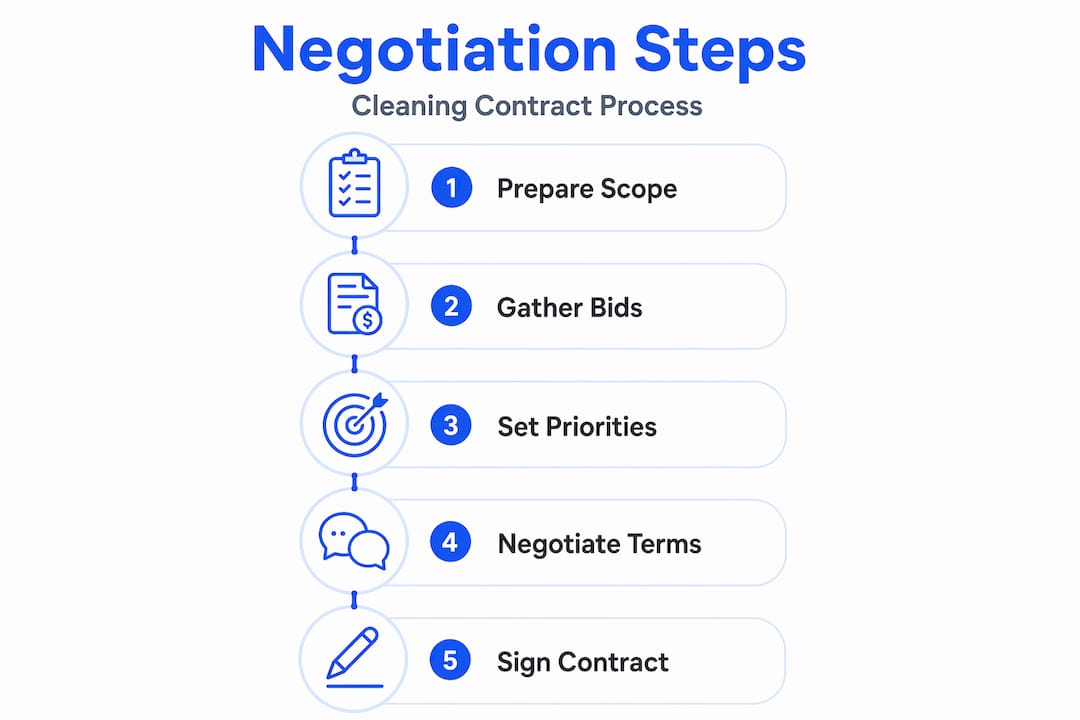
- Step-by-step negotiation for cleaning contracts
- Red flags and pitfalls to avoid
- Verifying performance and managing the contract
- My honest take on cleaning contract negotiations
- How Clean Space SA makes contracts straightforward
- FAQ
Key takeaways
| Point | Details |
|---|---|
| Get multiple bids | Collect 3 to 5 proposals using the same scope to create real pricing leverage. |
| Scope beats price | Adjusting scope is more effective than demanding discounts when reducing costs. |
| Trial periods protect you | A 60 to 90 day trial with an easy exit reduces risk before long-term commitment. |
| Verify performance in writing | Require documented reports after each visit to support renewal negotiations. |
| Watch for red flags | Vague scope, short notice windows, and steep termination penalties signal trouble. |
How to negotiate commercial cleaning contract terms effectively
Before you can negotiate well, you need to know what you’re negotiating. A commercial cleaning contract is not just a price agreement. It’s a set of operating instructions for your facility, and every clause carries real financial or operational weight.
The clauses that matter most
The scope of work is the most important section in any cleaning service agreement terms. It should specify which areas get cleaned, how often, and exactly what tasks are included. Think floor types, restroom protocols, trash removal frequency, and any specialty work like window washing. If the scope is vague, you have no basis for a complaint when service falls short.
Beyond scope, focus on these critical terms:
- Pricing structure: Is the rate flat, per square foot, or hourly? What triggers a price increase?
- Payment terms: Net 15, net 30, and auto-pay arrangements all carry different cash flow implications.
- Term length: A 12-month auto-renewing contract with a 60-day cancellation window is very different from a month-to-month arrangement.
- Termination rights: Understand what it costs to exit early. Poorly negotiated contracts often include early termination penalties of 50 to 100 percent of the remaining contract value.
- Insurance and liability: Confirm the vendor carries general liability and workers’ compensation. Gaps here become your problem.
Prepare before you negotiate
The best practices for cleaning contract negotiation start with preparation, not the negotiation table. Gather your current facility data: square footage, traffic patterns, special-use areas, and existing service history. Collect 3 to 5 bids using the same detailed scope of work so you can make a real apples-to-apples comparison. This step alone gives you leverage that most businesses never build.

Define your priorities before any conversation. Are you trying to reduce cost, tighten quality control, or get more flexibility to exit? Knowing your objective keeps the negotiation focused and prevents you from trading the wrong things.
| Preparation step | What it involves | Why it matters |
|---|---|---|
| Define scope in detail | List every area, task, and frequency | Eliminates disputes over what’s included |
| Gather multiple bids | 3 to 5 proposals, identical scope | Creates pricing leverage and benchmarks |
| Research vendor background | Check references and reviews | Reduces risk of poor performance |
| Set your walkaway point | Define minimum acceptable terms | Keeps you from agreeing to bad deals |
| Know your current costs | Total annual cleaning spend | Gives you a baseline for comparison |
Step-by-step negotiation for cleaning contracts
With preparation done, you’re ready to negotiate. Here’s a practical sequence that works for commercial cleaning contract negotiation at any facility size.
-
Share a detailed scope document. Before asking for a price, send every vendor the same written scope. Specify room types, tasks, frequency, and any special requirements. This forces comparable quotes and signals that you’re a serious, organized buyer.
-
Negotiate the contract length and renewal terms. Push for a 12-month initial term rather than multi-year commitments. More importantly, fight for a convenience termination clause with 30 days’ written notice and cap early termination fees to no more than one month’s service value.
-
Adjust scope instead of chasing discounts. When the price is over budget, the instinct is to ask for a lower rate. Resist that. Adjusting scope of work is more effective and preserves service quality because you’re deciding together what gets done, not just squeezing the vendor’s margin until corners get cut invisibly.
-
Request a trial period. A 60 to 90 day trial period with an easy exit clause lets you verify quality before locking in. Any reputable vendor should be willing to offer this. Hesitation on their part is itself a data point.
-
Separate routine janitorial services from project work. Bundling everything together creates dependency. Separating project-based work like floor stripping, post-construction cleanup, or window washing into separate line items lets you bid those services independently without disrupting your core cleaning arrangement.
-
Build in an annual review clause. Negotiating service level agreements should include a scheduled review point each year. This keeps pricing and scope tied to current conditions rather than locked into terms set years ago.
-
Get performance reporting requirements in writing. Specify that the vendor must provide documented visit logs or performance summaries. This is not optional paperwork. It becomes your evidence during any dispute or renewal conversation.
Pro Tip: Time your commercial cleaning contract negotiation to start at least 60 days before your current contract’s renewal date. Most auto-renewal windows close at 30 to 60 days, and you lose negotiating leverage the moment the contract rolls over automatically.
Red flags and pitfalls to avoid
Knowing how to negotiate cleaning services is only half the battle. Knowing what to reject is equally important. These are the warning signs that routinely trap businesses and property managers.
- A scope of work shorter than two pages. For any facility over a few thousand square feet, a proper scope document for a 10,000 square foot office should be 3 to 5 pages. Anything shorter is a liability waiting to happen.
- Auto-renewal windows under 30 days. Some contracts require cancellation notice 60 to 90 days before renewal. Miss the window by a week and you’re locked in for another year.
- No transition clause. Most businesses overlook transition clauses despite their importance. When you switch vendors, you need the outgoing provider to cooperate on access, schedules, and inventory handoffs during a 2 to 4 week overlap period. Without this clause, service gaps are almost guaranteed.
- Unilateral indemnification language. Some contracts require you to hold the vendor harmless for nearly anything. Have legal counsel review any indemnification clause before signing.
Pro Tip: Watch for proxy pricing hidden inside optional add-on services. Some vendors price the base contract low and inflate rates for extras like carpet cleaning or restroom supply restocking. Request a full menu of service rates upfront, including all add-ons, before committing.
Understanding commercial cleaning service types helps you write a scope document thorough enough to close these gaps before they become problems.
Verifying performance and managing the contract
Signing a good contract is step one. Making it deliver over time requires active management. Here’s what that looks like in practice.
Performance reporting and documentation
Require the vendor to submit documented visit logs after each service. Some vendors call these Proof Packs or Contract Health Reports. They simplify renewal negotiations by creating a record of what was done, when, and by whom. Without this documentation, disputes devolve into your word against theirs.
Contract health reports also improve transparency and build vendor trust over time. A vendor who resists providing them is a vendor who does not want accountability.
SLAs and escalation processes
Negotiating service level agreements means defining what “acceptable performance” actually looks like with measurable metrics. Response time for complaints, re-clean turnaround, and inspection pass rates are all fair game. Spell out the escalation process when those metrics are missed: who gets contacted, in what timeframe, and what remedy the vendor owes you.
Annual reviews and rebidding
Annual review clauses prevent what vendors love and clients hate: autopilot renewals where costs creep up and service quality drifts down. Build a formal review point into the contract where both parties evaluate scope, pricing, and performance against current market rates. Rebid the contract every two to three years to confirm you’re still getting competitive terms. For San Antonio facilities, commercial cleaning pricing guidance can help you benchmark what you should be paying.
| Verification method | What it tracks | Benefit |
|---|---|---|
| Visit logs / Proof Packs | Tasks completed per visit | Creates accountability trail |
| Annual scope review | Task list and frequency accuracy | Catches scope drift early |
| SLA performance scorecard | Response times, complaint resolution | Quantifies service quality |
| Periodic market rebid | Current competitive pricing | Prevents above-market renewals |
| Client walkthrough inspections | Visual quality check | Supplements paper documentation |
My honest take on cleaning contract negotiations
I’ve watched businesses spend months complaining about a cleaning vendor they could have exited or renegotiated with a single well-structured conversation. What I’ve found is that most contract problems are not vendor problems. They’re scope problems that trace back to a contract nobody read carefully before signing.
What I’ve learned from reviewing dozens of service agreements is that the scope of work and the termination clause are where deals actually get made or broken. Every other negotiation point is secondary. A fair price for an undefined scope is still a bad deal because you will never agree on what was promised.
My real advice: treat the commercial cleaning contract negotiation as the beginning of a managed partnership, not a one-time transaction to close quickly. I’ve seen facilities that spend time upfront on scope definition, trial periods, and annual review clauses run year after year without a single service dispute. I’ve also seen facilities that rush the process spend twice as much time managing complaints and switching vendors.
The businesses that get the most value don’t necessarily get the lowest price. They get clarity, flexibility, and a vendor who knows expectations will be measured. That combination is worth more than any percentage discount you could negotiate on rate.
— Jean
How Clean Space SA makes contracts straightforward
When you’re ready to negotiate a cleaning arrangement that actually holds up, working with a vendor who welcomes transparency makes a significant difference. Clean Space SA serves businesses and property managers across San Antonio, including Leon Valley, Helotes, and Alamo Ranch, with office cleaning services built around clear scopes, defined tasks, and no surprise charges. Every proposal includes detailed service descriptions so you know exactly what you’re agreeing to before you sign.
Clean Space SA also offers project-based services like window washing that can be priced separately from routine janitorial work, giving you the contract flexibility this guide recommends. Whether you need a full service proposal, a scope-of-work checklist, or a conversation about trial arrangements, the Clean Space SA team is ready to walk through it with you. Contact them directly for a quote tailored to your facility.
FAQ
How many bids should I get before negotiating a cleaning contract?
Collect at least 3 to 5 bids using the same detailed scope of work. This creates genuine pricing leverage and gives you the benchmarks you need to negotiate from a position of knowledge.
What is a convenience termination clause?
A convenience termination clause lets you exit a contract with 30 days’ written notice without paying excessive penalties. It’s one of the most protective terms you can negotiate into any cleaning service agreement.
Should I negotiate price or scope when reducing cleaning costs?
Adjusting scope is a better approach than demanding a rate reduction. Cutting specific tasks or frequencies maintains service quality in the areas that matter most, rather than pushing the vendor to cut invisible corners to hit a lower price.
What makes a cleaning contract scope of work too vague?
Any scope document shorter than two pages for a mid-sized facility is a red flag. A thorough scope for a 10,000 square foot office should run 3 to 5 pages and specify tasks, frequencies, and area-by-area requirements in detail.
How often should I review a commercial cleaning contract?
Build an annual review clause into every contract. A formal yearly evaluation of scope, pricing, and service performance prevents autopilot renewals and keeps terms aligned with your current facility needs.
Recommended
- How commercial cleaning pricing works for San Antonio landlords
- Types of Commercial Office Cleaning Services Explained
- Commercial cleaning service checklist for San Antonio
Jean runs growth strategy at AimSetWin, a performance marketing agency specializing in local service businesses across Texas. he's helped plumbers, HVAC companies, pest control operators, and home service brands build predictable revenue systems using data-driven advertising and conversion optimization.


