

Learn how to set up an office cleaning schedule that boosts productivity and keeps your workspace organized. Get started today!
A messy office isn’t just an eyesore. It actively costs you money through sick days, reduced focus, and the kind of slow entropy that makes good employees start looking elsewhere. If you’re trying to set up an office cleaning schedule that actually holds up over time, you’ve probably already discovered that a basic checklist isn’t enough. What you need is a system, not a list. This guide walks you through exactly how office cleaning schedules work, from assessing your space to assigning ownership and verifying results, so you can build something that runs without constant supervision.
Table of Contents
- Key takeaways
- How to set up an office cleaning schedule that actually works
- Assessing your office and building your task list
- Implementing the schedule: roles, timing, and accountability
- Verifying and adjusting your schedule over time
- My take on why most office cleaning schedules fail
- Let Clean Space SA handle the heavy lifting
- FAQ
Key takeaways
| Point | Details |
|---|---|
| Schedules are operating controls | A cleaning schedule defines ownership, frequency, and proof of completion, not just tasks. |
| Zone-based planning works better | Dividing your office into zones helps you assign the right frequency and resources to the right areas. |
| Ownership determines success | Every task needs a named owner. Shared responsibility almost always means no responsibility. |
| Pilot before you commit | Test your schedule in one zone first to catch timing conflicts and unclear instructions early. |
| Verification closes the loop | Supervisor walkthroughs and data tracking prevent the gradual slide back to a dirty office. |
How to set up an office cleaning schedule that actually works
Most business owners approach this the wrong way. They search for a cleaning schedule template, fill it in, print it out, and tape it to the supply closet. Two weeks later, nobody’s following it. The reason isn’t laziness. The reason is that the schedule was never built to be followed. It had tasks but no owners. It had frequencies but no enforcement. It was a list, not a system.
A real office cleaning plan functions as an operating control tool, the same way a shift log or a quality checklist does in manufacturing. It defines what gets done, how often, by whom, and how you’ll know it happened. That distinction changes everything about how you build it.
The core elements every schedule needs
Any schedule worth keeping needs four things locked down before you write a single task:
- Scope: Which areas are included? Every zone, from the lobby to the server room, needs to be named and defined.
- Frequency: How often does each task happen? Daily, weekly, monthly, and quarterly tasks all belong in different parts of your plan.
- Ownership: Who is responsible for each task? In-house staff, a porter, or an outside vendor. Pick one per task.
- Proof of completion: How do you know it happened? A sign-off sheet, a digital log, a photo. Proof is what turns a schedule into accountability.
Routine cleaning versus deep cleaning
These are two different things and they belong on two different schedules. Routine janitorial work is daily or several times a week: emptying trash, wiping surfaces, vacuuming, cleaning restrooms. Deep cleaning happens quarterly or seasonally and covers things like carpet extraction, grout scrubbing, air vent cleaning, and thorough disinfection of high-contact surfaces. Mixing both onto one flat list is one of the most common reasons office cleaning plans fall apart.
Pro Tip: Create two separate documents: one for your routine schedule and one for your periodic deep cleaning calendar. Link them together by zone so nothing gets missed.
Assessing your office and building your task list
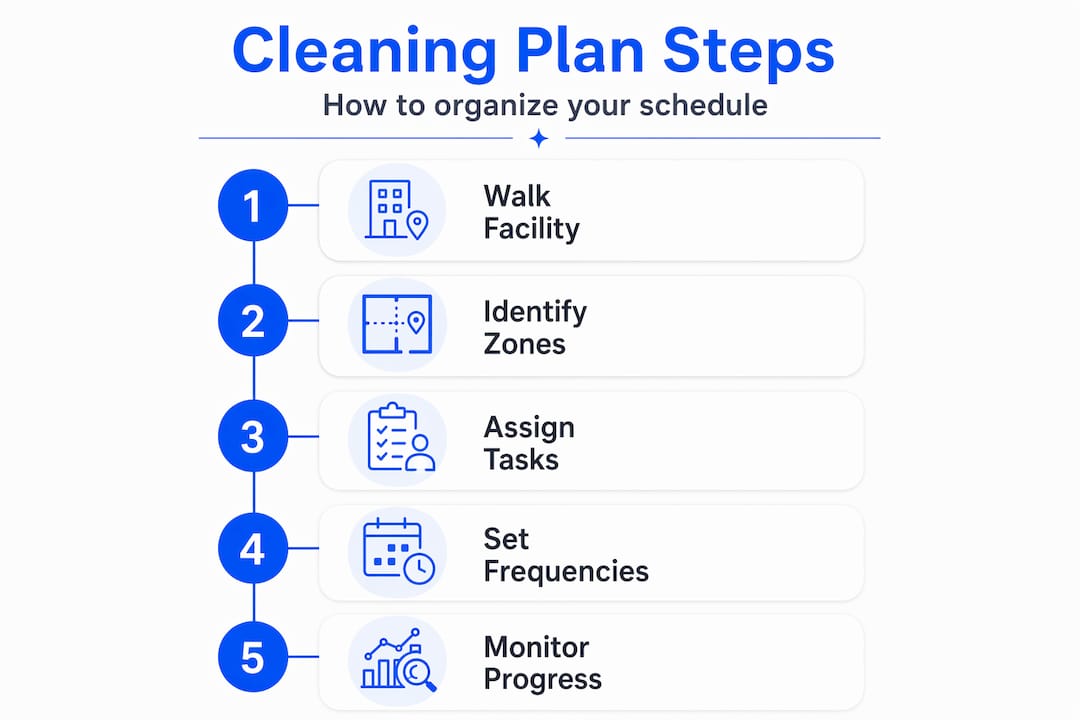
Before you write a single line on your cleaning timetable, you need to walk your space with fresh eyes. Not as the manager who knows where everything is, but as someone who’s noticing what actually gets dirty and when.

Conducting your facility walk
Walk every area during or just after peak occupancy. You’re looking for traffic patterns, surface contact points, and anything that accumulates mess faster than you’d expect. Pay attention to the floor in front of the coffee machine. Check under conference room tables. Look at the door handles, light switches, and elevator buttons. These are the areas where missed cleaning creates real health consequences.
The typical zones in an office include reception and lobby, open workspace, break room and kitchen, restrooms, meeting rooms, and support spaces like copy rooms and storage. Each zone has its own contamination risk and its own appropriate cleaning frequency.
Building your task table by zone and frequency
Once you’ve completed your walk, organize your findings into a table. This is the backbone of your office cleaning plan.
| Zone | Daily | Weekly | Monthly |
|---|---|---|---|
| Restrooms | Disinfect fixtures, restock supplies, mop floors | Deep scrub tiles and grout | Inspect caulking, clean vents |
| Break room / kitchen | Wipe counters, empty trash, clean sink | Clean refrigerator, mop floors, sanitize appliances | Degrease exhaust fan, clean cabinet fronts |
| Open workspace | Empty trash, wipe shared surfaces | Dust desks and monitors, vacuum carpets | Clean windows, wipe baseboards |
| Reception / lobby | Vacuum or sweep, wipe entry glass | Dust furniture, mop hard floors | Clean light fixtures, polish entry surfaces |
| Meeting rooms | Wipe tables, straighten chairs | Vacuum, dust AV equipment | Clean whiteboards thoroughly, wipe walls |
Assigning frequency based on consequence is the key move most people miss. If the restroom goes uncleaned for one day, the result is immediate and visible. If the storage room baseboards go undusted for a week, nobody notices. That difference in consequence should directly determine your cleaning frequency for each zone.
Pro Tip: Daily tasks in high-traffic areas like restrooms and kitchens can reduce germ presence by up to 80% and lower employee sick days by 15 to 25%. Prioritize those zones first when resources are limited.
Implementing the schedule: roles, timing, and accountability
Having a great plan on paper means nothing if the execution falls apart. This is where most office managers lose control. The schedule looks thorough, but three weeks in, tasks are getting skipped because nobody was sure whose job it was, or the cleaning window conflicted with a late team, or the supply closet was locked when the cleaner arrived.
Here’s how to avoid that:
- Assign a named owner to every task. Not “cleaning staff.” Not “facilities.” A specific person or vendor with their name next to the task. Poor follow-through causes 40% of cleaning schedule failures, and unclear ownership is the leading driver of that.
- Set realistic shift windows. A cleaner who’s supposed to cover the full office in 45 minutes will cut corners. Walk the tasks yourself at least once to time them. Then add buffer.
- Choose your record method before you launch. A sign-off sheet on a clipboard works for small offices. Larger operations benefit from a digital CMMS or even a simple shared spreadsheet. Schedules that integrate with CMMS platforms allow you to track completions, flag failures, and adjust labor over time rather than guessing.
- Set completion standards, not just task descriptions. “Wipe down kitchen counters” is too vague. “Wipe down all kitchen counter surfaces with disinfectant spray; counters must be visibly dry and free of debris before sign-off” gives your cleaner something to meet and your supervisor something to verify.
- Train before you launch. Walk through the schedule with whoever is executing it. Show them the zones, explain the standards, and make sure they know what to do when supplies run low or something needs escalating.
If you’re working with an outside vendor, this is also the moment to look at how cleaning contract terms are structured so that the schedule you’ve built is reflected in what you’re paying for. Vague contracts create vague results.
Verifying and adjusting your schedule over time
You built the schedule. You assigned the owners. You launched it. Now comes the part that separates offices with genuinely clean spaces from offices that slide back into chaos within a month.
- Pilot in one zone first. Before rolling out across your entire facility, test the schedule in your highest-traffic area for one week. Restrooms and the break room are ideal because problems show up fast.
- Do supervisor walkthroughs with a checklist. Don’t rely on self-reporting. Walk the zones against your task list and note what’s actually done versus signed off. Discrepancies tell you where the system is failing, not the people.
- Look for timing conflicts and access issues. Testing in real conditions quickly reveals problems like a cleaning window that starts before the building is unlocked, or a supply room that’s not restocked until Thursday even though the cleaner needs supplies Monday morning.
- Adjust frequencies based on what you observe. If the meeting room carpets are still visibly dirty on Thursday despite a Monday vacuum, move vacuuming to twice weekly. If the reception floor stays clean all week after one mop, drop the frequency and redirect that labor.
- Schedule a formal quarterly review. Office use changes. Headcount grows, new teams move in, traffic patterns shift. Your cleaning timetable should evolve with the building. Set a calendar reminder every 90 days to review and update.
My take on why most office cleaning schedules fail
I’ve seen this play out dozens of times. A manager spends an afternoon creating what looks like a thorough schedule. It covers every zone, it has daily and weekly columns, it gets emailed to staff. And then nothing really changes.
What I’ve learned is that the failure almost never happens at the planning stage. It happens at the handoff. The schedule gets created by someone who isn’t doing the cleaning and handed to someone who wasn’t involved in designing it. There’s no shared understanding of what “clean” actually means for each zone. The standards live in the manager’s head and nowhere else.
The offices I’ve seen get this right treat the launch of a new schedule like the rollout of any other operational process. They hold a brief kickoff meeting. They walk the zones together. They establish what a passing inspection looks like before the first shift begins.
The other thing I’d push back on is the instinct to make the schedule as thorough as possible from day one. I’ve watched elaborate office cleaning plans collapse under their own weight because they were too detailed to execute consistently. Start leaner than you think you need to. Get the daily and weekly tasks running smoothly. Then layer in the monthly and quarterly tasks once the habit is established. Consistency beats thoroughness every time, especially in the first 60 days.
— Jean
Let Clean Space SA handle the heavy lifting
If you’d rather spend your time running your business than managing a cleaning roster, Clean Space SA does this work every day for offices across San Antonio, including Leon Valley, Helotes, and Alamo Ranch. Whether you need a reliable routine cleaning crew or a scheduled deep clean service to reset your space, the team at Clean Space SA is background-checked, trained to a consistent standard, and built around showing up when they say they will.
Explore professional office cleaning options tailored for San Antonio businesses, from weekly maintenance to one-time resets. Getting started is simple, and you’ll immediately have one fewer thing to manage.
FAQ
What should an office cleaning schedule include?
A solid office cleaning schedule defines each zone, the specific tasks for that zone, how often each task happens, who is responsible, and how completion is verified. A task list without ownership and proof of completion is not a schedule. It is a suggestion.
How often should an office be professionally cleaned?
Most offices benefit from routine cleaning three to five times per week for high-traffic areas like restrooms and kitchens, with full office cleaning at least weekly. Deep cleaning should happen quarterly or seasonally to address surfaces that routine cleaning misses.
What are the most important weekly office cleaning tasks?
Weekly tasks typically include vacuuming carpets, mopping hard floors, dusting desks and conference room surfaces, cleaning the refrigerator, and wiping down windows. These go deeper than daily maintenance and prevent buildup that becomes much harder to address over time.
How do I organize office cleaning if I have a small team?
Zone the office into sections and assign one person ownership per zone. Keep tasks simple and specific, set clear completion standards, and use a shared sign-off log so you can see what’s getting done without having to ask every day.
Why do office cleaning schedules fail so often?
Poor follow-through and unclear task ownership account for 40% of cleaning schedule failures. The fix is to name a specific owner for every task, define what “done” looks like, and verify results through regular walkthroughs rather than relying on self-reporting.
Recommended
- Office Cleaning – Clean Space Sa | commercial cleaning | San Antonio, TX, USA
- What Is Deep Clean for Office Spaces: A Manager’s Guide
- Types of Commercial Office Cleaning Services Explained
- Office cleaning OLD – Clean Space Sa | commercial cleaning | San Antonio, TX, USA
Jean runs growth strategy at AimSetWin, a performance marketing agency specializing in local service businesses across Texas. he's helped plumbers, HVAC companies, pest control operators, and home service brands build predictable revenue systems using data-driven advertising and conversion optimization.


