

Learn how to effectively manage cleaning vendors for your small business with proven strategies, ensuring quality and cost control.
Managing cleaning vendors for a small business is the process of systematically selecting, overseeing, and maintaining relationships with cleaning service providers to deliver consistent results at controlled costs. Most small business owners treat this as a one-time hire decision. The ones who get it right treat it as an ongoing operational discipline, using tools like vendor scorecards, structured contracts, and scheduled inspections to protect both their workspace and their budget. This article gives you the exact framework to do the same.
How to manage cleaning vendors for your small business
Vendor management, in the facility services industry, refers to the structured process of evaluating, contracting, and monitoring third-party service providers. For small businesses outsourcing cleaning, this means going beyond a handshake deal and building a system that holds vendors accountable from day one.
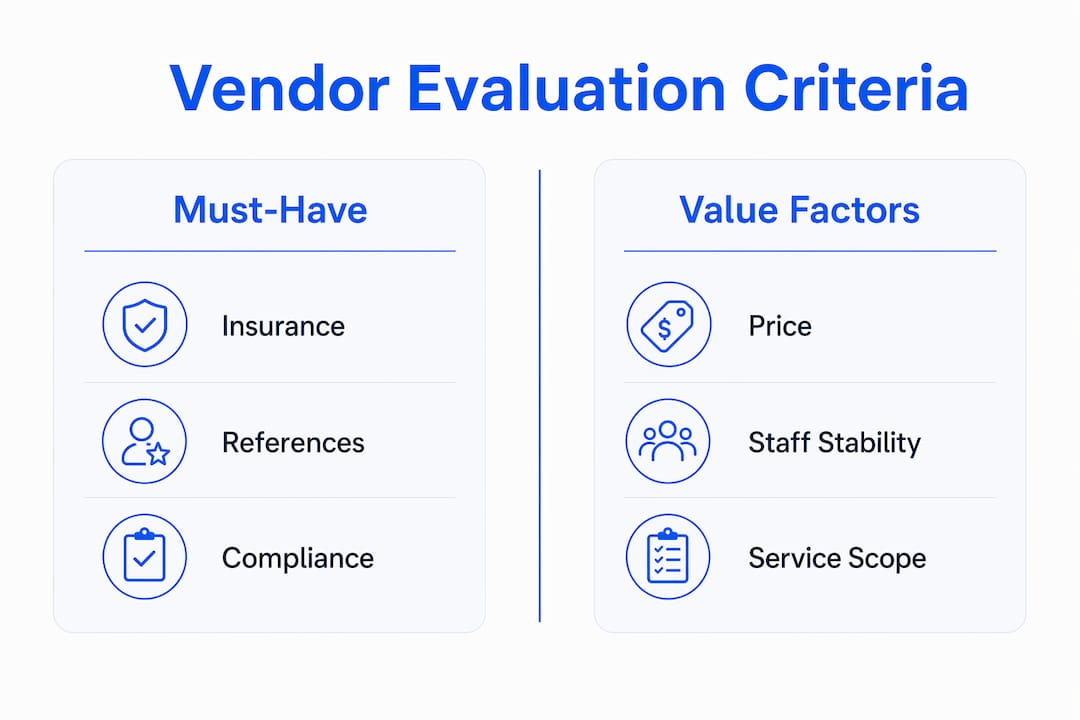
The most common mistake is treating price as the primary filter. Price should account for only 25 to 30% of your vendor evaluation. The remaining 70 to 75% should cover operational capacity, quality systems, and references. This matters because the cheapest bid almost always reflects a narrower scope of work, which means you pay more later through re-procurement, service failures, and management time.

A practical starting point is the 7-point vendor scorecard, which scores vendors across categories like staffing stability, training programs, insurance, and communication responsiveness on a 1 to 5 scale. Any vendor scoring below 28 out of 35 points should be removed from consideration regardless of their price. This threshold protects you from vendors who look good on paper but underdeliver in practice.
What criteria should you use to evaluate cleaning vendors?
Before you request a single bid, conduct a facility walkthrough with each candidate. Vendors who ask detailed questions about your space, traffic patterns, and specific cleaning requirements before pitching their services are demonstrating the kind of rigor that predicts future performance. Professional companies ask detailed facility questions before pitching; vendors who skip this step are signaling future communication problems.
Use this comparison framework when reviewing candidates:
| Evaluation factor | What to look for |
|---|---|
| Insurance coverage | At least $1 million general liability, verified directly from carrier |
| Certifications | ISSA, CIMS, or industry-specific credentials relevant to your facility type |
| References | Similar facility types; refusals to provide references are a red flag |
| Staffing model | Employee-based vs. subcontractor; employees indicate more accountability |
| Quality systems | Written inspection protocols, not just verbal promises |
| Communication | Dedicated point of contact and defined escalation paths |
| Pricing transparency | Line-item scope, not lump-sum bids |
Verify insurance coverage by requesting the Certificate of Insurance directly from the carrier, not from the vendor. Vendors who hand you a copy of their own COI are giving you an unverifiable document. This single step eliminates significant liability risk for your business.
Pro Tip: Ask each vendor for references from facilities that match your square footage and industry. A vendor experienced in medical offices or food service environments brings compliance knowledge that a generalist cannot replicate.
Be cautious of vendors who claim they do everything. Generalist vendors often lack the specialization and compliance systems required for regulated environments like healthcare-adjacent offices, food prep areas, or childcare facilities. Specialization is not a luxury. It is a risk management requirement.
How should you structure contracts to protect service quality?
A cleaning contract is your primary enforcement tool, and most small businesses underinvest in it. The contract should define not just what gets cleaned, but how often, to what standard, and what happens when those standards are not met. You can find a detailed commercial cleaning contract breakdown that covers the clauses most businesses miss.
Structure your contract to include these elements in order of priority:
- Scope of work: A task-level list specifying every surface, area, and frequency. Vague scopes create disputes.
- Performance standards: Measurable outcomes, not subjective descriptions. “Restrooms sanitized to OSHA standards” beats “restrooms cleaned thoroughly.”
- Inspection schedule: Who inspects, how often, and what form the documentation takes. Third-party inspections carry more weight than vendor self-reporting.
- Complaint resolution process: A defined path from complaint to resolution with a response time commitment, typically 24 to 48 hours.
- Penalty clauses: Financial consequences for repeated failures. Without penalties, complaints become suggestions.
- Termination conditions: Clear grounds for ending the contract without penalty if service standards are not met consistently.
Structured contracts with formal complaint resolution and regular quality inspections are the single most effective tool for preventing service decline over time. Vendors who proactively offer escalation paths and inspection schedules during the sales process are demonstrating operational maturity. Those who resist these terms are telling you something important.
Pro Tip: When negotiating terms, use the guidance in this contract negotiation resource to push for monthly performance reviews in the first quarter. This creates a feedback loop early, before bad habits become entrenched.
What are the best practices for day-to-day vendor communication?
Consistent oversight is what separates a vendor relationship that holds up over two years from one that degrades within six months. The structure you build at the start determines whether you spend your time managing results or managing complaints.
Here are the practices that make the biggest difference in day-to-day vendor management:
- Assign a single point of contact on your side. Vendors who receive instructions from multiple people in your organization will prioritize whoever is loudest, not whoever is right. One contact means one clear channel.
- Schedule quality checks that the cleaning crew does not conduct. Moving from improvised management to structured oversight with formal inspections is the defining shift between reactive and proactive vendor management. Use a third party or a designated internal staff member who is not part of the cleaning operation.
- Log every service issue in writing. A text message is not a record. Use email or a shared log so you have a documented history if a dispute arises or you need to invoke a penalty clause.
- Define escalation paths before you need them. Know who at the vendor company handles complaints above the crew supervisor level. Get that contact in writing during contract negotiation, not after a problem occurs.
- Conduct a formal quarterly review. Review the service log, discuss recurring issues, and confirm that the scope of work still matches your current facility needs. Businesses change. Cleaning scopes should change with them.
Professional providers invest in employee training, supervision, and accountability systems to deliver consistent quality. When you see these systems in place during your vendor evaluation, you are looking at a company that will be easier to manage long-term. You can also use a San Antonio cleaning checklist to benchmark what a thorough service scope should include.
How do you normalize cleaning bids and control costs?
Comparing cleaning bids without a normalized scope is like comparing restaurant menus where each one lists different dishes. The lowest number on the page rarely represents the lowest actual cost. Lowest bids rarely equate to best value because of hidden costs, re-procurement expenses, and management overhead that accumulate over multi-year contracts.
The fix is to create a task-level scope of work before you send out any bid requests. This document lists every cleaning task, the frequency, and the standard expected. Every vendor bids against the same list. When you receive bids back, you can compare line by line rather than total by total.
| Cost factor | Low-bid vendor risk | Structured-scope vendor advantage |
|---|---|---|
| Initial price | Appears lowest | Slightly higher but fully scoped |
| Hidden add-ons | Common after contract start | Defined in contract, no surprises |
| Re-procurement cost | High after early termination | Lower due to stable service quality |
| Management time | High due to frequent issues | Lower with defined escalation paths |
| Total 2-year cost | Often highest | Typically lower overall |
Normalize scope before comparing prices by requiring every vendor to bid against your task-level document. Vendors who refuse to bid on a defined scope, or who submit a lump-sum number without line items, are signaling that they plan to manage scope creep in their favor after signing.
Pro Tip: Ask each vendor to identify any tasks in your scope they would subcontract. Subcontracted tasks introduce a second vendor relationship you did not agree to manage. Get it in writing that all work is performed by their direct employees or approved subcontractors with equivalent insurance.
Understanding the small office cleaning package structure can help you build a realistic scope document if you are starting from scratch.
Key takeaways
Effective vendor management for small business cleaning requires structured evaluation, enforceable contracts, and consistent oversight. Without all three, even a good vendor will underperform over time.
| Point | Details |
|---|---|
| Weight evaluation beyond price | Limit price to 25 to 30% of your vendor score; prioritize quality systems and references. |
| Use a threshold scorecard | Exclude any vendor scoring below 28 out of 35 on a 7-point evaluation before price comparison. |
| Build enforceable contracts | Include task-level scopes, inspection schedules, complaint resolution timelines, and penalty clauses. |
| Normalize bids before comparing | Create a task-level scope document so every vendor bids on identical deliverables. |
| Maintain structured oversight | Log issues in writing, assign one point of contact, and conduct quarterly performance reviews. |
What small businesses consistently get wrong about vendor management
I have seen the same pattern repeat across small businesses of every size: the owner spends two weeks vetting vendors, signs a contract, and then essentially disappears from the relationship. Six months later, the cleaning quality has slipped, the vendor has quietly reduced the scope, and the owner is frustrated but has no documentation to act on.
The uncomfortable truth is that vendor management is not a setup task. It is an ongoing operational responsibility. The businesses that get the best results from their cleaning vendors are the ones that treat the relationship like any other supplier relationship: with regular reviews, written records, and clear consequences for underperformance.
I also see too many small business owners default to the lowest bid because the budget is tight. I understand the pressure. But the long-term cost of ownership for a low-bid vendor, including switching costs and service failures, almost always exceeds what a mid-tier vendor would have cost from the start. The math only becomes visible after the damage is done.
One more thing worth saying directly: the quality of your vendor interview predicts the quality of your service relationship. A vendor who asks you nothing about your facility before quoting is not going to ask questions later either. That incuriosity carries through to every interaction. Choose vendors who treat the sales process like a discovery process. They are the ones who will still be performing well in year two.
— Jean
Clean Space SA keeps your business space consistently clean
Small businesses in San Antonio deserve a cleaning partner that shows up with the same standards every visit, not just on the first one. Clean Space SA provides professional office cleaning for commercial clients across Leon Valley, Helotes, and Alamo Ranch, with transparent pricing, background-checked staff, and a defined service scope built into every agreement. There are no vague promises and no surprise add-ons. If you want to see what a structured, accountable cleaning relationship looks like in practice, Clean Space SA is ready to walk you through it. Book your service and get a clear scope and price before you commit to anything.
FAQ
How do I choose the right cleaning vendor for my small business?
Evaluate vendors using a weighted scorecard that limits price to 25 to 30% of the total score, with the remaining weight on operational capacity, quality systems, insurance, and references. Exclude any vendor scoring below 28 out of 35 points before comparing prices.
What should a cleaning vendor contract include?
A strong contract includes a task-level scope of work, measurable performance standards, an inspection schedule, a formal complaint resolution process with response time commitments, penalty clauses for repeated failures, and clear termination conditions.
How do I verify a cleaning vendor’s insurance?
Request the Certificate of Insurance directly from the vendor’s insurance carrier, not from the vendor. Accepting a vendor-supplied copy without carrier verification leaves you exposed to coverage gaps you cannot detect until a claim is filed.
Why is the lowest cleaning bid usually a bad choice?
Low bids typically reflect a narrower scope of work, which means tasks are excluded that you expect to be included. Over a multi-year contract, the re-procurement costs, service failures, and management time required to address quality issues make the lowest bid the most expensive option in practice.
How often should I review my cleaning vendor’s performance?
Conduct a formal review quarterly, especially in the first year of a new contract. Review your service issue log, confirm the scope still matches your facility’s current needs, and address any recurring problems before they become entrenched patterns.
Recommended
- Commercial Cleaning Contract Considerations List for Businesses
- What Is a Small Office Cleaning Package?
- How Cleaners Access Commercial Properties: 2026 Guide
Jean runs growth strategy at AimSetWin, a performance marketing agency specializing in local service businesses across Texas. he's helped plumbers, HVAC companies, pest control operators, and home service brands build predictable revenue systems using data-driven advertising and conversion optimization.


