

Explore the types of commercial office cleaning services to find the right fit for your facility. Boost health, impression, and compliance today!
Not every office has the same cleaning needs, and choosing the wrong service mix costs you more than money. It costs you employee health, client impressions, and regulatory standing. Understanding the types of commercial office cleaning services available before you sign a contract puts you in control of the outcome. This guide breaks down every major category, from daily janitorial routines to post-construction cleanup, so you can match the right office cleaning solutions to your facility’s actual requirements.
Table of Contents
- Key takeaways
- 1. Types of commercial office cleaning services: janitorial and general upkeep
- 2. Specialized carpet and floor cleaning options
- 3. Window and glass cleaning services in commercial settings
- 4. Sanitization and disinfecting services for workplace health
- 5. Upholstery, post-construction, and emergency cleaning
- 6. Comparing commercial cleaning options: cost, scope, and contracts
- What I’ve learned about choosing commercial office cleaning services
- How Cleanspacesa supports your San Antonio office cleaning needs
- FAQ
Key takeaways
| Point | Details |
|---|---|
| Match service to facility type | Office size, foot traffic, and use determine which cleaning categories you actually need. |
| Layer routine with deep cleaning | Combining deep cleans with maintenance annually or biannually delivers the best cost-to-cleanliness ratio. |
| Sanitization is compliance, not optional | EPA-registered disinfectants and proper dwell times are regulatory requirements, not upsells. |
| Contract type affects total cost | Hourly, per-square-foot, and bundled packages each suit different facility sizes and budgets. |
| Specialty services fill critical gaps | Post-construction, upholstery, and emergency cleaning address needs your routine contract won’t cover. |
1. Types of commercial office cleaning services: janitorial and general upkeep
Janitorial service is the foundation of any commercial cleaning program. It covers the recurring, day-to-day tasks that keep your office functional and presentable. Without it, every other specialty service you add loses its impact within days.
Typical janitorial activities include:
- Dusting surfaces, shelves, and equipment
- Emptying trash and recycling bins
- Restroom sanitation and restocking consumables
- Vacuuming carpets and mopping hard floors
- Wiping down common area surfaces and break room appliances
- Spot-cleaning glass doors and partitions
Flexible scheduling options are standard among professional providers, including evening and weekend service windows that keep your operations uninterrupted. For a 10-person office, daily service may be overkill. For a 200-person facility with shared kitchens and conference rooms, anything less than five days a week creates visible problems fast.
One often-missed customization is zoning. High-traffic areas like lobbies, restrooms, and break rooms need daily attention. Private offices and storage areas may only need service two or three times per week. Structuring your contract this way reduces cost without sacrificing the areas that matter most.
Pro Tip: When adding specialty services like carpet cleaning or window washing, coordinate their schedules with your janitorial provider. Running them on the same day wastes the specialty work. Schedule specialty services the day before a janitorial visit so the routine crew handles any residual dust or debris.
2. Specialized carpet and floor cleaning options
Floors take more abuse than any other surface in a commercial office. Carpet traps allergens, bacteria, and odors that routine vacuuming never fully removes. Hard floors lose their finish under daily foot traffic. Neither problem solves itself.
For carpeted offices, three primary methods are used in commercial settings:
- Hot water extraction: The most thorough method for heavily soiled carpets. Water and cleaning solution are injected deep into fibers and extracted along with embedded debris. Hot water extraction is best scheduled during low-occupancy periods due to drying time.
- Low-moisture cleaning: Faster drying, suitable for offices that cannot afford downtime. Less effective on deep soiling but practical for maintenance cycles.
- Encapsulation: A polymer solution crystallizes soil particles around carpet fibers, which are then vacuumed away. Good for interim maintenance between deep cleans.
| Method | Best for | Drying time | Cost level |
|---|---|---|---|
| Hot water extraction | Heavy soiling, deep clean | 4 to 8 hours | Higher |
| Low-moisture | Maintenance, quick turnaround | 1 to 2 hours | Moderate |
| Encapsulation | Interim upkeep | Under 1 hour | Lower |
For hard floors, stripping removes old wax buildup, waxing restores protection and gloss, and buffing maintains shine between full treatments. Tile, vinyl, and concrete each require different products, so confirm your provider has experience with your specific floor type before signing.
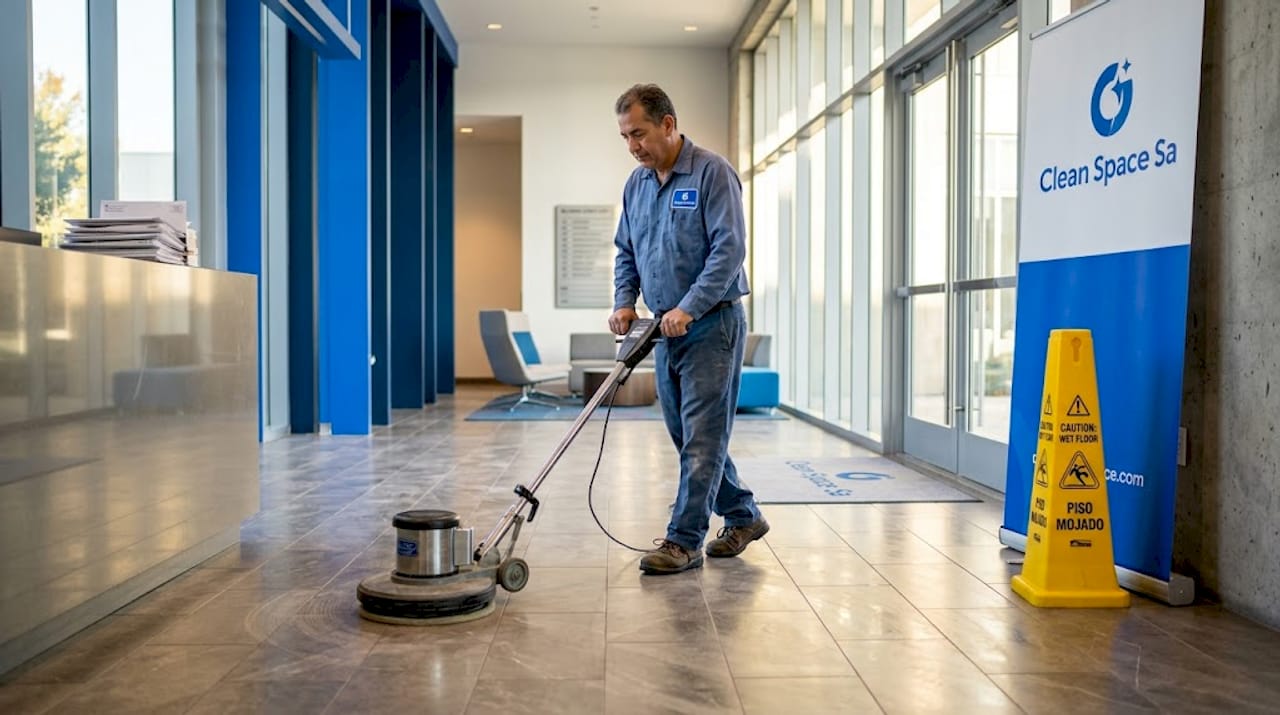
Pro Tip: Ask your provider to document floor condition before and after each deep clean. This record protects you if a damage dispute arises and helps you track when the next treatment is due.
3. Window and glass cleaning services in commercial settings
Clean windows do more than look professional. They maximize natural light, which directly affects employee mood and energy. A building with grimy windows signals neglect to every visitor before they walk through the door.
Commercial window cleaning frequency depends on location and building height. Ground-floor retail-adjacent offices in high-traffic areas may need monthly service. Multi-story buildings in quieter locations often schedule quarterly cleanings. Special-event cleaning before a major client visit or building inspection is also a common add-on.
The equipment and techniques vary by building type:
- Interior glass: Squeegees, microfiber cloths, and streak-free solutions
- Exterior low-rise: Extension poles and water-fed systems
- Exterior high-rise: Rope access, boom lifts, or scaffolding
Safety is non-negotiable here. Safety regulations require that technicians working at height be insured, trained, and compliant with OSHA standards. Always request proof of liability insurance and worker’s compensation coverage before allowing any exterior window work on your building. If a provider hesitates to provide documentation, that is your answer.
Cleanspacesa handles commercial window washing for San Antonio businesses, including multi-story properties, with fully insured crews.
4. Sanitization and disinfecting services for workplace health
Sanitization is not the same as cleaning. Cleaning removes visible dirt. Sanitization and disinfection reduce or eliminate pathogens on surfaces. For a commercial office, especially one with shared equipment, high foot traffic, or immunocompromised employees, the distinction matters.
Types of office sanitization services include:
- High-touch surface disinfection: Doorknobs, elevator buttons, light switches, keyboards, and shared equipment are treated with EPA-registered disinfectants at specified dwell times.
- Electrostatic spraying: A charged mist wraps around surfaces for full coverage, including the backs and undersides of furniture that manual wiping misses. Electrostatic spraying improves coverage of hard-to-reach surfaces significantly.
- Outbreak response cleaning: Triggered by a confirmed illness event in the office. More intensive than routine disinfection and typically requires a separate service call.
“Commercial cleaning is fundamentally about risk management and regulatory compliance, not just aesthetics.” This framing matters when you are building a cleaning program. If your provider cannot tell you which EPA-registered products they use or what the required dwell time is for each disinfectant, they are not running a compliant program.
Sanitization services integrate most effectively when layered into your janitorial contract rather than treated as a standalone add-on. High-touch surface disinfection should happen every time the cleaning crew visits. Electrostatic treatments can be scheduled monthly or quarterly depending on your office’s health risk profile.
5. Upholstery, post-construction, and emergency cleaning
These three categories fall outside routine contracts, but they address some of the most expensive and disruptive cleaning situations your office will face.
Upholstery and furniture cleaning extends the life of your office seating and improves indoor air quality. Upholstery cleaning removes allergens, bacteria, and odors embedded in fabric that routine vacuuming never reaches. Methods vary by fabric type: hot water extraction for durable upholstery, dry cleaning solvents for delicate materials. Schedule this annually in offices with heavy seating use.
Post-construction cleaning is a category that surprises many facility managers with its complexity. Fine drywall dust penetrates HVAC systems, settles on every surface, and creates air quality problems if not removed properly. Post-construction cleaning requires specialized skills and is almost always booked separately from your routine contract. Attempting to handle it with your standard janitorial crew typically results in inadequate results and potential equipment damage.
A post-construction clean typically follows this sequence:
- Rough clean: Remove large debris, tape, and packaging materials
- Detail clean: Wipe all surfaces, clean fixtures, and address dust on walls and ceilings
- Final clean: Polish floors, clean glass, and prepare the space for occupancy
Emergency cleaning covers spills, water intrusion, biohazard incidents, and other unforeseen events. Not all commercial cleaning providers offer this service. If your facility carries any risk of these events, confirm emergency availability and response time before you commit to a provider.
6. Comparing commercial cleaning options: cost, scope, and contracts
Choosing between commercial cleaning options comes down to three variables: what you need cleaned, how often, and what you are willing to pay. The contract structure you choose affects all three.
| Contract type | Best for | Flexibility | Typical cost driver |
|---|---|---|---|
| Hourly rate | Small offices, irregular needs | High | Time on site |
| Per square foot | Mid-size to large facilities | Moderate | Building size |
| Bundled package | Multi-service needs | Lower | Scope of services |
Hourly contracts work well for offices under 2,000 square feet or those with unpredictable cleaning schedules. Per-square-foot pricing scales predictably for larger facilities and makes budgeting straightforward. Bundled packages combine janitorial, floor care, and sanitization into a single monthly rate, which usually delivers better value than purchasing each service separately.
Scheduling deep cleans annually or biannually alongside monthly maintenance cleaning provides the best balance of cost and cleanliness. When evaluating providers, ask specifically about responsiveness. A provider that cannot commit to a response time for urgent requests is a liability, not an asset.
When learning how to choose office cleaning services, prioritize providers who offer written scope-of-work documentation, not just a verbal agreement. Vague contracts lead to disputes about what was and was not included.
What I’ve learned about choosing commercial office cleaning services
I’ve seen facility managers make the same mistake repeatedly: they select a provider based on the lowest quote and then spend the next six months managing complaints and rebooking missed services. Price matters, but it is a poor primary filter.
The providers that consistently deliver are the ones who ask questions before quoting. They want to know your foot traffic, your floor types, your industry, and your compliance requirements. A law firm has different sanitization standards than a construction company’s admin office. A provider who treats both identically is not paying attention.
My honest take on best practices for office cleaning: the deep clean is the most neglected service in most commercial programs. Managers see it as an expense rather than maintenance. But when carpet replacement costs $8 to $15 per square foot and a professional deep clean costs a fraction of that, the math is obvious. Skipping deep cleans is a false economy.
I also think too many businesses treat sanitization as a pandemic-era holdover. It is not. High-touch surface disinfection is basic risk management, and health and safety compliance drives service protocols in every serious commercial cleaning program. If your current provider cannot explain their disinfection protocol in plain language, that gap is worth addressing now.
Review your cleaning contract annually. Your office changes. Your headcount, your layout, and your use patterns shift. A contract that was right two years ago may be leaving gaps today.
— Jean
How Cleanspacesa supports your San Antonio office cleaning needs
If you manage a commercial property in Leon Valley, Helotes, Alamo Ranch, or anywhere in the greater San Antonio area, Cleanspacesa offers the full range of office cleaning services your facility requires. From daily janitorial programs to floor care, window washing, sanitization, and post-construction cleanup, every service is delivered by background-checked, trained professionals who follow documented protocols.
Cleanspacesa builds flexible contracts around your schedule and your budget, whether you need after-hours service to avoid disrupting your team or a one-time deep clean before a major event. Transparent pricing and a clear booking process mean no surprises on your invoice. Request a customized quote and find out exactly what a professional commercial cleaning program looks like for your specific facility.
FAQ
What are the main types of commercial office cleaning services?
The main types include janitorial and general upkeep, carpet and floor care, window and glass cleaning, sanitization and disinfection, upholstery cleaning, post-construction cleaning, and emergency cleaning. Most commercial offices need a combination of routine and specialty services.
How often should a commercial office be deep cleaned?
Scheduling deep cleans annually or biannually alongside regular maintenance cleaning delivers the best balance of cost and cleanliness for most commercial offices.
What is the difference between sanitizing and disinfecting an office?
Sanitizing reduces the number of pathogens on a surface to safe levels. Disinfecting eliminates a broader range of pathogens using EPA-registered products applied at specific dwell times. Both are part of a complete types of office sanitization program.
How do I choose the right office cleaning contract type?
Hourly contracts suit small or irregular-use offices, per-square-foot pricing works well for larger facilities, and bundled packages offer the best value when you need multiple services. Always request a written scope-of-work document before signing.
Is post-construction cleaning included in standard commercial contracts?
No. Post-construction cleaning is typically booked separately from routine contracts because it requires specialized equipment and techniques to safely remove fine dust and construction debris.
Recommended
- Office Cleaning – Clean Space Sa | commercial cleaning | San Antonio, TX, USA
- Office cleaning OLD – Clean Space Sa | commercial cleaning | San Antonio, TX, USA
- Home old – Clean Space Sa | commercial cleaning | San Antonio, TX, USA
- Clean Space Sa | commercial cleaning | San Antonio, TX, USA
Jean runs growth strategy at AimSetWin, a performance marketing agency specializing in local service businesses across Texas. he's helped plumbers, HVAC companies, pest control operators, and home service brands build predictable revenue systems using data-driven advertising and conversion optimization.


