

Discover what is a commercial cleaning service and how it ensures health and safety in businesses. Learn key benefits and hiring tips!
Most people picture a janitor emptying trash cans when they hear “commercial cleaning.” That picture is incomplete. A commercial cleaning service is a professional, contract-based hygiene operation designed specifically for businesses, institutions, and high-traffic public spaces. It covers everything from daily restroom sanitation to post-construction debris removal and infection-control disinfection. This guide breaks down what commercial cleaning services include, how they work, why they matter for health and safety, and what to look for when hiring one.
Table of Contents
- Key takeaways
- What is a commercial cleaning service?
- What commercial cleaning typically includes
- Health, safety, and regulatory considerations
- How commercial cleaning services work
- Benefits of hiring a commercial cleaning service
- My take on what most businesses get wrong
- Clean Space SA keeps San Antonio businesses spotless
- FAQ
Key takeaways
| Point | Details |
|---|---|
| More than janitorial work | Commercial cleaning covers specialized disinfection, floor care, and compliance-driven protocols, not just trash and dusting. |
| Health and safety focus | Infection prevention and control ranks as a top priority in modern commercial cleaning programs. |
| Distinct from residential cleaning | Scale, regulation, and service complexity separate commercial cleaning from standard home cleaning. |
| Provider selection matters | Staffing methods, certifications, and contract terms all affect service quality and compliance. |
| Technology is changing the field | AI and IoT tools now help commercial cleaning programs improve efficiency and reduce workforce gaps. |
What is a commercial cleaning service?
A commercial cleaning service, sometimes called a facility cleaning or janitorial service at the professional level, is a structured cleaning program delivered by trained staff for businesses and institutions. According to ISSA, it covers professional services for larger, high-traffic spaces that face stricter regulatory requirements than typical homes.
The environments served span a wide spectrum.
- Office buildings and corporate campuses
- Retail stores, restaurants, and hospitality venues
- Medical and dental clinics, hospitals, and labs
- Schools, universities, and government facilities
- Industrial plants, warehouses, and manufacturing floors
Each setting has different contamination risks, foot traffic levels, and compliance obligations. A law office and a food processing plant are both commercial spaces, but they require fundamentally different cleaning protocols.
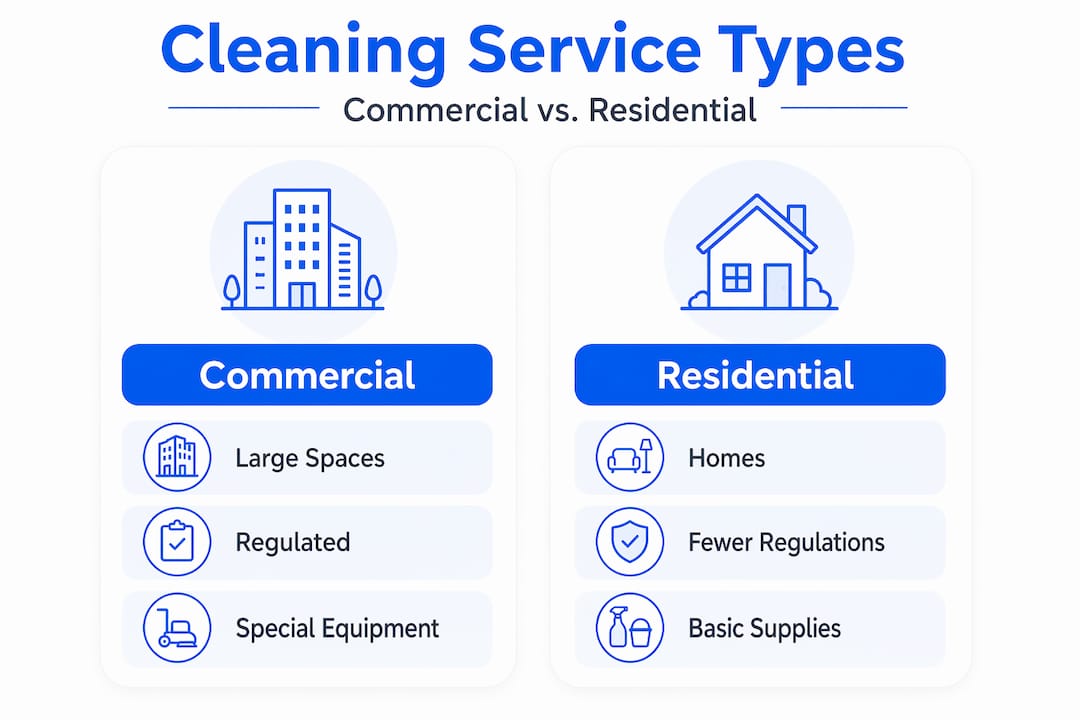
The difference between residential and commercial cleaning comes down to three factors: scale, complexity, and regulation. Residential cleaning addresses a single household with predictable messes. Commercial cleaning addresses dozens or hundreds of occupants, specialized surfaces like industrial flooring, biohazard risks in medical settings, and compliance obligations from bodies like OSHA and the CDC. Commercial contracts also involve service-level agreements, scheduled audits, and documentation requirements that simply do not exist in home cleaning.
What commercial cleaning typically includes
Commercial cleaning covers routine janitorial tasks, floor care, specialty services, and infection control. These are not four separate things you pick from a menu. A well-designed program layers all of them based on building type and occupancy patterns.
Routine janitorial tasks
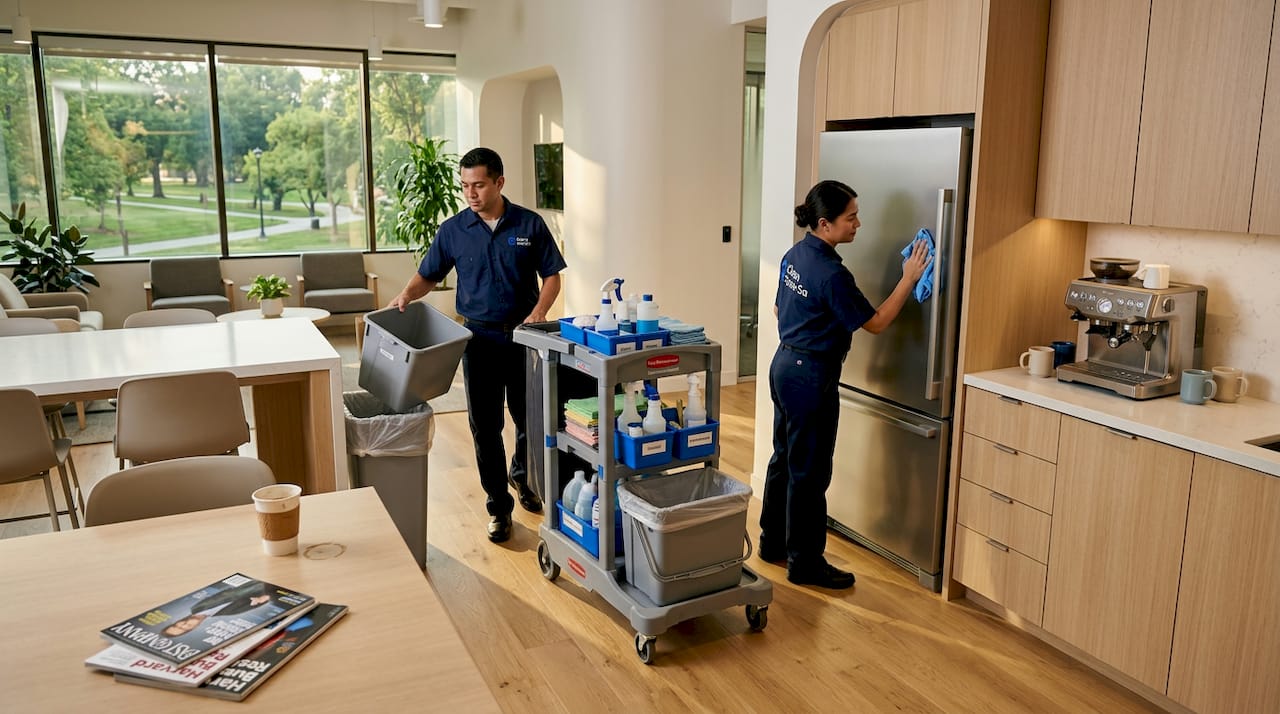
This is the daily and weekly work that keeps a space functional. It includes dusting workstations and surfaces, emptying trash and recycling, restroom cleaning and restocking, vacuuming carpets, mopping hard floors, and wiping down break rooms and reception areas. These tasks follow written checklists tied to specific zones and frequencies.
Floor care
Floor maintenance goes beyond a quick mop. Commercial floor care includes carpet extraction cleaning, hard floor scrubbing, waxing, buffing, and stripping old finish from vinyl or tile. High-traffic lobbies may need floor work weekly. Carpeted conference rooms might only need deep extraction quarterly.
Specialty services
This category includes window washing, post-construction cleanup, power washing exterior surfaces, and in some cases hazardous waste handling. Property managers often schedule specialty work seasonally or after renovation projects.
Infection control and disinfection
This is where commercial cleaning diverges sharply from residential work. High-touch surfaces like door handles, elevator buttons, keyboards, and light switches require disinfectants that stay visibly wet for the labeled contact time, typically one to ten minutes. Skipping that dwell time is the most common reason disinfection fails in commercial settings.
| Service type | Frequency | Example environments |
|---|---|---|
| Routine janitorial | Daily or weekly | Offices, schools, retail |
| Floor care | Weekly to quarterly | Hospitals, warehouses, lobbies |
| Specialty cleaning | Seasonal or as needed | Post-construction, exterior facades |
| Disinfection protocols | Daily or event-driven | Medical clinics, food service, gyms |
Pro Tip: Request a copy of the cleaning checklist and disinfectant product labels before signing any commercial cleaning contract. If dwell times are not written into the scope of work, disinfection is unlikely to be effective in practice.
Health, safety, and regulatory considerations
Commercial cleaning is not just about appearance. It is an operational hygiene program with legal obligations attached.
OSHA’s Hazard Communication Standard requires that all chemical containers in a workplace carry proper labels, that Safety Data Sheets (SDS) are accessible at all times, and that workers receive training on chemical hazards. In commercial cleaning, the chemicals involved include detergents, disinfectants, solvents, degreasers, and sometimes biohazard agents. Every one of those substances carries exposure risks if handled incorrectly.
Reputable commercial cleaning providers build OSHA compliance into their training programs from day one. That means workers know what each chemical does, what protective equipment to use, and what to do if something goes wrong. Employers are also required to maintain a written hazard communication plan covering all chemicals on site.
“Infection prevention and control” is not a hospital-only concept. Any space with shared occupancy, from a coworking office to a gym, carries cross-contamination risk that only structured cleaning protocols can address consistently.
Beyond chemical handling, the infection prevention and control side of commercial cleaning has become a defining priority for facility managers. The data backs this up: roughly half of facility management professionals now identify IPC as the central focus of their cleaning programs, outranking cost reduction.
Pro Tip: Ask any prospective commercial cleaning provider whether their team is trained on SDS access and chemical dwell times. If they cannot explain either, their safety program likely has gaps.
Water damage scenarios add another layer. When a commercial space floods, cleaning and disinfection requirements intensify significantly. Understanding the commercial water damage cleanup process helps property managers set the right expectations for their cleaning vendor before a crisis happens.
How commercial cleaning services work
Understanding how a commercial cleaning provider actually operates helps you evaluate proposals and manage service quality once a contract is signed.
-
Assessment and scoping. The provider visits the facility, measures square footage, identifies surface types and high-risk zones, and maps cleaning frequencies to occupancy patterns. This is where they calculate labor hours and staffing needs.
-
Scheduling and staffing. Providers use time-and-workload tools like the ISSA Cleaning Times guide to match task lists to realistic labor estimates. Understaffing a cleaning program is the most common cause of service failure.
-
Access and logistics. Commercial properties require careful planning around key handling, security protocols, and after-hours access. A structured cleaner access process protects both the client and the provider.
-
Service delivery. Teams work from zone-specific checklists and follow documented protocols for each task. Supervisors or quality-control apps often track task completion in real time.
-
Technology integration. AI and IoT tools are increasingly part of commercial cleaning operations. Digital feedback systems give supervisors real-time data on which areas need attention, improving cleaning ROI without adding staff.
-
Review and contract management. Most commercial cleaning contracts include service-level checkpoints, complaint response windows, and options for scope adjustments. Knowing how to negotiate contract terms before you sign protects you if service quality slips.
When selecting a provider, verify their insurance and bonding, check whether their staff are background-screened, confirm their chemical handling training, and ask for client references from buildings similar to yours. Low price is a reliable predictor of understaffed, undertrained crews. The office cleaning schedule you agree to is only as good as the crew delivering it.
Benefits of hiring a commercial cleaning service
The case for professional commercial cleaning goes well beyond a tidy reception area.
- Reduced illness and absenteeism. Consistent disinfection of high-touch surfaces cuts pathogen transmission across shared workspaces, which means fewer sick days.
- Regulatory compliance. Businesses in food service, healthcare, and childcare face legal cleaning requirements. A professional provider documents compliance, which matters during inspections.
- Asset protection. Proper floor care, surface maintenance, and HVAC filter cleaning extend the life of expensive building materials and equipment.
- Occupant satisfaction. Clean facilities contribute directly to employee well-being and visitor impressions. A dirty office signals neglect regardless of what else the business does well.
- Reduced liability. Documented cleaning programs reduce slip-and-fall risks and demonstrate due diligence if an incident occurs.
- Operational focus. When facility hygiene is managed professionally, your team can stay focused on the work they were hired to do.
A commercial cleaning service checklist helps businesses in San Antonio and across Texas track whether their provider is actually delivering on all of these fronts.
My take on what most businesses get wrong
I have seen businesses treat commercial cleaning as an afterthought. They hire the cheapest provider, skip reviewing the scope of work, and then wonder why restrooms are inconsistent or the carpets look bad three months in.
What I have learned is that commercial cleaning is an operational investment, not a commodity purchase. The difference between a mediocre crew and a trained one shows up in the details: whether disinfectant actually dwells long enough to work, whether floor finish is stripped before new coats are applied, whether the team logs what was completed and flags what was missed.
The technology angle is also underappreciated. Digital reporting tools and IoT sensors do not replace cleaners. They make cleaning programs accountable in ways that a handshake agreement and a monthly walk-through never can.
My honest take: the businesses that get the most value from commercial cleaning are the ones that treat it like any other vendor relationship. They set clear expectations, review performance data, and renegotiate scope when usage patterns change. That approach gets you cleaner facilities, documented compliance, and a team that actually takes ownership of their work.
— Jean
Clean Space SA keeps San Antonio businesses spotless
Clean Space SA works with offices, commercial properties, and specialty spaces across San Antonio, including Leon Valley, Helotes, and Alamo Ranch. The team is background-checked, trained on safety and compliance protocols, and equipped for everything from daily janitorial work to post-construction cleanup. If you are ready to understand exactly what types of cleaning your facility needs, explore commercial office cleaning options or go straight to office cleaning services to see what a tailored program looks like for your space. Clean Space SA makes professional cleaning straightforward, documented, and consistently delivered.
FAQ
What is a commercial cleaning service?
A commercial cleaning service is a professional, contract-based cleaning program for businesses and institutions. It covers routine janitorial tasks, floor care, specialty services, and infection-control disinfection tailored to the specific building type and occupancy level.
What does commercial cleaning include?
Commercial cleaning services include dusting, trash removal, restroom sanitation, carpet and floor care, window washing, post-construction cleanup, and structured disinfection of high-touch surfaces. The exact scope depends on the facility type and contract terms.
How is commercial cleaning different from residential cleaning?
Commercial cleaning addresses larger spaces, higher foot traffic, regulatory compliance requirements, and specialized surfaces that residential cleaning does not. Commercial contracts also include service documentation, OSHA-compliant chemical handling, and scheduled performance reviews.
Why should a business hire a commercial cleaning service?
Professional commercial cleaning reduces illness-related absenteeism, protects facility assets, supports regulatory compliance, and improves occupant satisfaction. Documented cleaning programs also reduce liability exposure in the event of incidents on the property.
How do disinfection protocols work in commercial cleaning?
Disinfection requires applying a product to a surface and allowing it to remain wet for the labeled dwell time, typically one to ten minutes. Wiping the surface too soon kills fewer pathogens and is the most common failure point in commercial disinfection programs.
Recommended
- Types of Commercial Office Cleaning Services Explained
- How commercial cleaning differs from residential: San Antonio guide
Jean runs growth strategy at AimSetWin, a performance marketing agency specializing in local service businesses across Texas. he's helped plumbers, HVAC companies, pest control operators, and home service brands build predictable revenue systems using data-driven advertising and conversion optimization.


