

Discover what a warehouse cleaning service really entails. Learn how professional cleaning enhances safety, compliance, and efficiency today!
Warehouse managers often assume they already know what a warehouse cleaning service covers. Broom, mop, done. But that assumption costs money, risks lives, and fails audits. A professional warehouse cleaning service is a specialized discipline that goes far beyond basic janitorial work. It includes industrial floor care, overhead dust removal, machinery degreasing, compliance-aligned safety protocols, and customized schedules built around your specific operations. This guide breaks down exactly what these services involve, how warehouse cleaning works, and why the difference between basic cleaning and professional warehouse cleanup matters more than most managers realize.
Table of Contents
- Key Takeaways
- What warehouse cleaning service actually includes
- Building a cleaning schedule that fits your operation
- Benefits of warehouse cleaning for safety and efficiency
- How warehouse cleaning differs from general janitorial services
- My take on choosing the right warehouse cleaning partner
- How Clean Space SA supports your facility’s cleaning needs
- FAQ
Key Takeaways
| Point | Details |
|---|---|
| Not basic janitorial work | Warehouse cleaning involves industrial-grade methods that general office cleaners are not trained or equipped to handle. |
| Frequency must be customized | High-traffic zones need daily or weekly attention, while overhead areas require quarterly deep cleans. |
| Compliance is built in | Professional crews follow OSHA-aligned procedures including PPE use, hazard communication, and dust mitigation. |
| Safety impact is measurable | Regular cleaning directly reduces slip, trip, and fall hazards while protecting air quality and machinery. |
| Cost tracks to scope | The cost of warehouse cleaning services depends on square footage, frequency, and the specific tasks required. |
What warehouse cleaning service actually includes
Most people picture a push broom and a mop bucket. The reality involves walk-behind scrubbers, industrial degreasers, scissor lifts for overhead work, and specialized floor coatings. Understanding how warehouse cleaning works means looking at each layer of the facility, not just what is at eye level.
Floor care: the foundation of a clean warehouse
Warehouse floors take an enormous beating. Forklifts, pallet jacks, heavy foot traffic, spills, and constant abrasion all degrade floor surfaces. Warehouse floor cleaning involves sweeping, scrubbing, degreasing, and polishing for concrete, epoxy, and other hard industrial surfaces. Each material requires a different approach. Concrete needs a scrubber with the right chemical solution to lift embedded grease without damaging the surface. Epoxy floors require non-abrasive products that protect the coating.
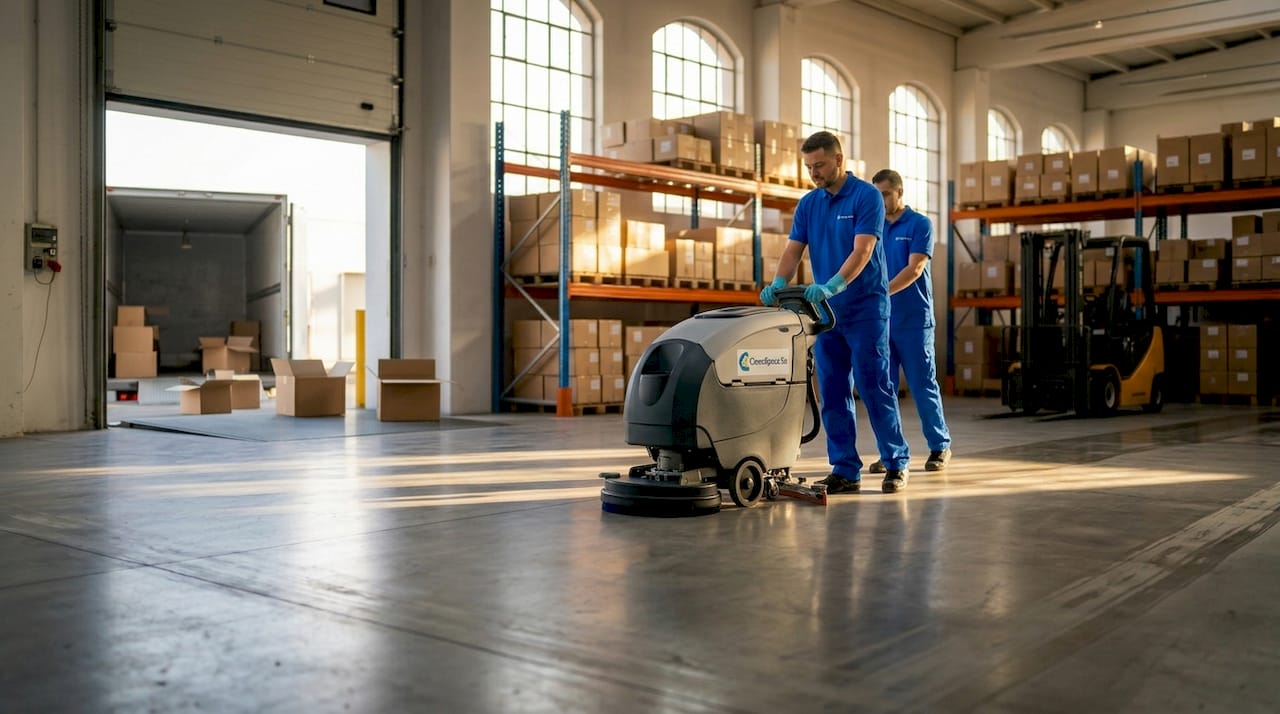
Degreasing is often the most overlooked step. Loading docks, maintenance bays, and areas near machinery accumulate grease that a standard mop will simply spread rather than remove. Professional warehouse cleanup uses industrial-strength degreasers applied with the right dwell time to break down buildup completely.
High dusting and overhead cleaning
Walk into most warehouses and look up. Rafters, pipes, ductwork, overhead racking, light fixtures, and sprinkler systems are magnets for dust accumulation. Dust buildup affects air quality and employee health in ways you cannot see from ground level.
Removing this buildup requires elevated equipment, the right brushes and vacuums with HEPA filtration, and trained crews who can work safely at height. A general janitor is not going to climb a scissor lift to clean the rafters. That is a specialized task that warehouse cleaning companies are specifically prepared for.
Machinery and equipment cleaning
Production equipment, conveyor systems, and forklifts all accumulate grease, dust, and debris. Left unaddressed, this buildup damages mechanical components and creates fire and slip hazards. Professional warehouse cleanup includes degreasing and wiping down machinery surfaces in ways that do not interfere with operational parts.
Pro Tip: Always confirm with your cleaning provider that their staff understands lockout/tagout procedures before any machinery cleaning begins. This is a non-negotiable safety requirement.
Safety protocols during cleaning
Warehouse cleaning companies use PPE, hazard communication, spill response, and dust mitigation to meet safety standards. Training includes confined space awareness and combustible dust protocols, which are specific to industrial environments. This is not something a residential or basic commercial cleaner brings to the job.
Building a cleaning schedule that fits your operation
No two warehouses have identical needs. A food distribution facility has completely different cleaning requirements than an automotive parts warehouse. Getting the schedule right is where professional warehouse maintenance services separate themselves from generic providers.
A well-structured cleaning program typically works in three tiers:
-
Daily upkeep covers high-traffic areas like loading docks, break rooms, restrooms, and primary aisles. These spaces see constant use and accumulate debris fast. Spill response, sweeping, and basic floor maintenance fall here.
-
Weekly cleaning addresses secondary zones including rack aisles, equipment areas, and less-traveled floor sections. This is also when floor scrubbing runs on a more thorough pass across the main floor.
-
Quarterly deep cleans target overhead structures, high-bay racking, ductwork, and any accumulated grime that daily and weekly efforts do not reach. Quarterly deep cleaning specifically handles overhead dust removal, which has the biggest impact on air quality and fire risk.
Custom cleaning schedules depend on building size, traffic, and specific industry requirements, which is why no responsible provider should quote a plan without first walking your facility. A provider who gives you a canned schedule without asking questions is a provider who does not understand warehouse environments.
The value of tailored cleaning programs goes beyond cleanliness. Aligning tasks and frequencies to your warehouse layout and workflow protects operations rather than interrupting them. Cleaners working during shift changes or during peak fulfillment periods create safety hazards and slow output. A good provider builds the schedule around your operation, not theirs.
Good warehouse organization practices also inform cleaning frequency. If you are working to organize your warehouse with better product flow and aisle management, your cleaning provider can adjust their plan to reflect the new layout immediately.
Benefits of warehouse cleaning for safety and efficiency
The business case for professional warehouse cleaning services is not just about appearance. It comes down to risk reduction, compliance, and protecting your most expensive assets.
-
Slip, trip, and fall reduction. Professional warehouse cleaning reduces accident risk by managing dust, debris, and spills across all floor surfaces. Slip-and-fall injuries are among the most common warehouse accidents, and most are preventable with consistent floor care.
-
Worker health protection. Facilities that skip deep cleaning accumulate hazardous dust and grime that increases respiratory risk and machinery damage. Clean air in a warehouse is not optional when staff are spending 8 to 10 hours a day breathing it.
-
Machinery and inventory protection. Dust and grease that build up on equipment accelerate wear. Inventory stored in dusty environments can be contaminated or damaged, particularly in food, pharmaceutical, or electronics sectors. Regular cleaning extends equipment life and protects product quality.
-
OSHA and regulatory compliance. Cleaning is not just a housekeeping issue in industrial facilities. It is a regulatory one. OSHA standards cover aisle clearance, spill management, and air quality. Professional warehouse cleaning companies structure their work to keep you within those requirements.
-
Employee morale and client confidence. A clean facility signals to employees that their safety matters. It signals to clients and auditors that your operation is professional. That perception has real business value.
How warehouse cleaning differs from general janitorial services
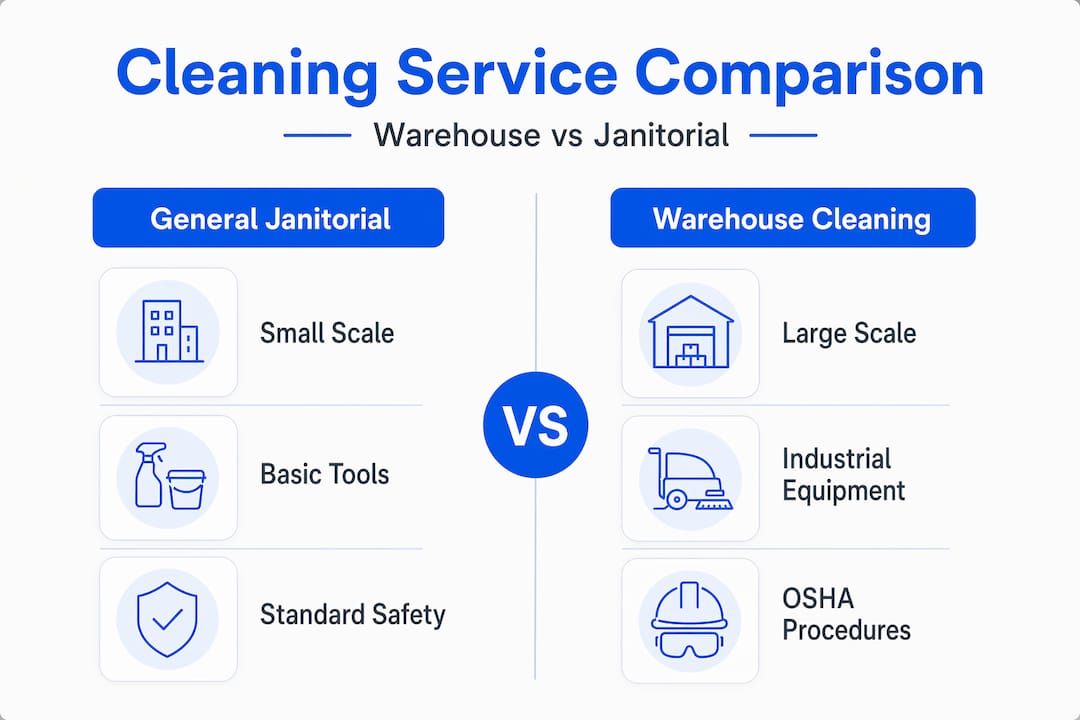
This distinction matters more than most managers initially realize. Hiring a standard janitorial company for a warehouse is like calling a residential plumber to fix an industrial boiler. The category sounds right, but the scope is completely wrong.
| Factor | General janitorial | Warehouse cleaning service |
|---|---|---|
| Scale | Office or retail sized spaces | 10,000 to 500,000+ sq ft industrial facilities |
| Equipment | Mops, vacuums, basic scrubbers | Ride-on scrubbers, scissor lifts, industrial degreasers |
| Chemical knowledge | General cleaning products | Industrial-grade chemicals with correct dwell times |
| Safety training | Basic safety awareness | OSHA-aligned: PPE, combustible dust, confined space protocols |
| Compliance tasks | Minimal | Spill documentation, hazard communication, audit readiness |
| Overhead work | Rarely performed | Routine part of service scope |
Commercial warehouse cleaning requires trained crews using OSHA-aligned procedures and specialized equipment that general janitorial providers simply do not carry. When you are comparing providers, ask specifically about their experience in industrial environments, the equipment they bring on-site, and whether their staff holds relevant safety certifications. These are the questions that reveal whether you are talking to the right type of company.
For a deeper look at how commercial cleaning compares to residential work in terms of scope and specialization, the contrast helps clarify what industrial facilities actually require from their cleaning partners.
My take on choosing the right warehouse cleaning partner
I have seen warehouse managers make the same mistake repeatedly. They choose a provider based on price alone, sign a short-term contract, and then spend months managing a relationship that creates more friction than it removes. The cleaning crew does not understand the facility layout. They schedule work during peak shipping hours. They use the wrong chemicals near sensitive inventory. The result is that cleaning becomes a source of operational problems rather than a solution.
What I have learned is that the best warehouse cleaning relationships look more like partnerships than vendor contracts. The provider should walk your facility before quoting. They should know which zones are off-limits during certain hours, which machinery cannot be cleaned with water-based products, and what your compliance reporting requirements are. That level of operational alignment does not happen on a low-bid contract.
I also think managers underestimate the value of consistent crews. When the same people show up every week, they know your space. They notice when something changes. They catch a new oil leak before it becomes a floor hazard. That institutional knowledge is worth far more than saving a few dollars by rotating through whoever is available.
My honest advice: treat the provider selection process the same way you would hire a safety contractor. Verify their certifications, ask for warehouse-specific references, and look for someone who asks you questions before quoting. If a provider does not ask about your operation, they are not thinking about your operation.
— Jean
How Clean Space SA supports your facility’s cleaning needs
If you manage a commercial space in the San Antonio area and need a cleaning partner who actually understands the scope of what professional facility cleaning requires, Clean Space SA is worth the conversation. The team brings the same disciplined approach to commercial environments that has made them a trusted name in the Leon Valley, Helotes, and Alamo Ranch communities. Clean Space SA builds customized cleaning plans around your facility’s layout, workflow, and scheduling constraints, not around a standard package that may not fit. Whether you need recurring maintenance services or a thorough one-time professional cleanup, the team is background-checked, trained to commercial standards, and focused on consistency. Explore commercial cleaning services or reach out directly to discuss a plan that fits your facility’s specific demands.
FAQ
What is a warehouse cleaning service?
A warehouse cleaning service is a professional industrial cleaning program that includes floor scrubbing, high dusting, machinery degreasing, spill management, and compliance-driven safety protocols. It is designed for large-scale industrial facilities and goes well beyond what general janitorial companies offer.
How often should a warehouse be professionally cleaned?
Cleaning frequency depends on your industry and traffic levels, but a standard approach covers daily or weekly attention to high-traffic zones and quarterly deep cleans for overhead structures and racking areas.
What does professional warehouse cleaning cost?
The cost of warehouse cleaning services varies based on square footage, the specific tasks required, and how often service is performed. Facilities with specialized needs like food handling or pharmaceutical storage typically require more frequent and thorough cleaning, which increases the investment.
How is warehouse cleaning different from regular commercial cleaning?
Warehouse cleaning requires industrial-grade equipment, OSHA-aligned safety training, and experience with hazards like combustible dust and chemical spills. Regular commercial cleaning is designed for office-scale spaces and does not include these capabilities.
What are the biggest safety benefits of regular warehouse cleaning?
Consistent professional cleaning reduces slip and fall risk, improves indoor air quality, protects machinery from grease and dust damage, and keeps your facility within OSHA compliance requirements. These are not cosmetic benefits. They directly affect worker safety and operational continuity.
Recommended
- What Is Deep Clean for Office Spaces: A Manager’s Guide
- Office cleaning OLD – Clean Space Sa | commercial cleaning | San Antonio, TX, USA
- Types of Commercial Office Cleaning Services Explained
- Commercial cleaning service checklist for San Antonio
Jean runs growth strategy at AimSetWin, a performance marketing agency specializing in local service businesses across Texas. he's helped plumbers, HVAC companies, pest control operators, and home service brands build predictable revenue systems using data-driven advertising and conversion optimization.


