

Discover what deep clean for office spaces entails and its crucial benefits for employee health and productivity. Explore our essential guide!
Your office might look clean. It probably isn’t. The average desk harbors bacteria levels that most facility managers would find alarming, and standard janitorial routines barely scratch the surface. So what is deep clean for office spaces, exactly, and why does it matter more than the daily tidying your team already does? This guide breaks down what deep cleaning actually involves, what the research says about its impact on employee health and productivity, and how to build a practical program that works for your specific workspace.
Table of Contents
- Key Takeaways
- What deep cleaning for office spaces actually means
- Why deep cleaning directly affects health and productivity
- Deep cleaning checklist and frequency guide for offices
- DIY deep cleaning vs. professional office cleaning services
- How to build a deep cleaning program for your office
- My take on what most offices get wrong
- Get your office genuinely clean with Cleanspacesa
- FAQ
Key Takeaways
| Point | Details |
|---|---|
| Deep clean goes beyond routine cleaning | It targets hidden germs, allergens, and buildup that daily or weekly cleaning never reaches. |
| Office surfaces carry extreme contamination | Some office equipment is 400 times dirtier than a toilet seat, making thorough disinfection critical. |
| Health and productivity benefits are measurable | Cleaner offices see a 12.5% drop in sick days, directly protecting your bottom line. |
| Professional services offer real advantages | Trained cleaners use EPA-registered disinfectants and specialized tools that DIY efforts cannot match. |
| Scheduling and frequency matter | High-touch areas need attention monthly; carpets, vents, and floors benefit from quarterly or bi-annual deep cleans. |
What deep cleaning for office spaces actually means
Deep cleaning is not a more thorough version of your regular cleaning schedule. It’s a fundamentally different category of cleaning. Where routine cleaning handles visible surfaces, emptied trash cans, and vacuumed floors, a deep clean targets the layers of contamination that accumulate behind, beneath, and inside the things your daily crew never touches.
Routine cleaning only removes visible dirt and dust. Deep cleaning goes after viruses, allergens, mold spores, and bacteria that build up over time on surfaces that look perfectly fine to the naked eye. That includes the grout between bathroom tiles, the upholstery fibers on conference room chairs, the interior of air vents, and the underside of desks where dust and debris collect undisturbed for months.
Deep cleaning tasks in an office context typically include:
- Disinfecting all high-touch surfaces with EPA-registered products: door handles, light switches, elevator buttons, shared equipment
- Carpet steam cleaning to remove embedded dirt, allergens, and stains
- Floor stripping, waxing, and polishing for hard surface floors
- Air vent and duct cleaning to reduce airborne contaminants circulating through your HVAC system
- Upholstery cleaning for chairs, couches, and cubicle panels
- Deep restroom sanitation including grout scrubbing and fixture descaling
- Kitchen and break room disinfection including appliance interiors and sink drains
- Window cleaning inside and out, including sills and frames
- Baseboard and ceiling corner cleaning to remove accumulated dust
Professional providers also bring commercial-grade equipment that makes a meaningful difference. Industrial steam cleaners, HEPA-filtered vacuums, and electrostatic sprayers distribute disinfectants in ways a spray bottle and microfiber cloth simply cannot replicate.
Pro Tip: Ask your cleaning provider specifically which EPA-registered disinfectants they use and whether those products are effective against the pathogens most relevant to your office environment, including respiratory viruses and common bacteria.
Why deep cleaning directly affects health and productivity
The connection between office cleanliness and employee performance is not theoretical. The numbers behind it are concrete and worth understanding before you make any budget decisions.
Americans spend roughly 90% of their time indoors, and indoor air pollution levels run two to five times higher than outdoor air, and in some cases up to 100 times higher. Office environments concentrate that risk significantly because of shared HVAC systems, high occupancy, and surfaces that rarely get sanitized properly. When your ventilation system circulates air through clogged ducts lined with dust and microbial buildup, every person in the office breathes that in all day.
“Deep cleaning is a vital health intervention, not just a cosmetic improvement. The incredibly high levels of germs found on office equipment compared to common assumptions make thorough, periodic disinfection a workplace safety issue.” — Office Cleaning Research
The productivity argument is just as strong. Cleaner offices see a 12.5% reduction in sick days. For a team of 20 people, that’s a meaningful recovery of working hours every single year. Fewer absences mean fewer project delays, less strain on colleagues covering for sick teammates, and lower costs associated with temporary coverage or missed deadlines.
There are also less obvious benefits worth factoring in. Deep cleaning extends asset lifespan by preventing the material degradation that dirt and grime cause to carpets, upholstery, and office equipment over time. A carpet that gets steam-cleaned regularly lasts years longer than one that doesn’t. Office chairs with maintained upholstery hold their structure and appearance far longer.
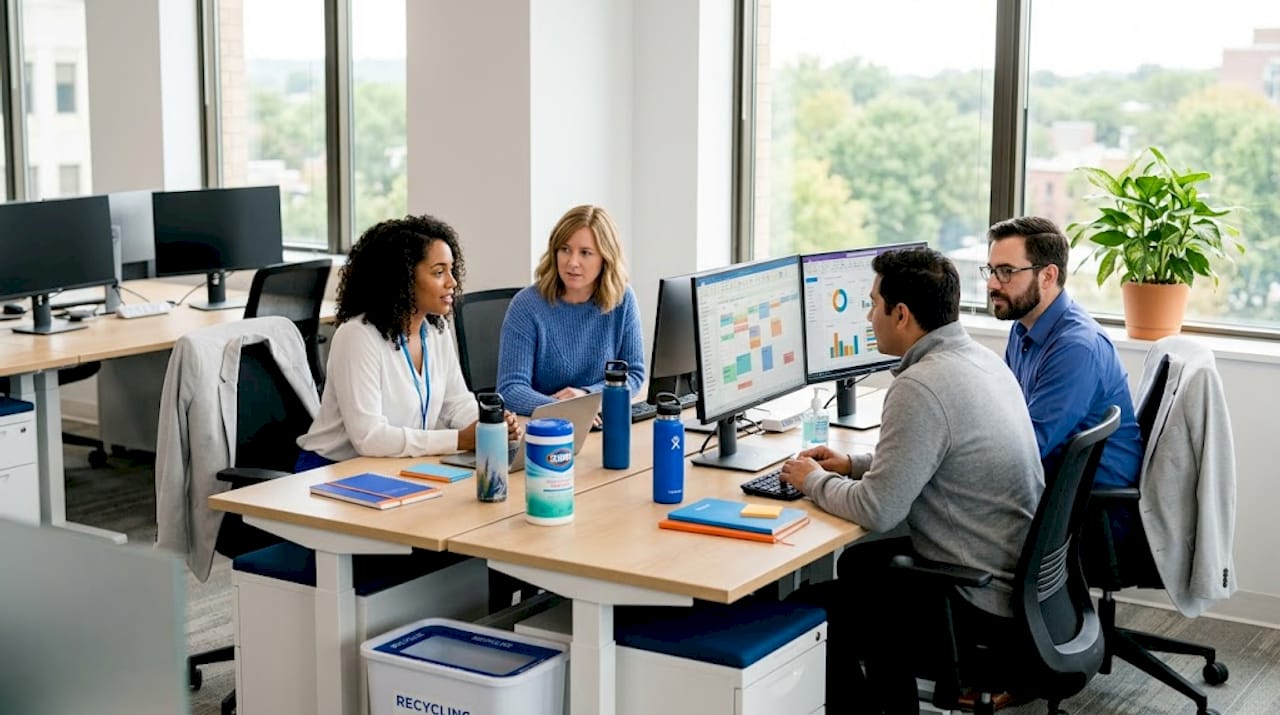
Safety is another dimension that gets overlooked. Sanitized floors and cleaned carpets reduce slip and fall risks, a real liability concern for any business owner managing a physical workspace. Clean floors mean better traction, clearer walkways, and fewer workplace incidents.
Then there’s the morale factor. Employees notice when their workspace is genuinely clean. It signals that leadership takes the work environment seriously, and that translates into engagement, focus, and a stronger sense of pride in the workplace itself.
Deep cleaning checklist and frequency guide for offices
Knowing what deep cleaning involves is one thing. Knowing when to schedule each task is where most facility managers struggle. The right frequency depends on traffic levels, the nature of work happening in each area, and your overall occupancy.
Here’s a practical breakdown organized by area and recommended cadence:
-
Weekly or bi-weekly: Disinfect all high-touch surfaces including desks, keyboards, phones, mice, door handles, light switches, and shared equipment. These areas accumulate germs fastest due to constant contact.
-
Monthly: Deep clean restrooms beyond the standard daily wipe-down. This means descaling fixtures, scrubbing grout, sanitizing drain areas, and addressing any odor sources. Also address the kitchen or break room at this frequency, including the inside of microwaves, refrigerator shelves, and sink drains.
-
Quarterly: Steam-clean carpets and upholstered furniture. Schedule professional floor stripping and waxing for hard floors, particularly in high-traffic corridors and lobbies. Clean air vents and replace or inspect HVAC filters.
-
Bi-annually: Full air duct cleaning, interior and exterior window cleaning, baseboard and ceiling detail cleaning, and a complete review of all storage areas and less-trafficked zones.
-
Annually or as needed: Tile and grout restoration, odor treatment programs, and any deep cleaning of server rooms or specialized equipment areas.
The following table gives you a quick reference for comparing regular cleaning tasks against deep cleaning tasks by scope:
| Task | Regular cleaning | Deep cleaning |
|---|---|---|
| Floor care | Vacuuming and mopping | Stripping, waxing, steam cleaning |
| Surfaces | Wiping visible areas | Disinfecting all contact points including undersides |
| Restrooms | Daily wipe-down | Grout scrubbing, descaling, drain sanitation |
| Air quality | None addressed | Vent and duct cleaning, filter replacement |
| Upholstery | None | Steam cleaning, stain removal |
Pro Tip: Schedule deep cleaning outside business hours, whether evenings or weekends, to avoid disrupting your team and to allow treated surfaces adequate drying and off-gassing time before occupancy.
DIY deep cleaning vs. professional office cleaning services
Many businesses attempt to handle deep cleaning in-house, either by assigning it to existing staff or by hiring a general cleaning crew without specialized deep-cleaning training. This approach has real limitations.
The core problem is scope and equipment. General staff rarely have access to commercial-grade steam cleaners, electrostatic sprayers, or HEPA-filter vacuum systems. More critically, most commercial disinfectants require specific dwell times and application methods to actually kill pathogens. Applying a disinfectant spray and wiping it off immediately does not achieve effective sanitization, but that is the most common approach in DIY cleaning scenarios.
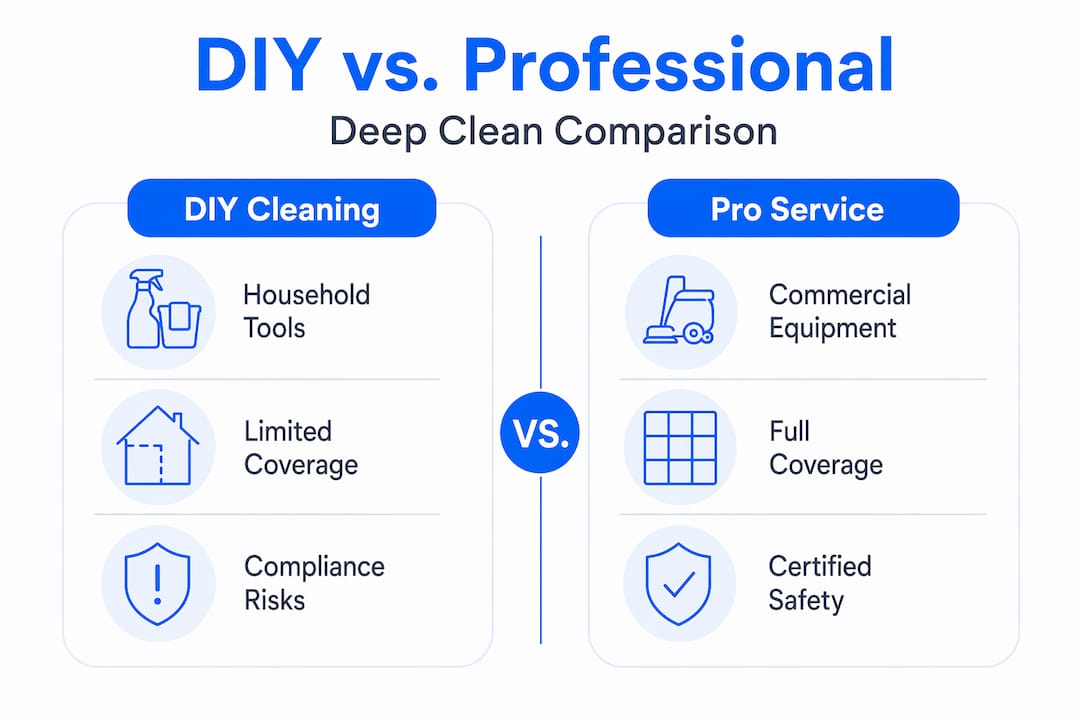
Here is a direct comparison of the two approaches:
| Factor | DIY cleaning | Professional service |
|---|---|---|
| Equipment quality | Consumer-grade tools | Industrial, specialized equipment |
| Disinfectant access | Limited retail options | EPA-registered commercial products |
| Training | Minimal or none | Certified, protocol-trained staff |
| Compliance | Inconsistent | Meets health and safety standards |
| Cost model | Lower upfront, higher long-term | Higher upfront, stronger ROI |
| Coverage depth | Surface-level | Full-scope including hidden areas |
Professional office deep cleaning services address compliance concerns that DIY approaches simply cannot. This matters particularly in regulated industries or workplaces where health and safety audits are a real possibility.
The ROI case for professional services is also stronger than it looks on paper. Factor in the cost of employee sick days, the replacement cost of prematurely worn carpets and equipment, and the liability exposure from workplace accidents tied to poorly maintained floors. Against those numbers, professional deep cleaning becomes a straightforward financial decision.
How to build a deep cleaning program for your office
Getting a deep cleaning program in place does not require a complex overhaul. It requires a clear assessment, the right partner, and a schedule that fits your operations.
-
Audit your office for risk areas. Walk through your space and identify zones with the highest foot traffic, shared equipment, and areas that are rarely cleaned thoroughly. Restrooms, break rooms, reception areas, and open-plan desks consistently rank as highest-risk.
-
Define your cleaning scope. Separate your recurring daily or weekly cleaning needs from your periodic deep cleaning requirements. These often need different providers or at minimum different protocols and equipment.
-
Select a reputable commercial cleaning provider. Ask about their specific training, the disinfectants they use, their insurance coverage, and whether staff undergo background checks. A provider that cannot answer these questions clearly is not ready to manage your facility.
-
Set and communicate your cleaning schedule. Share the schedule with your team so they know when common areas will be inaccessible. Transparency reduces friction and actually increases employee confidence in the program.
-
Support employee hygiene between deep cleans. Provide desk-safe disinfectant wipes, keyboard cleaning kits, and hand sanitizer stations at key entry points. This fills the gap between professional visits and dramatically reduces surface contamination accumulation.
-
Review and adjust quarterly. Track sick day frequency, employee feedback, and visual inspection results. Adjust frequency or scope based on what the data shows.
My take on what most offices get wrong
I’ve seen a lot of offices that consider themselves “clean.” The floors are swept, the trash is emptied, the bathrooms get a daily wipe-down. And from a distance, everything looks fine.
What I’ve found is that business owners often conflate tidy with clean. These are genuinely different conditions, and conflating them creates a false sense of security about the health environment their team works in every day. The contamination that causes illness and affects air quality is invisible. It lives in the HVAC system, in the carpet fibers, on the keyboard keys that 10 people have touched today.
In my experience, the offices that invest in professional deep cleaning on a real schedule see a noticeable shift within the first quarter. Employees comment on how the space feels different. Sick day frequency drops. The physical environment stops being background noise and starts becoming something people are actually proud of.
The most common pitfall I see is scheduling deep cleaning too infrequently and then treating it as a one-off event when something goes wrong, like a norovirus outbreak or a health inspection. Deep cleaning works best as a preventive system, not a reactive one. Build the schedule before you need it, and stick to it with the same discipline you’d apply to any other operational priority.
— Jean
Get your office genuinely clean with Cleanspacesa
If this article has made you reconsider what “clean” means for your workspace, the next step is straightforward.
Cleanspacesa provides professional commercial office cleaning for businesses across San Antonio, including Leon Valley, Helotes, and Alamo Ranch. Their team is background-checked, trained to commercial hygiene standards, and equipped with the tools and EPA-registered disinfectants that actually make a difference. Beyond standard deep cleaning, Cleanspacesa also handles specialized floor care services including stripping, waxing, and polishing, plus window washing for complete facility coverage. Request a quote and get a cleaning plan built around your office’s actual needs.
FAQ
What is deep cleaning in an office?
Deep cleaning in an office goes beyond routine surface cleaning by targeting hidden germs, allergens, mold spores, and bacteria in areas like air vents, upholstery, carpets, and deep restroom surfaces using professional-grade equipment and EPA-registered disinfectants.
How often should an office be deep cleaned?
High-touch surfaces should be disinfected weekly, restrooms and kitchens deep-cleaned monthly, carpets and floors quarterly, and air ducts with full detail cleaning at least bi-annually, though high-traffic offices may need more frequent schedules.
What is the difference between regular and deep cleaning?
Regular cleaning handles visible dirt, dust, and surface tidying. Deep cleaning addresses embedded contamination, structural surfaces, HVAC systems, and areas that standard janitorial work never reaches.
Can deep cleaning reduce employee sick days?
Yes. Research shows offices that maintain clean environments see a 12.5% reduction in sick days, making professional deep cleaning a direct investment in workforce productivity.
Should I hire professionals or deep clean in-house?
Professional services are strongly preferable for deep cleaning due to their industrial equipment, certified training, and access to commercial-grade disinfectants. DIY deep cleaning typically misses key areas and cannot achieve the same level of pathogen reduction.
Recommended
- Office cleaning OLD – Clean Space Sa | commercial cleaning | San Antonio, TX, USA
- Office Cleaning – Clean Space Sa | commercial cleaning | San Antonio, TX, USA
- Post-Construction Clean – Clean Space Sa | commercial cleaning | San Antonio, TX, USA
- Clean Space Sa | commercial cleaning | San Antonio, TX, USA
Jean runs growth strategy at AimSetWin, a performance marketing agency specializing in local service businesses across Texas. he's helped plumbers, HVAC companies, pest control operators, and home service brands build predictable revenue systems using data-driven advertising and conversion optimization.


