

Discover why offices need professional cleaning to boost health and productivity. Learn how genuine hygiene management benefits your team!
Most office managers assume a tidy-looking space is a safe one. It isn’t. The gap between looking clean and being clean is where sick days accumulate, productivity slips, and workplace health risks hide in plain sight. Understanding why offices need professional cleaning goes well beyond aesthetics. It’s about controlling what you cannot see, protecting the people who show up every day, and making a measurable investment in your business’s output. This guide breaks down the evidence, the risks, and the practical steps that separate surface-level tidying from genuine commercial hygiene management.
Table of Contents
- Key Takeaways
- Why professional cleaning matters for office health
- How cleanliness shapes productivity and satisfaction
- Cleaning and air quality: why you need both
- Practical steps for hiring professional office cleaners
- My take on what offices consistently get wrong
- Clean Space SA can make this straightforward
- FAQ
Key Takeaways
| Point | Details |
|---|---|
| Health risk reduction | Professional cleaning targets pathogens on high-touch surfaces, directly lowering sick day rates across your team. |
| Productivity connection | Cleanliness affects cognitive focus and employee satisfaction in ways that translate to measurable work output. |
| Air quality partnership | Surface cleaning and air quality management work together; filtration alone cannot compensate for dirty surfaces. |
| Risk-targeted approach | Trained cleaners map high-touch zones and adjust frequency by traffic patterns, not just calendar schedules. |
| Cost is an investment | The cost of professional cleaning is far lower than the cumulative cost of illness-related absenteeism and turnover. |
Why professional cleaning matters for office health
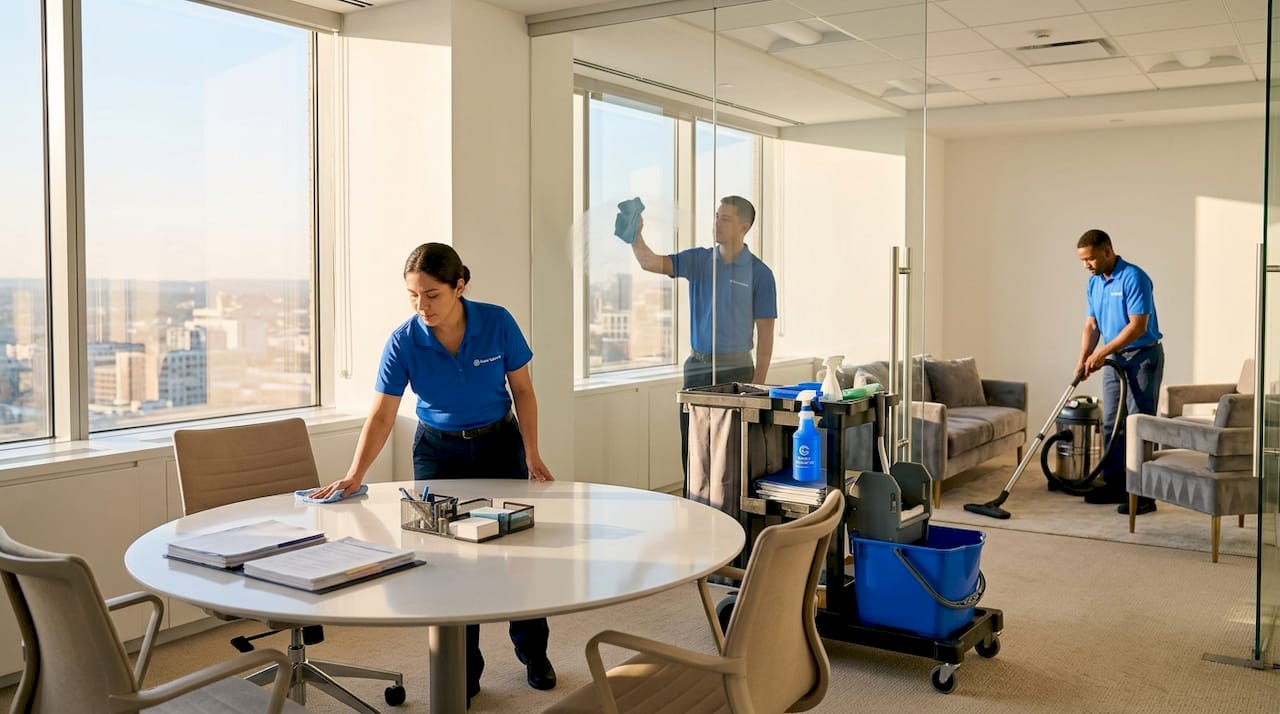
The industry term for what most people call “professional cleaning” in a commercial context is commercial cleaning or facility hygiene management. The distinction matters because it signals a higher standard than routine janitorial work. Janitorial services typically cover surface sweeping, trash removal, and restroom basics. Commercial cleaning incorporates targeted disinfection, hazard-aware protocols, and scheduled deep cleaning that actually controls pathogen transmission.
The CDC recommends enhanced cleaning and disinfection of high-touch surfaces after any suspected illness case in an office. Workstations, keyboards, telephones, and doorknobs are specifically flagged as priority zones. Providing wipes for employees to self-clean before use is listed as a supplemental step, not a replacement for professional disinfection.
Here is what routine in-house cleaning almost always misses:
- Keyboard and peripheral cleaning. Most office keyboards harbor more bacteria per square inch than a restroom toilet seat. Standard janitorial staff rarely include these in their scope.
- Shared equipment surfaces. Printers, copiers, coffee machines, and conference room remotes change hands dozens of times a day with almost no cleaning attention.
- Biological contamination risks. In offices with storage spaces or older HVAC infrastructure, rodent contamination poses hantavirus risk. Dry sweeping or vacuuming in affected areas can aerosolize infectious particles. Wet cleaning methods and proper PPE are the only safe approach.
“Cleaning should be risk-targeted, not uniform. Focusing on high-touch areas and enhancing cleaning cadence after contamination events is what separates professional facility hygiene from routine tidying.”
Pro Tip: Ask any prospective cleaning service whether they conduct a hazard assessment before proposing a cleaning plan. A service that skips this step is not operating at a professional standard.
Well-maintained office cleanliness dramatically decreases the incidence of common illness transmission in high-traffic areas. That translates directly into fewer sick days and a healthier workforce over the full year.
How cleanliness shapes productivity and satisfaction
This is the angle most office managers underestimate. Cleanliness is not just a health issue. It is a performance issue.
Research on integrated indoor environmental quality shows that when cleanliness is part of a broader environmental quality strategy, employee satisfaction scores improve significantly across multiple dimensions, and stronger outcomes in employee focus and overall productivity follow. The study examined public-sector hybrid workplaces, which reflects the reality most offices now operate in.
The sensory dimension is just as real. A multi-group analysis published in Nature Scientific Reports found that sensory cleanliness in offices critically influences both work satisfaction and life satisfaction in office workers. The mechanism is straightforward: your brain processes a cluttered, visually dirty environment as a low-level stressor. That constant background noise consumes cognitive resources that should be going toward focused work.
What does this look like in practice? Consider two meeting rooms in the same building. One is cleaned nightly, surfaces wiped, carpet vacuumed, air smelling neutral. The other gets a once-a-week once-over. Staff will unconsciously gravitate toward scheduling meetings in the cleaner room, and the quality of thinking that happens there will reflect the environment. This is not a theory. It is how human perception works.
Pro Tip: Run a simple internal survey asking employees to rate their workspace cleanliness alongside their focus and motivation scores. The correlation is almost always higher than managers expect, and the data makes the case for professional cleaning budgets far more effectively than any cost spreadsheet.
Motivated, productive employees in clean environments enhance overall business performance and workplace morale. That relationship runs both directions. A cleaner office tells your team that you take their working conditions seriously.
Cleaning and air quality: why you need both
A common misconception among facilities decision-makers is that upgrading the HVAC system or adding portable air filtration units eliminates the need for intensive surface cleaning. The research does not support that assumption.
An office study conducted as part of the EDIAQI project found that portable air filtration showed limited impact on reducing overall particulate matter in real occupied offices. High-molecular-weight PAHs decreased by roughly 30%, but cleaning and proper ventilation remained necessary to address indoor air quality comprehensively.
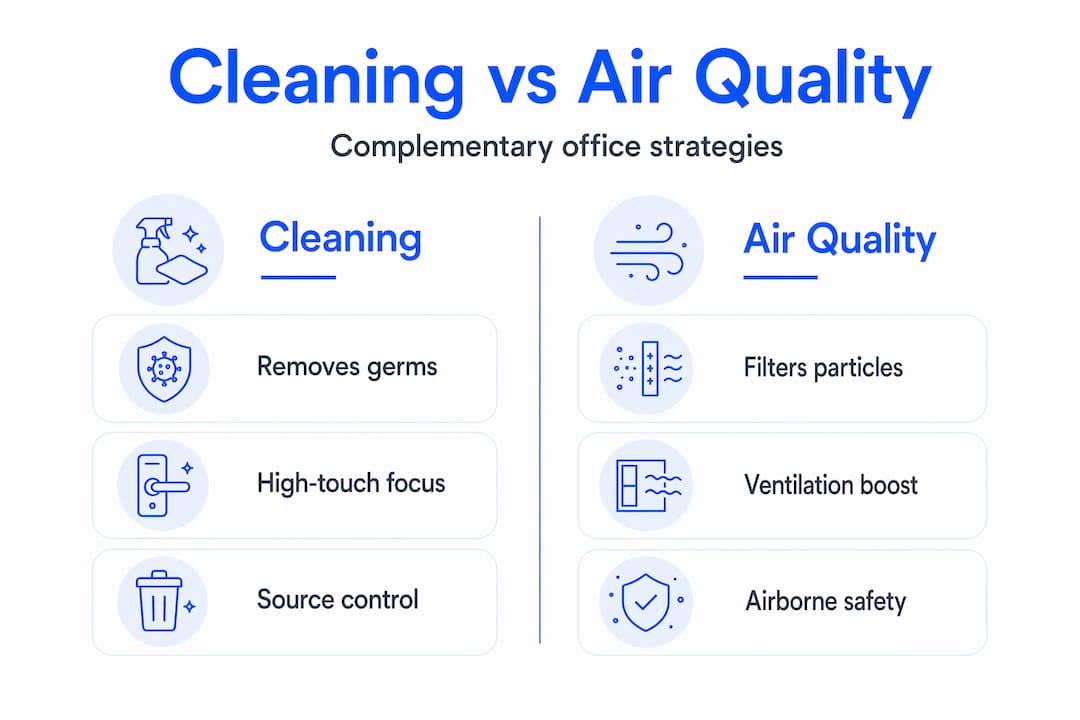
Here is a practical breakdown of how cleaning and air quality management interact:
| Strategy | What it addresses | What it misses without the other |
|---|---|---|
| Air filtration only | Airborne particles, some VOCs | Surface-bound pathogens, settled dust, biological contaminants |
| Surface cleaning only | Contact-transmitted pathogens, visible debris | Airborne allergens, recirculated particles |
| Cleaning + ventilation + filtration | Full-spectrum indoor air quality and surface hygiene | Nothing significant, when all three are applied consistently |
Source control, meaning removing contamination at the point of origin before it spreads, is the principle that makes professional cleaning indispensable. Filtration can catch particles once they are airborne. It cannot clean a contaminated keyboard, wipe down a doorknob, or sanitize a shared breakroom counter. Those tasks require trained hands and the right products applied at the right frequency.
The need for commercial cleaning as a complement to air quality management is not a sales argument. It is a basic principle of indoor environmental science.
Practical steps for hiring professional office cleaners
Knowing the benefits of professional cleaning is one thing. Knowing how to actually procure and implement the right service is where most office managers stall. Here is a structured approach.
Map your touchpoints first
Before you contact any service, walk your office and document every surface that multiple people touch within a single day. Door hardware, light switches, elevator buttons, printer interfaces, coffee machine controls, and shared monitors all belong on this list. This map becomes your baseline cleaning scope document. High-touch micro-locations like door hardware, printers, keyboards, and telephones should anchor any professional cleaning cadence.
Match cleaning frequency to traffic patterns
A conference room used twice a week needs a different schedule than a reception desk staffed eight hours daily. Professional services worth hiring will ask about your space usage patterns. Uniform blanket cleaning applied on a fixed schedule regardless of usage is a sign that the service is not operating at a strategic level.
Prioritize method selection
Cleaning method matters as much as frequency. Dry sweeping or vacuuming can aerosolize infectious particles in certain contamination scenarios. Ask specifically whether the service uses wet cleaning methods and whether their staff are trained in hazard assessment and PPE use. This is especially relevant if your office has storage areas, older infrastructure, or has experienced any pest activity.
Understand the service scope options
The types of commercial cleaning services available range from routine maintenance visits to periodic deep cleaning and post-event disinfection. You likely need a combination. Routine visits handle the ongoing workload. Scheduled deep cleaning addresses what accumulates over time. Having both in your contract prevents the slow degradation that happens when offices rely on routine-only programs.
Think through the cost-benefit honestly
A single employee sick day in a mid-level professional role costs anywhere from $250 to $500 in lost output, coverage, and administrative time. A professional cleaning contract for a 20-person office typically runs well under that per month. The math in favor of the service is not close.
Clean offices also make a direct impression on clients and visitors. Professional offices reflect organizational care and professionalism in ways that marketing materials simply cannot replicate.
My take on what offices consistently get wrong
I’ve reviewed a lot of commercial spaces over the years, and the pattern I see most often is not neglect. It’s misplaced confidence. An office looks clean, so the assumption is that it is clean. The surfaces shine. The trash is emptied. But the keyboard hasn’t been disinfected in six months, the breakroom refrigerator seal is growing something nobody wants to identify, and the carpet near the printer is quietly accumulating particulate matter from daily traffic.
What I’ve learned is that visible cleanliness and microbial cleanliness are two entirely different things. A space can pass any visual inspection and still be a significant source of illness transmission. The offices that get this right are the ones that treat cleaning as a system, not a task.
I’ve also seen what happens after a single norovirus or influenza event sweeps through a poorly maintained office. The cost in productivity, morale, and sometimes in staff turnover is significant. Every time, the calculation that made professional cleaning seem “too expensive” gets reversed immediately. The managers who went through that usually never cut the cleaning budget again.
My honest take: if you are managing an office of more than ten people and relying on part-time janitorial coverage or staff self-cleaning, you are carrying a risk you have probably not fully priced in. The investment in proper commercial hygiene management pays for itself faster than almost any other facilities decision.
— Jean
Clean Space SA can make this straightforward
If you manage an office in San Antonio, Leon Valley, Helotes, or the Alamo Ranch area, Clean Space SA offers professional office cleaning built around the kind of targeted, health-focused approach this article describes. Their team is background-checked, trained to high standards, and experienced in both routine commercial maintenance and scheduled deep cleaning for offices of varying sizes. Booking is straightforward, pricing is transparent, and the service is designed to work around your schedule so operations are never disrupted. Clean Space SA treats commercial cleaning as a health and productivity service, not just a facilities checkbox.
FAQ
How often should an office be professionally cleaned?
Most offices benefit from professional cleaning at least two to three times per week for routine maintenance, with monthly or quarterly deep cleaning scheduled separately. High-traffic spaces like reception areas and restrooms may need daily attention.
What surfaces should professional cleaners prioritize in offices?
High-touch surfaces including keyboards, telephones, door handles, shared equipment controls, and workstation areas should be the first priority in any professional office cleaning program.
Does professional cleaning actually reduce employee sick days?
Yes. Regular professional upkeep dramatically decreases illness transmission in high-traffic office areas, with consistent cleaning directly lowering the incidence of common illnesses spread through surface contact.
Can’t employees just clean their own workspaces?
Employee self-cleaning with wipes is a useful supplement, but it does not replace professional service. Staff lack the training, products, and time to address high-touch zones systematically, and inconsistent cleaning actually creates unpredictable hygiene outcomes across the office.
What is the difference between janitorial and commercial cleaning?
Janitorial service covers basic maintenance like trash removal and floor sweeping. Commercial cleaning includes targeted disinfection, hazard-aware protocols, scheduled office deep cleaning, and strategic coverage of high-risk surfaces that routine janitorial work does not address.
Recommended
- What Is Deep Clean for Office Spaces: A Manager’s Guide
- Office Cleaning – Clean Space Sa | commercial cleaning | San Antonio, TX, USA
- Office cleaning OLD – Clean Space Sa | commercial cleaning | San Antonio, TX, USA
- What Is a Warehouse Cleaning Service? A Manager’s Guide
Jean runs growth strategy at AimSetWin, a performance marketing agency specializing in local service businesses across Texas. he's helped plumbers, HVAC companies, pest control operators, and home service brands build predictable revenue systems using data-driven advertising and conversion optimization.


